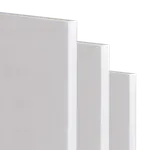
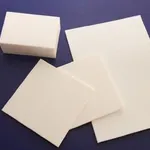
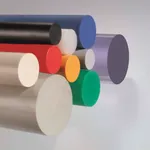
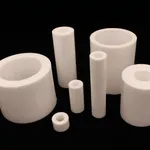
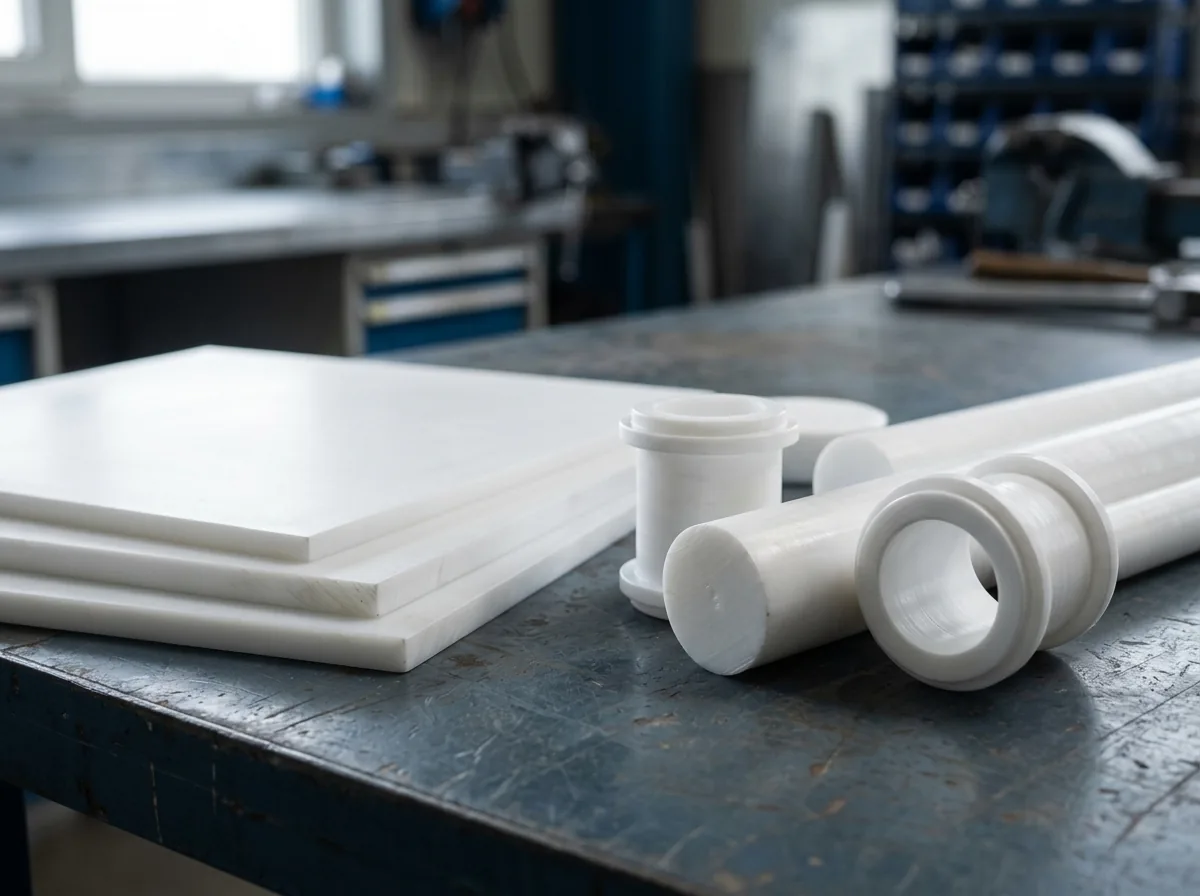
 This image was created with artificial intelligence – marked under Art. 50 of the AI Act, Regulation (EU) 2024/1689. It is a placeholder until the company's photos arrive.
PTFE/Teflon sheets: advantages and application areas
The advantages of PTFE/Teflon sheets. Buy Teflon now and choose the right sheet for your industry.
PTFE, better known as Teflon, is one of the most versatile and high-performance engineering plastics on the market. Anyone who wants to buy Teflon should not only find out about the basic properties, but also get to know the advantages, variants and diverse possible applications in order to select the optimum sheet for their project. This article gives you a comprehensive overview of PTFE sheets, explains their special properties and shows the areas in which they can best be used. This way you have all the important information before making a decision.
What is PTFE/Teflon?
PTFE (polytetrafluoroethylene) is a thermoplastic high-performance plastic, which is distinguished by outstanding chemical resistance, low friction and exceptional temperature resistance. Originally known as a non-stick coating for cookware, Teflon is today used in industrial applications in solid sheet form. PTFE sheets offer a durable solution for sliding, sealing and insulation applications and are distinguished by their longevity and freedom from maintenance.
In addition to the classic sheets, there are also PTFE films and special modified PTFE variants that offer additional properties such as increased hardness or better processing characteristics. Anyone who wants to buy Teflon should know the different variants and their specific advantages and disadvantages.
Advantages of PTFE/Teflon sheets
PTFE sheets are distinguished by an extraordinary combination of material properties that make them indispensable in many industries. Particularly noteworthy is the high chemical resistance, which makes it possible to use the sheets even in aggressive chemical environments without the material being damaged. At the same time, PTFE retains its dimensional stability and mechanical strength even at extreme temperatures, from very low sub-zero temperatures to high positive temperatures, as a result of which it works reliably in the most diverse areas of application. Another decisive characteristic is the very low surface friction, which not only minimises wear but also facilitates sliding movements, which extends the service life of machine components.
The outstanding electrical insulation properties also make PTFE a preferred material for electronics and electrical engineering, since it ensures safety and performance in sensitive applications. In addition, PTFE is particularly UV- and weather-resistant, as a result of which the material retains its properties even outdoors or under intensive solar radiation.
A further advantage is the hygiene and food compatibility of special PTFE grades, which enable use in sensitive areas such as the food industry or medical technology. PTFE sheets are also very low-maintenance, long-lasting and resistant to ageing and mechanical loads, which makes them an economically sensible solution for industrial applications. Last but not least, PTFE offers very good machinability: sheets can be milled, drilled or thermally formed so that they can be individually adapted to the needs of the respective project.
This combination of stability, versatility, chemical resistance and easy processing makes PTFE sheets one of the most reliable materials for technical solutions in numerous industries. In addition, special modified variants, such as PTFE filled with glass, bronze or carbon, offer improved mechanical properties, higher hardness and abrasion resistance, as a result of which even more demanding applications become feasible. All these factors together ensure that PTFE sheets function reliably under extreme conditions, remain stable in the long term and thus represent the perfect solution for a large number of industries.
Typical areas of application of Teflon sheets
Thanks to these properties, PTFE sheets are used in many industries:
- Mechanical engineering: sliding sheets, seals, guides, rollers and gears that reduce friction and minimise wear.
- Chemistry and laboratory: containers, linings, pipelines and valves for aggressive chemicals.
- Food industry: conveyor belts, cutting surfaces, separating sheets, packaging systems and non-stick coatings for production processes.
- Electronics: insulating components, circuit boards and cable sheathing to ensure safe current conduction.
- Medical technology: sterile components, laboratory equipment and components in diagnostic and therapeutic devices.
- Automotive industry: seals, bearings and wear parts that must withstand high temperatures and chemical loads.
- Aerospace: high-load components that are exposed to extreme temperatures and chemical influences.
Variants and modifications of PTFE
There are various PTFE variants that offer advantages depending on the application:
- Pure PTFE: standard grade, ideal for chemical resistance and non-stick properties.
- Filled PTFE: reinforced with glass, bronze or carbon to increase hardness, abrasion resistance and dimensional stability.
- Modified PTFE: for special applications, e.g. better machinability or increased compressive strength.
Anyone who wants to buy Teflon should check which variant best suits the requirements.
Purchasing criteria for Teflon
When buying PTFE sheets, the following aspects are decisive:
| Criterion | Significance |
|---|---|
| Sheet thickness | Influences stability, weight and machinability |
| Dimensions | Must be cut exactly to size in order to avoid installation problems |
| Degree of purity | Relevant for food or medical applications |
| Temperature range | Depends on the planned use |
| Processing | Some sheets are easier to mill, drill or bond |
| Reinforcement | Filled PTFE sheets offer better mechanical properties |
Tips for processing
The processing of PTFE sheets requires particular care, since the material is soft and flexible. When milling or sawing, the sheet should always be securely fixed in order to avoid slipping or deformation. The use of sharp tools is decisive in order to achieve clean cut edges and not to damage the material. When drilling, it is advisable to use low cutting speeds and cooling in order to prevent overheating and possible damage. For thermal forming, uniform temperatures should be used in order to avoid stresses in the material and to achieve the desired shape exactly.
With filled variants, such as PTFE with glass or bronze, care should be taken to use harder tools, since the sheets are more abrasive and normal tools wear out more quickly. After machining, it may be sensible to lightly deburr the edges and clean the surfaces in order to ensure optimum functionality and longevity. Storage should also be considered: PTFE sheets should be stored flat and dry in order to prevent deformation. Anyone who is unsure should consult the specialist trade and make use of customised cut pieces in order to ensure the best fit and functionality for the respective project.
It is also advisable to machine small test pieces before processing in order to check the behaviour of the material with the planned machining methods. With repeated use in machines or systems, the sheets should be regularly checked for wear and surface changes in order to ensure optimum performance and safety. By observing these processing tips, the service life of the PTFE sheets can be maximised and the efficiency of the project increased.
Sustainability of PTFE
Although PTFE is a plastic, the material is distinguished by its longevity and reusability, which makes it a sustainable solution in the long term. The sheets are extremely resistant and rarely have to be replaced, as a result of which material consumption and the amount of waste are reduced. In addition, remnants or cut pieces of PTFE sheets can be recycled or reused in other industrial processes. The high resistance of the material prevents rapid wear and extends the service life of the components used, which additionally saves resources. PTFE is chemically inert and, through its resistance, contributes to enabling systems and devices to be operated efficiently and in an environmentally friendly way.
Buying PTFE/Teflon sheets
When buying PTFE sheets, it is important to pay attention to quality, the degree of purity and the exact dimensions. Specialist retailers and manufacturers offer the option of ordering Teflon cut to size, so that the sheets are delivered directly suitable for the planned purpose. It should also be checked whether filled or modified variants are required in order to meet special requirements such as higher hardness, abrasion resistance or better machinability. A competent supplier provides information about the different variants, supplies technical data sheets and supports the selection of the suitable sheet in order to ensure an economical, long-lasting and safe solution.
In conclusion
PTFE/Teflon sheets offer a unique combination of chemical resistance, temperature resistance, low friction, electrical insulation, UV and weather resistance as well as food and medical compatibility. They are extremely long-lasting, low-maintenance, versatile and, through their robustness and reusability, contribute to sustainable solutions. Whether in mechanical engineering, the laboratory, the food industry, electronics or medical technology, PTFE convinces through its ability to function reliably even under extreme conditions.
Anyone who wants to buy Teflon should pay attention to variants, dimensions, degree of purity and the specific properties in order to obtain an economical, long-lasting and sustainable solution. PTFE sheets make it possible to implement projects efficiently, safely and in a resource-saving manner while offering the highest quality and functionality.