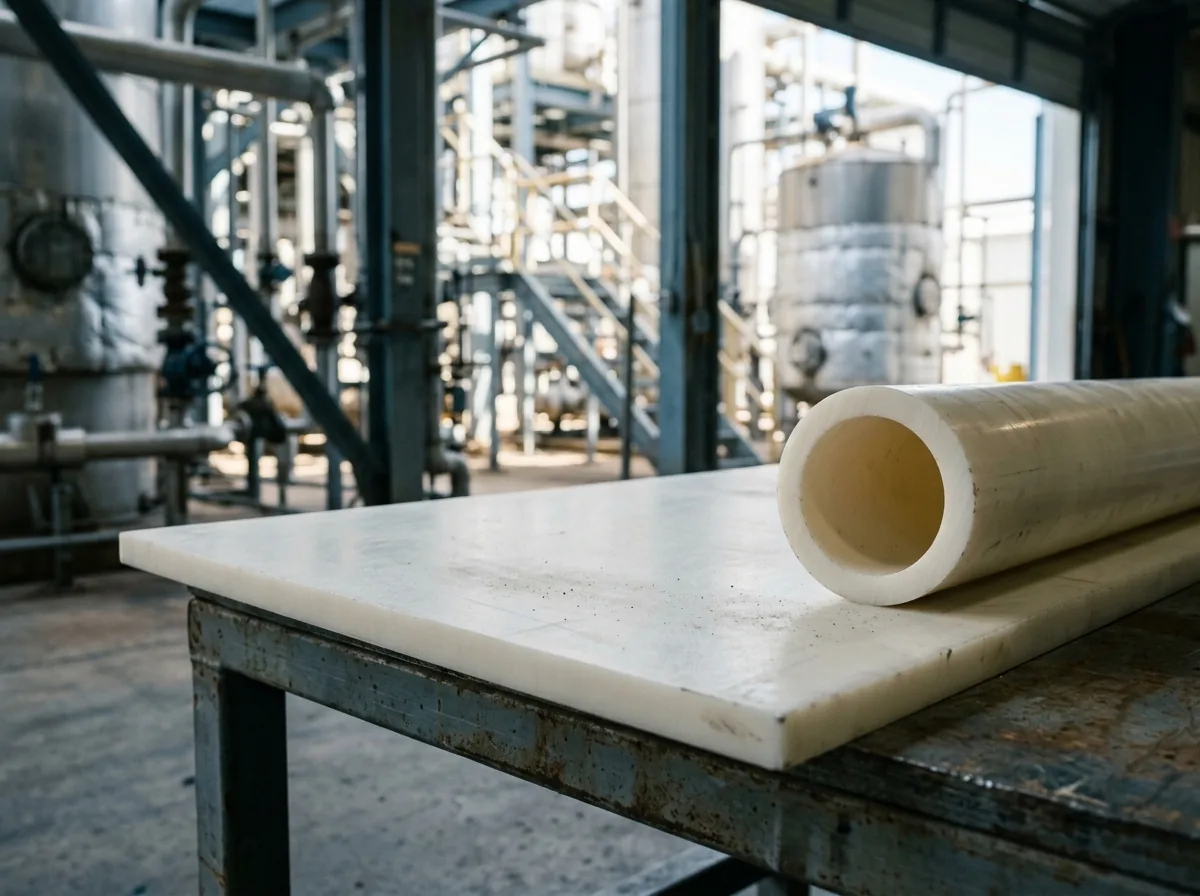
 This image was created with artificial intelligence – marked under Art. 50 of the AI Act, Regulation (EU) 2024/1689. It is a placeholder until the company's photos arrive.
High-performance plastics for outdoor use: which materials are suitable?
Which high-performance plastics are suitable for outdoor use? Find out more about UV, weather and temperature resistance.
Sun, rain, frost, moisture and strong temperature fluctuations place high demands on plastic components. For lasting outdoor use, high mechanical strength alone is therefore not enough. The material used must match the actual environmental conditions, loads and the required service life.
High-performance plastics can be a particularly durable alternative to metallic materials in outdoor applications. They are corrosion-resistant, comparatively light and, depending on the material, can offer high resistance to chemicals, moisture, temperature and wear.
However, the following applies: not every high-performance plastic is automatically permanently UV-resistant. When selecting the material, the specific plastic type, possible additives, the colour, mechanical stress and the duration of outdoor weathering must be taken into account.
Anyone specifically looking for resistance to sunlight will find further information in our article on UV-resistant plastics.
Which high-performance plastic is suitable for outdoor use?
For applications with permanent weathering and UV exposure, fluoroplastics such as PVDF and PTFE are particularly interesting. PEEK can be used under high thermal and mechanical loads, although the specific material grade should be checked for long-term outdoor applications. PPS and POM can also come into consideration for certain outdoor applications, but depending on the operating conditions they require a suitable material grade or stabilisation.
The selection should therefore not be made on the basis of the material designation alone. Relevant factors include:
- UV exposure and intensity of solar radiation
- minimum and maximum service temperature
- moisture and water absorption
- contact with chemicals, oils or cleaning agents
- mechanical load and wear
- required service life
- necessary dimensional stability
- colour and additives used
What do plastics outdoors have to withstand?
Outdoors, several loads often act on a component at the same time. This combination clearly distinguishes outdoor applications from many applications in enclosed spaces.
UV radiation
UV radiation can alter polymer chains and additives. Possible consequences are colour changes, embrittlement, surface cracks and a loss of mechanical properties.
Some plastics already have a high UV resistance due to their chemical structure. Other materials are specifically modified for outdoor use by UV stabilisers, pigments or special surfaces.
You can find out more about this in the guide Which plastics are resistant to UV radiation?.
Rain and moisture
Water absorption can lead to dimensional changes and a change in mechanical properties in certain plastics. For precision components outdoors, low water absorption is therefore often particularly important.
Frost and high temperatures
A plastic for outdoor use must be able to cope with both low winter temperatures and heating through direct solar radiation. However, the permissible service temperatures differ considerably between the individual materials.
A blanket temperature range for all high-performance plastics is therefore not sensible. The decisive factors are always the specific material type, load, duration of exposure and component geometry.
Temperature fluctuations
Not only maximum and minimum temperatures are relevant. Repeated temperature fluctuations cause expansion and shrinkage and may have to be taken into account, particularly with tight tolerances or material combinations.
Chemical influences
Outdoors, plastics can come into contact with cleaning agents, salts, industrial atmosphere, oils or other media. Chemical resistance should therefore always be tested against the substances actually present.
Mechanical loads
Wind, vibrations, impacts, abrasion or continuous forces place additional stress on outdoor components. Particularly with moving components, strength, wear and sliding properties must therefore be taken into account in addition to weather resistance.
Suitable high-performance plastics for outdoor applications
PVDF: very interesting under UV and chemical exposure
PVDF is one of the fluoroplastics and is characterised by very good weather and chemical resistance.
The material is particularly interesting when a component is permanently exposed to sunlight, moisture or aggressive media. Possible applications arise, for example, in plant engineering, chemical engineering and various technical outdoor applications.
PVDF is particularly suitable when the following requirements coincide:
- high weather resistance
- good UV resistance
- high chemical resistance
- low water absorption
- long-term outdoor use
PTFE: for extreme chemical and thermal requirements
PTFE has exceptionally high chemical resistance and a very low coefficient of friction. At the same time, the fluoroplastic has a high resistance to various environmental influences.
Typical applications include, for example, seals, sliding components, insulation or components that are simultaneously exposed to moisture, chemicals and temperature loads.
PTFE is particularly interesting with:
- high chemical exposure
- moisture
- wide temperature ranges
- low friction
- sealing and sliding applications
PEEK: for high mechanical and thermal loads
PEEK is a thermoplastic high-performance plastic with high temperature resistance, strength, dimensional stability and chemical resistance.
PEEK is therefore particularly suitable for demanding technical components where, in addition to environmental influences, high mechanical or thermal requirements occur.
For permanently sun-exposed applications, however, the specific PEEK grade should be considered. In addition to natural-coloured PEEK, black and modified material types are available, for example.
PEEK is particularly interesting with:
- high temperatures
- high mechanical stress
- tight tolerances
- low moisture absorption
- demanding technical components
PPS: dimensionally stable under thermal and chemical exposure
PPS combines high dimensional stability with good temperature and chemical resistance as well as low water absorption.
The material can therefore be interesting for technical housings, electrical components and precision parts that are exposed to varying climatic conditions.
For permanent direct UV exposure, it must also be checked for PPS whether the material grade used is suitable for the specific outdoor weathering.
POM: only with a suitable material grade for permanent outdoor applications
POM has high hardness, stiffness, dimensional stability and favourable sliding properties. The material is therefore suitable, for example, for gears, guides, bearing and motion elements.
However, unmodified POM should not be regarded as a permanently UV-resistant outdoor material across the board. For applications with intensive solar radiation, appropriately stabilised or specially selected grades are required.
POM is therefore particularly suitable when:
- good sliding properties are required
- high dimensional stability is needed
- mechanical components are moved
- a UV-stabilised grade suitable for the application is used
Comparison of high-performance plastics for outdoor use
| Material | Important properties | Typical suitability outdoors |
|---|---|---|
| PVDF | very good weather, UV and chemical resistance | permanent outdoor applications, chemically exposed components |
| PTFE | very high chemical resistance, low friction, wide temperature range | seals, sliding components, chemically and thermally exposed applications |
| PEEK | high strength, temperature and chemical resistance, low water absorption | highly stressed technical components; check material grade for UV exposure |
| PPS | high dimensional stability, low water absorption, high temperature and chemical resistance | precision and housing components; check outdoor weathering specific to the material |
| POM | high stiffness, dimensional stability and good sliding properties | moving components; choose a stabilised grade suitable for intensive UV exposure |
The table serves as initial guidance. For the final material selection, the specific operating conditions should always be taken into account.
Natural resistance or UV stabilisation?
When assessing a plastic for outdoor use, a distinction should be made between the fundamental material property and a targeted modification.
Plastics can, for example, be optimised for specific environmental conditions by UV absorbers, stabilisers, pigments or other additives. As a result, the behaviour of a modified grade can differ significantly from the standard material.
You can find out more about these possibilities in our article on Additives for plastics.
Surface treatments can also influence the resistance of a component. An overview is provided by the article Influence of surface treatment on the durability of plastics.
Why do plastics age outdoors?
The ageing of a plastic is not determined by a single factor. UV radiation, oxygen, moisture, temperature and mechanical stress often act simultaneously.
Depending on the polymer, the following changes can occur, among others:
- breakdown of polymer chains
- loss of impact strength
- embrittlement
- colour changes
- surface cracks
- change in dimensions
- change in mechanical properties
We explain in more detail how these processes arise in the article on Ageing processes in plastics.
Where are high-performance plastics used outdoors?
Construction industry
In the construction industry, plastics are used, for example, in technical profiles, covers, glazing, pipes and other components with contact to the weather.
Depending on the application, the focus here is on UV resistance, freedom from corrosion, low weight or moisture resistance.
Renewable energies
Wind power and photovoltaic systems are permanently exposed to sun, rain, temperature fluctuations and mechanical loads. Plastics are used here, among other things, for insulation, seals, bearing components, protective parts and other technical components.
You can find out more about the applications under Plastics for renewable energies.
Transport engineering
In transport engineering too, plastic components are permanently exposed to varying environmental conditions. Typical requirements are weather resistance, impact strength, low weight and electrical insulation.
Mechanical and plant engineering
For machines and systems outdoors, plastic components often have to withstand not only the weather but at the same time lubricants, chemicals, mechanical load and temperature fluctuations.
It is precisely here that high-performance plastics offer advantages, because several technical properties can be combined in one material.
High-performance plastics or metal outdoors?
High-performance plastics can offer various design advantages over metallic materials:
- no corrosion as with unprotected metallic materials
- lower density
- good chemical resistance
- electrical insulation with suitable materials
- in some cases very good sliding and wear properties
- high design freedom
- lower maintenance requirement in suitable applications
However, whether plastic or metal is more suitable economically and technically always depends on the respective application. Load-bearing capacity, temperature, component dimensions, manufacturing processes, service life and safety requirements must be considered together.
What should you look out for when selecting the material?
For a reliable material selection, you should define the operating conditions as precisely as possible.
1. How strong is the UV exposure? Direct solar radiation over many years places different requirements than occasional outdoor exposure.
2. What temperatures actually occur? In addition to the air temperature, a dark component can heat up considerably through solar radiation.
3. Does the component come into contact with water or high humidity? Depending on the plastic, water absorption can influence dimensional stability and mechanical properties.
4. Which chemicals act on the component? Cleaning agents, salts, oils, fuels and industrial atmosphere must be taken into account specific to the material.
5. Which mechanical forces occur? Static loads, impacts, abrasion and continuous movement place different requirements on the plastic.
6. What service life is required? A short-term outdoor application requires a different material design than a component that is to function for many years without replacement.
7. Is a standard material or a modified grade required? UV stabilisers, fibre reinforcements and other additives can specifically change the property profile.
Testing weather resistance
To assess ageing behaviour, plastics can be exposed to artificial weathering under defined conditions. An important series of standards for the artificial irradiation or weathering of plastics is ISO 4892.
Such tests help to investigate changes in optical or mechanical properties under defined conditions.
However, laboratory tests do not automatically replace the assessment of the actual application. Geographical location, component geometry, load condition and real environmental influences must also be taken into account.
Selecting the right high-performance plastic for outdoor use
For permanent outdoor use, there is no single optimum plastic. PVDF and PTFE offer advantages where there are high requirements for weather and chemical resistance. PEEK is particularly suitable for applications with additional high thermal and mechanical load. PPS and POM can also be used, provided that the material grade and environmental conditions match one another.
The more precisely temperature, UV exposure, moisture, chemical contact and mechanical stress are known, the more specifically the suitable material can be selected.
Martan Plastics supports you in selecting suitable plastic semi-finished products and materials for your technical application. For specific requirements, you can contact us via our contact page.
Frequently asked questions about high-performance plastics outdoors
Which plastic is suitable for permanent outdoor use?
For permanently weather-exposed applications, fluoroplastics such as PVDF and PTFE are interesting, among others. However, whether a material is actually suitable also depends on UV exposure, temperature, chemical contact, mechanical load and the specific material grade.
Are all high-performance plastics UV-resistant?
No. Classification as a high-performance plastic does not automatically mean unrestricted high UV resistance. Depending on the polymer, specially UV-stabilised, pigmented or otherwise modified grades may be required.
Is PEEK suitable for outdoor use?
PEEK has high thermal and mechanical load capacity, low moisture absorption and high resistance to numerous chemicals. For permanent UV exposure, however, the specific material grade should be checked for the intended operating conditions.
Is POM suitable for outdoors?
POM can be used for mechanical components outdoors, but should not be regarded as UV-resistant across the board under intensive and permanent solar radiation. Suitable stabilised material grades are required for such applications.
Which plastic is particularly weather-resistant?
Fluoroplastics such as PVDF and PTFE are characterised by high resistance to many weather and environmental influences. For the material decision, however, mechanical, thermal and design requirements must also be taken into account.
How can the UV resistance of plastics be improved?
Depending on the plastic, UV stabilisers, UV absorbers, pigments, suitable colouring or surface coatings can be used. Which solution is sensible depends on the base polymer and the application.
Which factors determine the service life of a plastic outdoors?
The most important factors include UV radiation, temperature, temperature fluctuations, moisture, oxygen, chemical contact and mechanical loads. Since these influences often occur simultaneously, the material selection should always be aligned with the specific application.