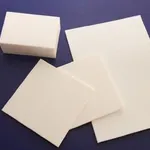
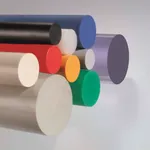
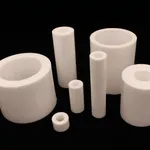
This image was created with artificial intelligence – marked under Art. 50 of the AI Act, Regulation (EU) 2024/1689. It is a placeholder until the company's photos arrive.
PTFE plastic
Learn more about PTFE: its outstanding properties, diverse application areas and comprehensive advantages. Details available in the PTFE data sheet.
What is PTFE?
PTFE, spelled out polytetrafluoroethylene, is a semi-crystalline high-performance plastic from the group of fluoropolymers. Produced by polymerisation of tetrafluoroethylene, it offers remarkable chemical and thermal resistance. PTFE is widely known under the brand name Teflon™, which, however, designates only certain fluoropolymer products.
Production and processing
Due to its high melt viscosity, PTFE cannot be processed by conventional injection moulding. Instead, semi-finished products are manufactured by pressing, sintering or RAM extrusion and then machined.
Properties of PTFE
PTFE is known for its virtually universal chemical resistance, which makes it resistant to most acids, alkalis and solvents. Equally important is its extremely low coefficient of friction, which provides an anti-adhesive surface. This enables low-maintenance operation of many components.
Temperature resistance
The plastic can be used in a temperature range from −200 °C to +260 °C, whereby the actual performance depends on the PTFE type and operating conditions.
Mechanical properties
Unfilled PTFE is soft and exhibits creep behaviour under continuous load. However, fillers such as glass fibres and carbon can significantly improve compressive strength and stability.
Electrical properties
PTFE impresses with high dielectric strength and low dielectric loss, which is why it is valued in the electronics industry.
Applications of PTFE
Thanks to its properties, PTFE is used in areas such as seals, plain bearings, electrical insulation and media-conveying components. It is the material of choice in chemically demanding environments and for components that require long-lasting performance under difficult conditions.
Special areas of application
Specially modified PTFE grades are used in plain bearings and guides in mechanical engineering to minimise wear. Further applications are found in medical technology due to the physiological safety of the material.
Advantages of PTFE
PTFE offers an incomparable combination of chemical resistance, thermal stability and excellent sliding properties. In addition, it is resistant to weathering effects such as UV radiation, which makes it ideal for long-lasting outdoor applications.
For more comprehensive information, download our PTFE data sheet to check the exact suitability and processing details for your project.
Frequently asked questions
How is PTFE produced?
PTFE is produced by polymerisation of tetrafluoroethylene and is usually processed into semi-finished products by pressing and sintering.
Which chemical substances can attack PTFE?
Very few, highly reactive substances can attack PTFE under extreme conditions.
In which industries is PTFE frequently used?
PTFE is frequently used in the chemical industry, mechanical engineering and medical technology.
What advantages do filled PTFE grades offer?
Filled PTFE grades offer improved compressive strength and wear resistance for demanding applications.
Why is PTFE often the choice for seals?
Due to its outstanding chemical resistance and anti-adhesive surface, PTFE is ideally suited for seals.