Plastics for electrical engineering: insulating and conductive solutions
Which plastics are used in electronics? More about electrical insulators, conductive plastics & suitable materials.
Plastics are indispensable materials in electronics and electrical engineering. Depending on the material and modification, they perform very different tasks: they can be used as electrical insulators made of plastic, protect electronic components or be specifically formulated to be electrically conductive or dissipative through special additives.
This versatility means plastics can be used to meet safety requirements, isolate electrical components from one another and at the same time produce lightweight, compact and precise plastic parts for electronic applications.
The role of plastics in electronics and electrical engineering
Electrical and electronic applications call for two opposing properties: the highest possible electrical insulating effect on the one hand and a defined conductivity on the other. Plastics can meet both requirements – depending on the base material, the additives and the particular material grade.
Typical plastic parts in electrical engineering and electronics include, for example:
- connectors
- switch housings
- insulators
- coil formers
- sensor components
- housings and covers
- spacers and support elements
- component mounts
- ESD components
Good electrical properties alone are not enough. Depending on the application, the plastics used must also be temperature-resistant, mechanically stable, dimensionally accurate, chemical-resistant or flame-retardant.
You will also find an overview of industrial applications in our plastics for electronics and the plastic solutions for the electrical industry.
Electrically insulating plastics: protection against unwanted current flow
Many unmodified plastics have very low electrical conductivity and are therefore suitable as electrically insulating materials. In electrical engineering, this property is used to separate conductive components from one another, prevent short circuits and insulate components against electrical voltages.
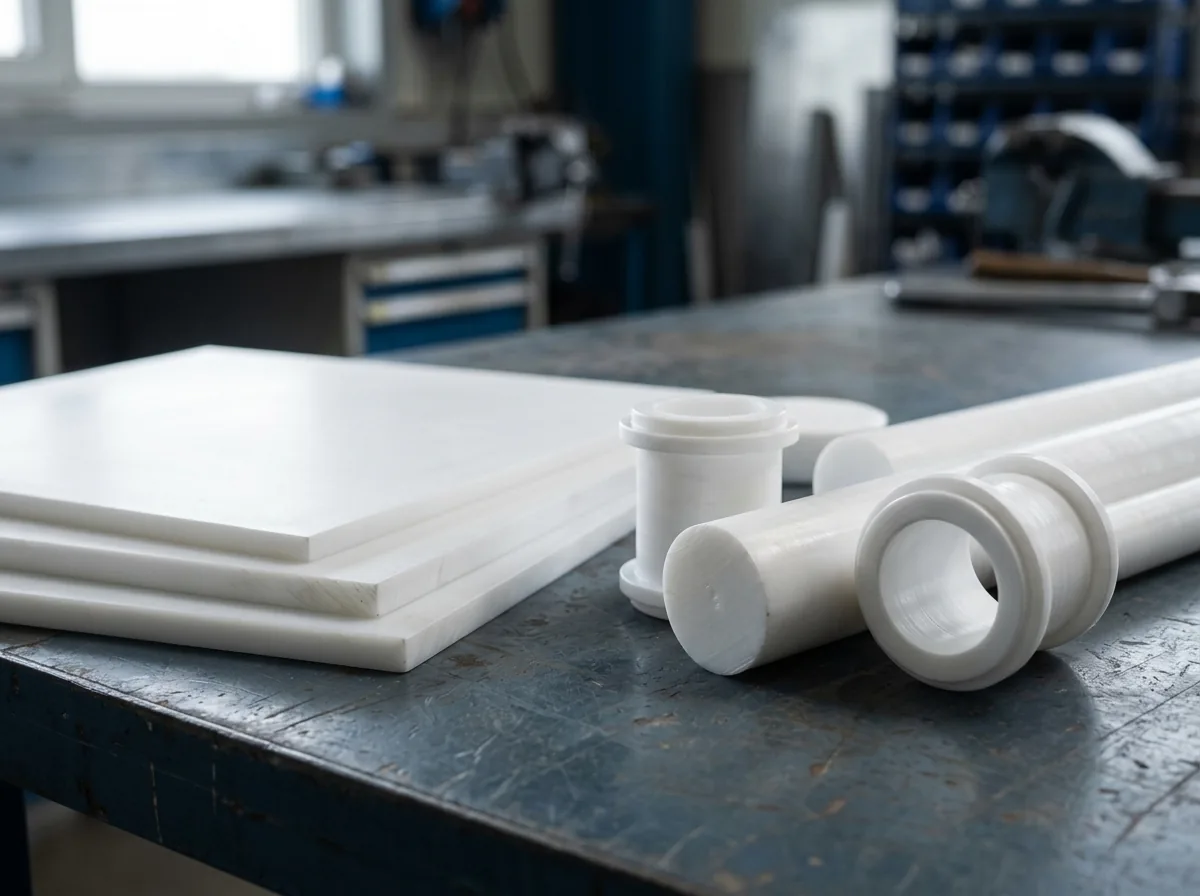
An electrical insulator made of plastic can be used, for example, as a spacer, housing part, connector, coil former or insulating structural element.
Typical insulating plastics include:
- Polyamide (PA): good electrical insulation and high mechanical load capacity
- Polycarbonate (PC): good insulation, high impact strength and, depending on the type, transparency
- Polyethylene terephthalate (PET): good electrical properties and high dimensional stability
- PBT: frequently used for electrical and electronic components
- PEEK: high-performance plastic for thermally and mechanically demanding applications
- PTFE: very good electrical insulation combined with high temperature and chemical resistance
Which of these materials are actually suitable depends, among other things, on the operating voltage, temperature, component geometry, moisture, mechanical load and the required standards.
Electrical insulating materials: practical examples
Typical electrical insulating materials include, alongside plastics, ceramics, glass and other non-conductive materials. Plastics, however, offer the advantage that electrical insulation can be combined with low weight, a high degree of design freedom and manufacturing processes that are well established in industry.
Typical plastic applications as an electrical insulating material are:
- insulating sheets and spacers
- electrical connectors
- switch and fuse components
- cable and line components
- coil formers
- insulating housings
- carriers for electronic assemblies
When selecting a material, the specific material grade must always be considered. Fillers, reinforcements and other modifications can significantly change the electrical properties of a plastic.
Conductive plastics: targeted dissipation and shielding
In their unmodified state, plastics are predominantly electrically insulating. However, conductive fillers such as carbon black, graphite, carbon fibres or metallic additives can be used to specifically alter their electrical properties.
A conductive plastic is used, for example, when electrostatic charges are to be dissipated in a controlled manner or sensitive electronic components are to be protected.
Typical applications are:
- ESD trays and workpiece carriers
- component mounts for electronic components
- housings with defined electrical properties
- components for electrostatic-sensitive production areas
- applications for electrostatic dissipation
Depending on the material modification, different resistance ranges can be achieved. Antistatic, electrostatically dissipative and electrically conductive plastics must therefore not be equated across the board.
You can find out more about material structure, properties and fields of application in the article on electrically conductive plastics.
Comparison: insulating and conductive plastics
| Property | Insulating plastics | Conductive or dissipative plastics |
|---|---|---|
| Electrical conductivity | very low | specifically adjusted |
| Typical function | electrical separation and insulation | dissipation of electrostatic charges |
| Applications | insulators, connectors, housings | ESD trays, holders, special housings |
| Weight | low | low |
| Corrosion resistance | very good, depending on material | very good, depending on material |
| Shaping | versatile | depending on material and modification |
Producing plastic parts for electrical engineering and electronics
Alongside material selection, manufacturing plays an important role. Depending on the material, geometry and quantity, plastic parts for electrical engineering and electronics can, for example, be machined, cut, extruded or produced by other plastic processing methods.
For smaller series, precise components or complex technical geometries, CNC-machined plastic parts in particular can be of interest. These include, for example, insulators, spacers, carrier plates, housing parts and custom components to drawing.
Martan Plastics supports you in selecting suitable materials and in plastic machining for technical applications.
Requirements for plastics in electrical engineering
Regardless of whether a plastic is insulating, dissipative or conductive, several properties should be considered together when selecting a material:
- Electrical properties: for example dielectric strength, specific resistance and tracking behaviour
- Temperature resistance: continuous and peak temperatures of the specific application
- Fire behaviour: required flame-retardant or fire protection classification of the particular material grade
- Mechanical load capacity: strength, stiffness and dimensional stability of the component
- Moisture absorption: particularly for plastics whose electrical and mechanical properties are affected by moisture
- Chemical resistance: contact with oils, cleaning agents, solvents or other media
- Dimensional stability: important for precise plug-in, switching and sensor components
- Manufacturing process: material and component geometry must match the intended production process
The material designation alone is therefore not enough to select a plastic for electrical engineering. The specific material grade and its technical data must be compared against the requirements of the particular application.
Future trends: miniaturisation, ESD protection and thermal management
With the increasing miniaturisation of electronic components, the demands on the plastics used also rise. What is needed are materials that combine high electrical insulation with low component thickness, high temperature resistance and good dimensional stability.
At the same time, defined electrical properties, ESD protection and the thermal management of electronic systems are gaining in importance. As a result, the range of specially modified engineering and high-performance plastics for electronic applications continues to grow.
Selecting the right plastic for electronics and electrical engineering
In electronic and electrical engineering applications, plastics can be used both as electrical insulators and as specifically conductive or dissipative materials. However, the specific electrical, thermal, mechanical and design requirements of the component are always decisive for the selection.
If you need a particular plastic part for an electrical engineering application, Martan Plastics supports you in selecting suitable materials and in manufacturing custom components.
Frequently asked questions about plastics in electronics
Which plastics are used in electronics?
Plastics used in electronics include PA, PBT, PC, PET, PTFE, PEEK and other engineering or high-performance plastics. Which plastic is suitable depends on electrical insulation, temperature, mechanical load, fire behaviour and other operating conditions.
Which plastic is suitable as an electrical insulator?
Many unmodified plastics have good electrical insulating properties. Depending on the application, PA, PBT, PET, PC, PTFE or PEEK, for example, may be considered. The specific suitability must be checked on the basis of the material grade and the required electrical characteristics.
Which electrically insulating materials are there?
Alongside plastics, ceramics and glass, for example, are used as electrical insulating materials. Plastics offer particular advantages in terms of weight, shaping and the production of complex components.
Can plastic be electrically conductive?
Yes. Conductive additives such as carbon black, graphite, carbon fibres or metallic fillers can make plastics antistatic, electrostatically dissipative or electrically conductive.
Which plastic parts are produced in electrical engineering?
Typical plastic parts for electrical engineering are insulators, spacers, connectors, coil formers, housings, covers, carrier plates and custom technical components.