High-performance plastics
High-performance plastics such as PEEK, PPS, PEI and PAI: properties, comparison, semi-finished products and finished parts for demanding industrial applications.
High-performance plastics are engineering plastics for applications in which conventional materials reach their limits due to high temperatures, mechanical loads, aggressive chemicals or special purity requirements.
Martan Plastics supplies high-performance plastics for demanding industrial components and supports you in selecting a suitable material. Depending on the application, various thermoplastic high-performance materials are available as semi-finished products, cut pieces or machined finished parts.
What are high-performance plastics?
High-performance plastics are plastics that provide reliable technical properties even under exceptional operating conditions. They differ from standard plastics and classic engineering plastics above all through their higher temperature resistance, strength, chemical resistance and long-term dimensional stability.
The group of high-performance plastics includes, among others, PEEK, PPS, PEI, PES, PPSU, PSU, PAI, polyimides and LCP.
Which high-performance plastic is suitable depends on the specific load. In addition to the maximum temperature, mechanical loads, contact media, friction, electrical requirements, moisture and the planned component service life must also be taken into account.
High-performance polymers for industrial applications
High-performance polymers are plastics that have been developed for particularly demanding operating conditions. Depending on the material, they combine high temperature resistance with mechanical strength, chemical resistance, dimensional accuracy or special electrical properties.
The most important high-performance polymers include PEEK, PPS, PEI, PAI, polyimides, PPSU, PSU and LCP. They are used when classic engineering plastics such as PA, POM or PET do not permanently achieve the required load capacity.
The term high-performance polymers essentially describes the same material group as high-performance plastics, but is more frequently used in the technical and materials science environment.
Properties of high-performance plastics
Depending on the material and the respective modification, high-performance plastics can offer different property profiles:
- High temperature resistance: reliable properties even at permanently elevated service temperatures
- Mechanical strength: high stiffness, compressive strength and load capacity
- Chemical resistance: resistance to numerous acids, alkalis, fuels, oils and solvents
- Dimensional stability: low deformation under temperature changes and mechanical load
- Wear resistance: suitable for moving components, guides, bearings and sliding applications
- Electrical properties: good insulating and dielectric properties depending on the material
- Low weight: significantly lower density than many metallic materials
- Modifiability: properties can be adapted using glass fibres, carbon fibres, PTFE, graphite or other additives
High-performance plastics in comparison
The individual materials differ significantly with regard to temperature resistance, strength, media resistance and machinability. The following overview serves as an initial guide.
| Material | Typical properties | Common applications |
|---|---|---|
| PEEK | Very temperature-resistant, mechanically loadable, chemical- and wear-resistant | Mechanical engineering, medical technology, semiconductor technology, aerospace |
| PPS | High chemical resistance, low water absorption, good dimensional stability | Pump components, electrical components, chemical industry |
| PEI | High stiffness, good electrical properties, inherent flame retardancy | Electrical engineering, aerospace, medical technology and technical housings |
| PPSU | High impact strength, hydrolysis-resistant, can be sterilised multiple times | Medical technology, healthcare and food technology |
| PAI | Very high strength and stiffness, wear-resistant, temperature-resistant | Precision components, bearings, seals and high-temperature applications |
| Polyimides | Very high thermal stability, low outgassing, good electrical insulation | Semiconductor industry, vacuum technology, electronics and aerospace |
| LCP | High dimensional accuracy, low thermal expansion, good flow properties | Electronics, connectors and filigree precision components |
The properties stated can vary depending on material grade, reinforcement, additives and specific operating conditions. The technical data of the intended grade should therefore always be checked for selection.
Manufacturing processes
Depending on the material, component geometry and quantity, high-performance plastics are processed using different methods. Many of these materials require high processing temperatures, precise process control and specially designed machines and tools.
Typical manufacturing processes are:
- Injection moulding for complex components and larger series
- Extrusion for the production of sheets, rods, tubes and profiles
- Pressing for compact moulded parts and special material grades
- Sintering for plastics that cannot be melt-processed or are particularly temperature-resistant
- Film casting and coating for thin technical layers and insulation applications
- Machining of semi-finished products by milling, turning and drilling
- Additive manufacturing for prototypes and geometrically complex components
High-performance plastics or engineering plastics?
Engineering plastics such as PA, POM, PET or PC already offer significantly better mechanical and thermal properties than standard plastics. For many components in mechanical engineering and industrial production, they are therefore sufficient.
High-performance plastics are used when these materials no longer reliably meet the requirements. This applies in particular to permanently high temperatures, aggressive chemicals, strong mechanical loads, high purity requirements or particularly tight tolerances.
The boundaries between engineering plastics and high-performance plastics are not always clear. What matters is therefore less the general classification than the question of which material functions permanently under the specific operating conditions.
Which high-performance plastic is suitable?
The material selection should be based on the actual operating conditions. The following criteria are particularly important:
| Requirement | Criteria to be checked |
|---|---|
| High service temperatures | Continuous service temperature, short-term peak temperature and heat deflection temperature |
| Mechanical load | Tensile strength, compressive strength, stiffness, impact strength and creep behaviour |
| Chemical contact | Type of medium, concentration, temperature and contact duration |
| Friction and wear | Sliding partner, speed, surface pressure and lubrication |
| Electrical requirements | Dielectric strength, surface resistance and tracking resistance |
| Dimensional accuracy | Thermal expansion, water absorption, tolerances and continuous load |
| Purity and approvals | FDA conformity, biocompatibility, sterilisation capability or low outgassing |
A material selection based solely on the maximum temperature is often not sufficient. A material may be thermally suitable but fail prematurely on contact with certain chemicals, under high surface pressure or with continuous friction.
High-temperature plastics
Many high-performance plastics are also high-temperature plastics. Nevertheless, the two terms are not entirely equivalent. High-temperature plastics are selected primarily because of their thermal load capacity. High-performance plastics can also offer special mechanical, electrical, chemical or tribological properties.
For applications at permanently high temperatures, PEEK, PPS, PAI, polyimides, PEI, PES, PPSU and PSU are particularly suitable. However, the actual service limit depends on the load duration, the component geometry, the environment and the respective material grade.
Delivery forms and production
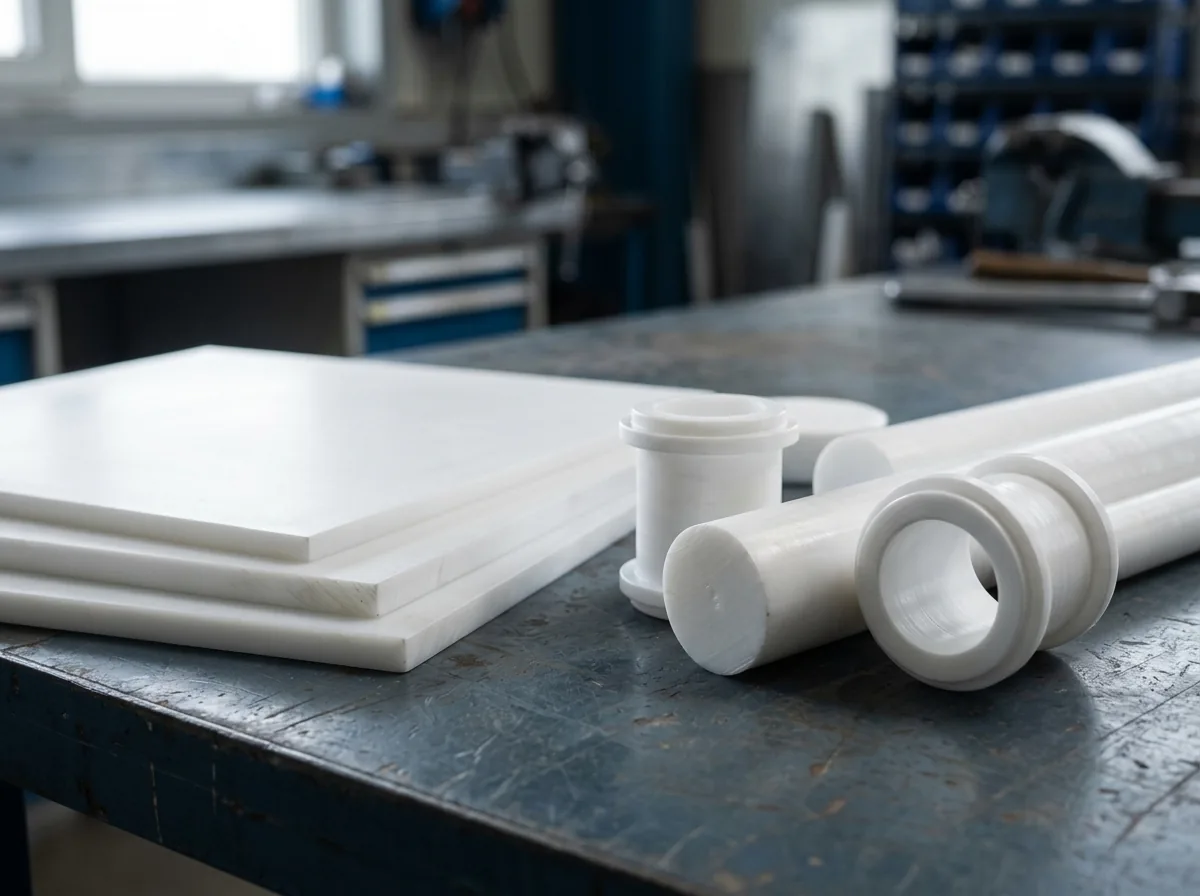
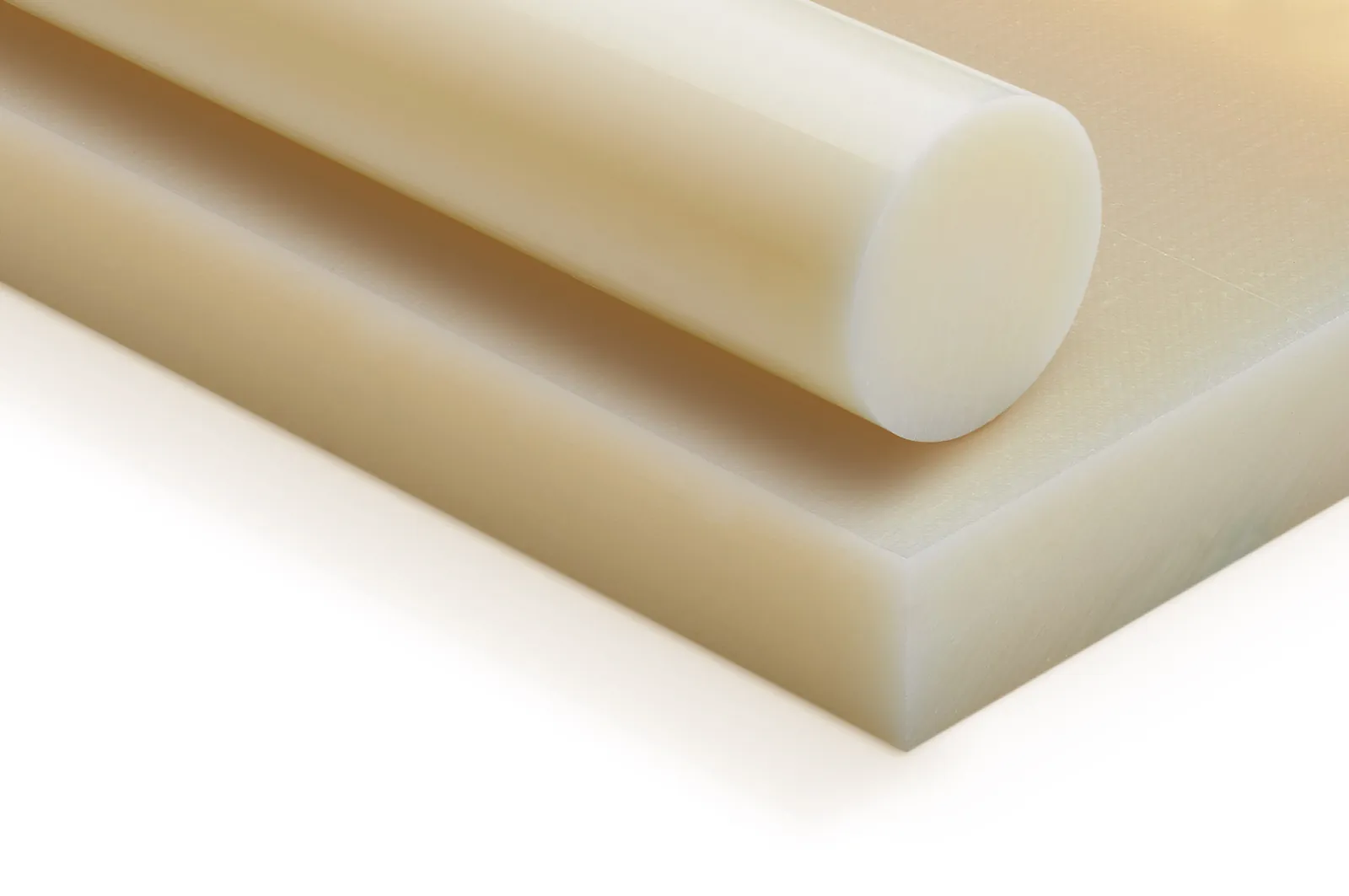
Depending on the material, high-performance plastics can be provided as sheets, rods, tubes, profiles or customer-specific semi-finished products. An overview of the available options can be found in the plastic semi-finished products section.
From the semi-finished products, Martan Plastics produces individual components to drawing or technical specifications. Depending on the material, dimensions and tolerances, CNC milling, CNC turning, drilling or waterjet cutting are used, among others.
Further information can be found on our page on plastic machining.
High-performance plastics as precision components
Precise components for applications with high thermal, mechanical or chemical requirements can be produced from high-performance plastics. Depending on the material, the starting material is sheets, rods or other semi-finished products, which are then machined.
Typical precision components made from thermoplastic high-performance plastics are, for example:
- Sliding and guide elements
- Bushes and bearing components
- Sealing and valve components
- Insulating parts
- Housing and support elements
- Components for cleanroom and semiconductor technology
- Customer-specific milled and turned parts
For dimensionally accurate components, the material, semi-finished product quality, tool geometry, clamping technology and machining parameters must be coordinated with one another.
Application areas of high-performance plastics
High-performance plastics are used when components must be reliable, long-lasting and at the same time lightweight. Typical applications are:
- Plain bearings, guides and wear-stressed machine elements
- Seals, valve seats and pump components
- Electrically insulating components and connectors
- Components for vacuum, cleanroom and semiconductor systems
- Sterilisable components for medical applications
- High-temperature-resistant housings and structural parts
- Components with high chemical resistance
- Lightweight metal replacement parts for moving constructions
Mechanical and plant engineering
In mechanical and plant engineering, high-performance plastics are used, among other things, for bearings, guides, seals, gears and structural precision parts. They can reduce weight, avoid corrosion and lower maintenance effort.
Electrical industry and electronics
In the electrical industry, the electrical insulating properties, dimensional stability and flame retardancy of certain high-performance polymers are particularly relevant. Typical components are insulators, housings, connectors and support elements.
Semiconductor and cleanroom technology
For applications in the semiconductor industry, materials with high purity, low outgassing, good chemical resistance and reliable dimensional accuracy are required. These include PEEK, PAI and polyimides, among others.
Medical technology
In medical technology, selected high-performance plastics are used for instruments, components and parts that must be cleaned or sterilised repeatedly. The specific suitability depends on the material grade and the required approvals.
Aerospace
In aerospace, high-performance plastics enable lightweight components with high mechanical and thermal load capacity. They are used, among other things, for electrical, structural and tribological applications.
Machining of high-performance plastics
The machining of high-performance plastics requires a material-appropriate design of the production parameters. Heat generation, tool geometry, clamping technology and machining direction can significantly influence the dimensional accuracy and surface quality of the component.
For fibre-reinforced materials, the increased tool wear and the anisotropic material properties must also be taken into account. Stresses in the semi-finished product can also affect the subsequent dimensions during machining.
For precise components, the material selection, semi-finished product quality, machining method and tolerances should therefore be coordinated with one another before production begins.
High-performance plastics from Martan Plastics
Martan Plastics is a system partner to industry for semi-finished products and finished parts made from engineering plastics and high-performance plastics. We support you from the selection of a suitable material through to the realisation of the finished component.
For a technical review, we need the most precise possible details on:
- Service temperature and load duration
- Mechanical stress
- Contact with chemicals or other media
- Dimensions and tolerances
- Required delivery form
- Desired quantity
- Required approvals or certificates
Send us your drawing, technical requirements or details of the material used previously. Together we will assess which high-performance plastic is technically and economically suitable for your application.