PET plastic
PET (polyethylene terephthalate) stands out for its high strength, transparency and recyclability. More about applications and advantages.
PET plastic, fully polyethylene terephthalate, is a partially crystalline thermoplastic polyester with high strength, rigidity and dimensional stability. The engineering plastic is particularly suitable for components that must remain dimensionally stable in the long term and be manufactured with tight tolerances.
In industrial use, PET is used among other things for mechanically stressed precision parts, plain bearings, rollers, guides, insulating components and components in food technology. Its low moisture absorption, good wear resistance and favourable friction behaviour make PET an important addition within engineering plastic materials.
Martan Plastics supports you in selecting suitable PET semi-finished products as well as in the manufacture of precise plastic components to drawing or technical specification.
What is PET plastic?
Polyethylene terephthalate belongs to the group of thermoplastic polyesters. The material is produced from ethylene glycol and terephthalic acid or their starting compounds. Through its partially crystalline structure, engineering PET combines high mechanical strength with good dimensional stability and comparatively low creep behaviour.
Many people know PET primarily from drinks bottles and packaging. For industrial applications, however, specially formulated engineering PET materials are used. These differ significantly from conventional packaging plastics in terms of manufacturing process, crystallinity, purity and possible additives.
PET is chosen as a construction material above all when components must be machined precisely and must reliably maintain their dimensions even under prolonged load.
Properties of PET
PET has a balanced technical property profile. The material achieves high rigidity and strength, absorbs only little moisture and can be machined with high dimensional accuracy. This makes it suitable for applications in which reproducible tolerances and reliable function are decisive.
Mechanical properties
PET exhibits high surface hardness, good compressive strength and pronounced dimensional stability. Compared with softer standard plastics, the material deforms significantly less under static load.
The most important mechanical advantages are:
- high strength and rigidity
- good compressive load capacity
- low creep behaviour
- high surface hardness
- good wear resistance
- high dimensional and shape stability
These properties make PET particularly interesting for precise machine elements and structural components.
Low moisture absorption
Compared with polyamide, PET absorbs only little water from the environment. As a result, dimensions and mechanical properties change only slightly with fluctuating humidity.
This advantage is particularly important for components with tight fits, defined gap dimensions or high requirements for repeatability. Further background information can be found in the article on the moisture absorption of various thermoplastics.
Good sliding and wear behaviour
PET offers a favourable ratio of surface hardness, wear resistance and friction behaviour. The material can therefore be used for plain bearings, guides, rollers and other moving components.
For heavily loaded applications or those running permanently dry, however, it must still be checked whether a modified PET variant or a special sliding material is better suited.
Electrical insulation
PET has good electrical insulation properties and can be used for components in electrical and electronic applications. These include, for example, insulating bodies, spacers, carrier plates, housing components and mechanically stressed functional parts.
Which requirements must be taken into account in such applications is explained in the articles on plastics for electronics and electrical engineering and on suitable plastics for high-voltage applications.
Chemical resistance
PET is resistant to numerous oils, greases, fuels, diluted acids and many organic solvents. The actual suitability, however, depends on the concentration, the temperature, the duration of exposure and the mechanical load on the component.
PET has only limited resistance to strong alkalis, hot water and hydrolytically active media. For critical media, an application-specific resistance test should therefore be carried out before the material is approved.
Technical data for PET
The specific values differ depending on the manufacturer, material type, crystallinity and possible modification. The following overview shows typical guide values for unreinforced engineering PET:
| Property | Typical range |
|---|---|
| Density | approx. 1.38–1.41 g/cm³ |
| Water absorption after 24 hours | approx. 0.1–0.2 % |
| Tensile strength | approx. 70–90 MPa |
| Modulus of elasticity | approx. 2,800–3,500 MPa |
| Continuous service temperature | often around −20 to +100 °C |
| Short-term temperature load | depending on version up to approx. +150 °C |
| Melting temperature | approx. 250–260 °C |
| Electrical properties | good insulating |
The values given are for guidance and do not replace testing of the specific material data sheet. For material selection, service temperature, type of load, component geometry, ambient media and required approvals must be considered together.
Advantages of PET plastic
PET combines several properties that are required simultaneously in technical precision components:
- high dimensional stability with tight tolerances
- low moisture absorption
- high rigidity and strength
- low creep behaviour
- good wear and sliding properties
- good electrical insulation
- good machinability
- resistance to many oils and greases
- types suitable for food contact available
Through this combination, PET can replace metallic materials or more moisture-sensitive engineering plastics in numerous applications.
Limits and disadvantages of PET
PET is not the best solution for every application. When selecting the material, the following limitations in particular must be taken into account:
- limited resistance to strong alkalis
- sensitivity to hot water and hydrolysis
- lower impact strength than, for example, polycarbonate or impact-modified polyamide
- notch sensitivity with unfavourable component geometry
- no permanent UV resistance without suitable stabilisation
- limited temperature resistance compared with high-performance plastics
For dynamic impact loads, continuous hot water exposure or aggressive alkaline media, it should be checked whether another material is technically more suitable.
Typical applications for PET
PET is used above all for components in which dimensional stability, wear resistance and mechanical stability come together.
Mechanical and plant engineering
In mechanical and plant engineering, PET is used among other things for guides, rollers, bearing bushes, stops, holders, strippers and precise functional parts. The low moisture absorption supports consistent dimensions and reproducible fits.
Food and packaging technology
For food plants, PET versions are available which, with the appropriate material approval, are suitable for direct or indirect food contact. Typical applications are transport stars, guide rails, rollers, format parts and components in filling or packaging machines.
Suitability for food contact must always be checked on the basis of the specific material type and the required conformity documentation.
Electrical engineering and electronics
Due to its good electrical insulation and dimensional stability, PET is suitable for insulating parts, holders, carriers, spacer elements, coil formers and other mechanically stressed electrical components.
Vehicle construction
In vehicle construction, PET can be used for precise holders, guide elements, insulating components and mechanical components. The decisive factors here are the specific temperature load, the media environment and the required impact strength.
Precision engineering and precision technology
The high dimensional stability and good machinability make PET a suitable material for gears, spacer rings, positioning elements, measuring fixtures, jigs and other components with tight tolerances.
PET compared with other plastics
The right material choice does not depend on a single property. What is decisive is the interaction of mechanical load, temperature, moisture, chemical contact and manufacturing process.
| Material | Strengths | Typical distinction from PET |
|---|---|---|
| PET | Dimensional stability, rigidity, wear resistance | Balanced for precise mechanical components |
| POM | Sliding behaviour, toughness, good machinability | Often more impact-resistant, PET sometimes more dimensionally stable |
| PA | Toughness, dynamic load capacity, wear resistance | PA absorbs significantly more moisture |
| PBT | Low water absorption, electrical properties, injection moulding | PBT crystallises faster and is well suited to series moulded parts |
| PE | Chemical resistance, toughness, low density | PET is more rigid and dimensionally stable |
| PC | High impact strength, transparency | PET often offers better wear and dimensional stability |
A direct overview is provided by the guide Plastics compared: PET, PVC and PE.
PET or PBT?
PET and PBT both belong to the group of thermoplastic polyesters. Nevertheless, the materials differ in processing and application.
PET has high rigidity, good wear resistance and is particularly suitable for machined precision parts. PBT plastic crystallises faster and is therefore often used for technically demanding injection-moulded parts.
Which variant is more suitable depends among other things on the manufacturing process, the geometry, the quantity, the temperature load and the electrical requirements.
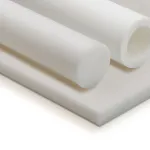
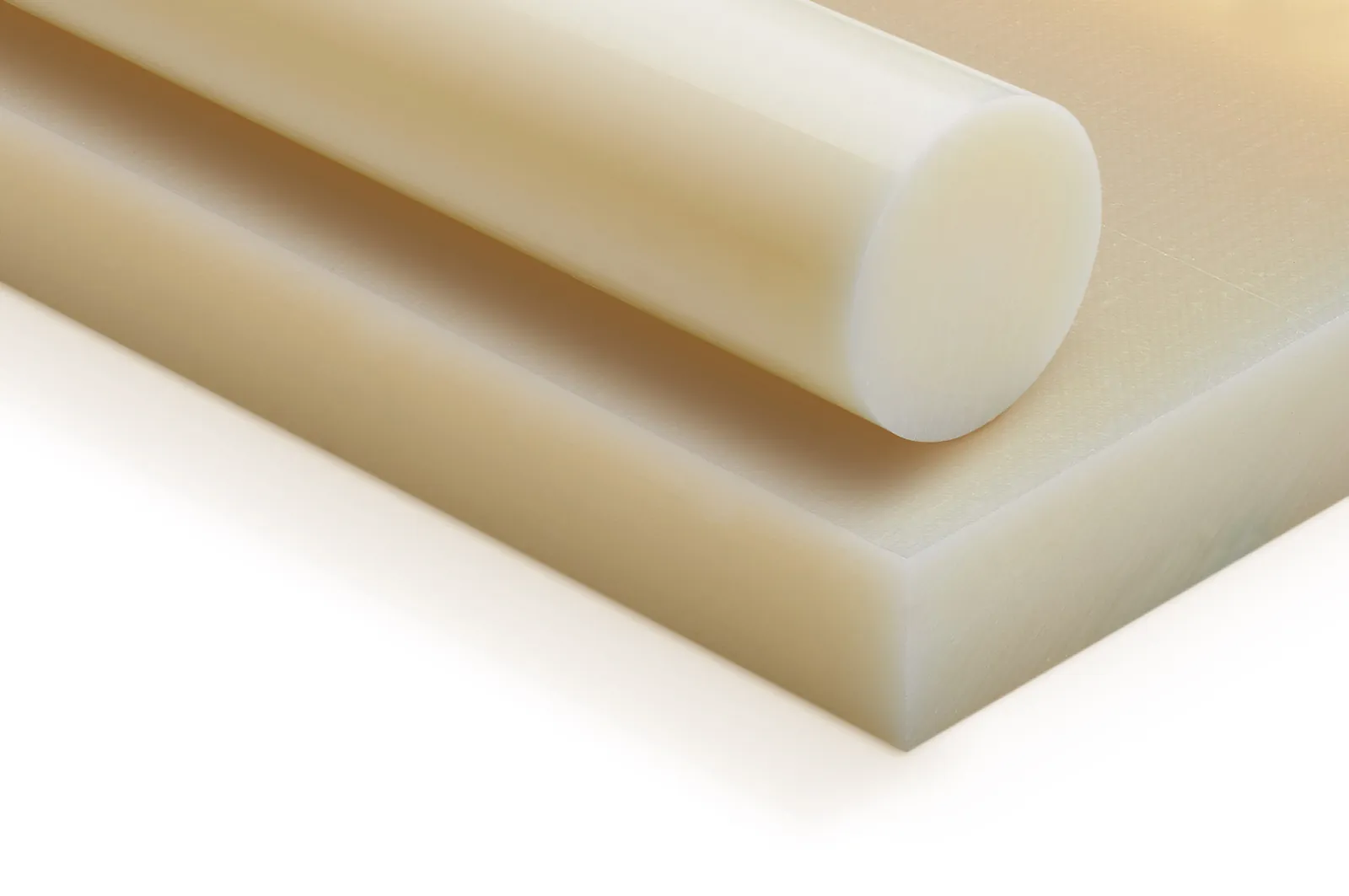
PET semi-finished products and finished parts
Engineering PET is available in various semi-finished product forms. These include in particular:
- PET sheets
- PET rods
- PET solid rods
- PET cut pieces
- PET finished parts to drawing
From the semi-finished products, precise components can be produced by CNC milling, CNC turning and other machining processes. The good machinability allows clean surfaces, tight tolerances and complex geometries.
During machining, heat generation, tool selection, the clamping strategy and possible internal stresses in the semi-finished product must be taken into account. Material-appropriate manufacturing reduces dimensional deviations, chipping and unwanted distortion.
Modified PET materials
In addition to unreinforced PET, modified variants are available for special requirements. Additives or fillers can, for example, change the sliding behaviour, wear resistance, electrical conductivity or dimensional stability.
Possible versions are:
- slide-modified PET
- wear-optimised PET
- glass-fibre-reinforced PET
- electrically conductive PET
- food-compliant PET types
Which modification is sensible depends on the load and the function of the later component. General information on the targeted adaptation of engineering plastics can be found under plastic modification.
Is PET suitable for food contact?
Certain PET types can be suitable for contact with food. For this, the raw materials and semi-finished products used must meet the respective statutory requirements and conformity requirements.
The general designation PET is not sufficient as proof. What is decisive is always the specific material type, the colour, possible additives, the service temperature and the intended contact duration.
Is PET recyclable?
PET is fundamentally thermoplastic and therefore meltable and materially recyclable. Established recycling streams exist particularly for packaging. For technical components, however, the actual recyclability depends on purity of type, additives, contamination and the available take-back systems.
For industrial applications, therefore, in addition to the theoretical recyclability, it should also be considered whether components can be constructed as a single material type, clearly labelled and separately collected at the end of their use.
Selecting PET for your component
PET is particularly suitable for precise, dimensionally stable and wear-stressed components with low moisture absorption. The material is an economical solution for numerous applications in mechanical engineering, food technology, electrical engineering and precision engineering.
Whether PET is suitable for your application, however, depends on the actual operating conditions. Temperature, load duration, chemical contact, friction, moisture and required approvals must be assessed together.
Martan Plastics supports you in selecting the suitable material within the engineering plastics and, on request, manufactures precise PET components to drawing, sample or technical specification.
Frequently asked questions about PET plastic
What is PET plastic used for?
Engineering PET is used among other things for plain bearings, guides, rollers, gears, spacers, insulating components, transport stars and precision parts. The material is particularly advantageous where there are high requirements for dimensional stability, rigidity and wear resistance.
Is PET an engineering plastic?
Yes. Specially manufactured PET is used as an engineering thermoplastic for mechanically and electrically stressed components. Engineering PET differs from PET for simple packaging applications in material quality, manufacturing process and property profile.
What temperature can PET withstand?
The permissible service temperature depends on the specific PET type, the load and the duration of use. Unreinforced engineering PET materials can often be used continuously up to around 100 °C. Short-term higher temperatures are possible depending on the material.
Is PET more dimensionally stable than polyamide?
PET absorbs significantly less moisture than many polyamides. As a result, its dimensions usually remain more stable under changing ambient conditions. For highly precise components, PET can therefore be a suitable alternative to PA.
Is PET chemically resistant?
PET is resistant to many oils, greases, fuels and diluted acids. There are limitations with regard to strong alkalis, hot water and hydrolytically active media. Suitability must therefore be checked separately for each medium and each service temperature.
Can PET be machined well?
Engineering PET can be milled, turned, drilled and sawn well. Due to its dimensional stability, it is suitable for precision components with tight tolerances. Suitable tools and controlled heat generation during machining are prerequisites.