Extruding PEEK – process, parameters, typical grades
How is PEEK extruded? Process, temperature, parameters and quality characteristics of extruded semi-finished products such as sheets, rods and tubes.
The extrusion of PEEK is one of the most demanding processing methods within high-performance plastics. Due to the high melting temperature, the narrow process windows and the required material purity, specialised equipment and in-depth material knowledge are necessary. This article explains the process, describes the most important parameters and shows typical quality characteristics of extruded PEEK semi-finished products.
Fundamentals of the extrusion process
During extrusion, PEEK granulate is heated, plasticised and then continuously formed into sheets, rods or tubes. Since PEEK only melts at around 343 °C, extruders, tools and temperature control systems must be designed for extreme thermal loads.
The process begins with the drying of the material. Although PEEK is less hygroscopic than other high-performance plastics, small amounts of moisture can still cause surface defects and structural weaknesses.
Further fundamentals on the material structure are provided by PEEK material science.
Process parameters in PEEK extrusion
The relevant settings include:
- Barrel temperatures: usually 360–400 °C
- Tool temperature: constant above 300 °C, depending on geometry
- Melt pressure: high, due to the viscosity
- Throughput: moderate, in order to avoid thermal damage
- Cooling: controlled, in order to regulate the crystallinity
Stable temperature control is decisive, since PEEK degrades when overheated and flows unevenly at temperatures that are too low.
Typical extruded PEEK semi-finished products
PEEK sheets
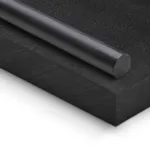
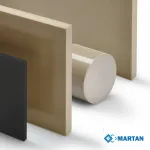
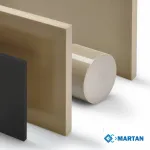
They are the standard semi-finished product for milled parts and are used in mechanical engineering, in electronics and in medical technology. Sheets are characterised by high dimensional accuracy and consistent material properties.
Product example: PEEK sheets natural – semi-finished product
PEEK rods
Rods are the basis for components produced by turning. Uniform material density and a defect-free surface are decisive for subsequent precision.
Product examples:
PEEK tubes
Extruded tubes are used wherever electrical insulation, media resistance or low weight combined with high stability are decisive. Thanks to tight diameter tolerances, they are also suitable for precision applications.
Fundamentals on the manufacturing process: Extrusion technologies
Quality characteristics of extruded PEEK semi-finished products
High-quality PEEK semi-finished products possess:
- homogeneous surfaces without streaks or inclusions
- uniform wall thicknesses and tolerances
- high material purity
- reproducible crystallinity for consistent mechanical properties
Irregularities such as matt areas, colour deviations or internal stresses indicate faulty process parameters.
Where is extruded PEEK used?
Typical applications are found in:
- High-temperature and vacuum technology
- Mechanical engineering
- Electronics and sensor technology
- Fluid technology
- Medical technology
A historical classification and development of the material is provided by PEEK history.
FAQ
Why is the extrusion of PEEK so demanding? Because of the high melting temperatures, the narrow process windows and the sensitivity to thermal damage.
Which semi-finished products are typically extruded? Sheets, rods and tubes.
Which quality characteristics are decisive? Uniform density, consistent tolerances, clean surface and reproducible material structure.
What role does crystallinity play? It determines the strength, stiffness and heat deflection resistance of the semi-finished product.