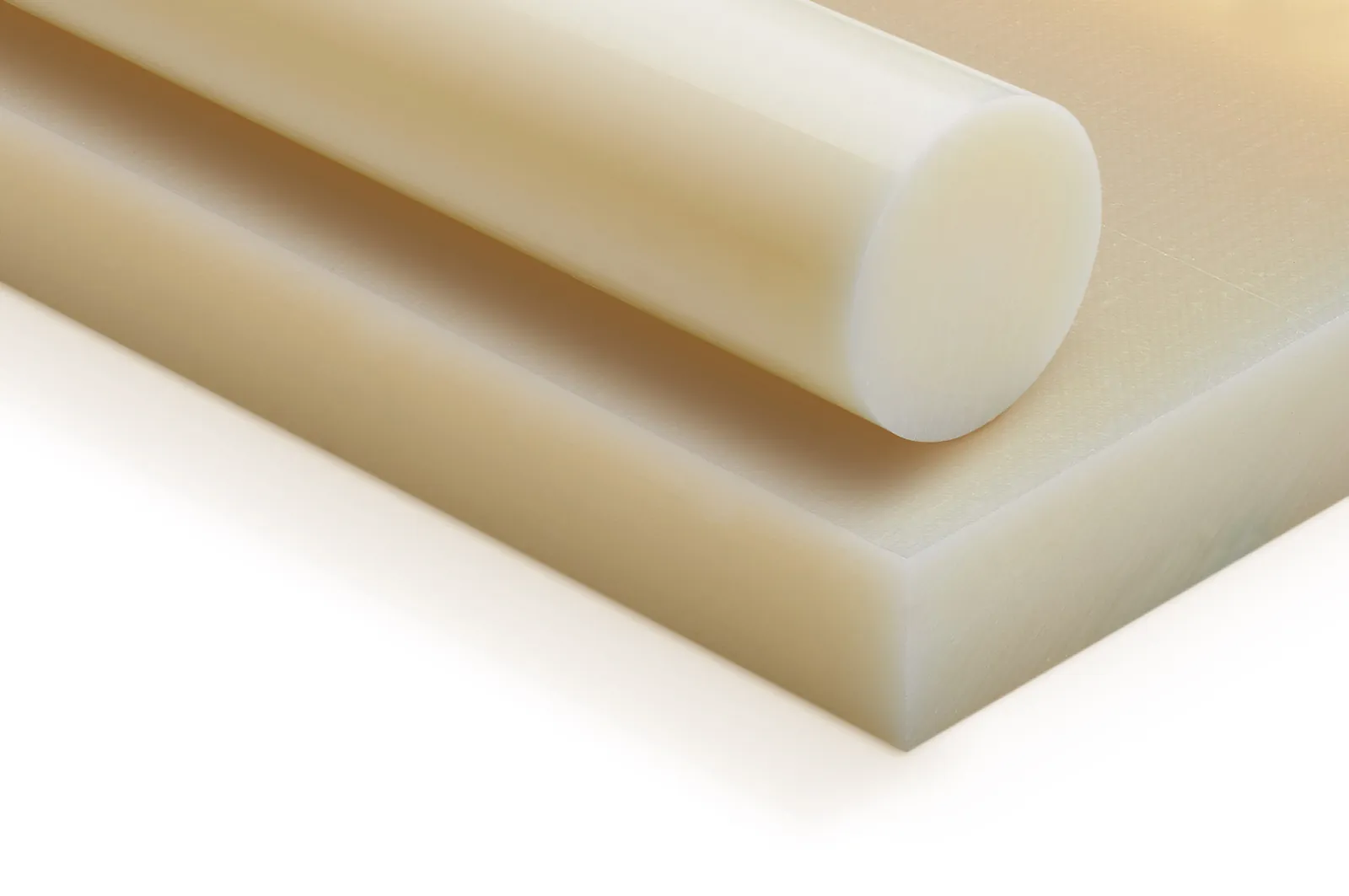
Polyphenylsulfone
PPSU (polyphenylsulfone) stands out for its high impact strength, sterilizability and chemical resistance. Applications, processing and advantages.
PPSU plastic is an amorphous thermoplastic high-performance plastic with exceptionally high impact strength, very good hydrolysis resistance and high thermal load capacity. The full material designation is polyphenylsulfone. The abbreviations PPSU and, in some cases, PPSF are also commonly used.
PPSU is particularly suitable for components that come into repeated contact with hot water, steam, cleaning agents or disinfectants. For this reason, the material is used, among other things, in medical technology, food technology, aerospace, the electrical industry and in water-carrying systems.
Martan Plastics supports you in selecting suitable high-performance plastics and supplies PPSU, depending on the available material grade, as a semi-finished product, cut piece or machined component to drawing.
What is PPSU?
Polyphenylsulfone belongs to the polysulfone family. Within this material group, PPSU stands out above all for its higher impact strength and better resistance to repeated steam sterilisation. The plastic combines the thermal stability of a high-performance thermoplastic with a toughness that is unusual for this material class.
As an amorphous plastic, PPSU does not have a clearly defined melting point. When heated, the material becomes increasingly soft within a temperature range. The glass transition temperature for many PPSU grades is approximately 220 °C. However, the actually permissible service temperature of a component is below this and depends on the material grade, the duration of loading, the component geometry and the mechanical stress.
Properties of PPSU plastic
Exceptionally high impact strength
PPSU is one of the particularly impact-resistant high-performance plastics. The material can absorb impact and shock loads without breaking in a brittle manner. This property is retained over a broad temperature range and is relevant above all for housings, handles, instrument parts, fastening elements and mechanically stressed components.
Compared with PSU and many PEI grades, PPSU exhibits higher toughness. PPSU can also offer advantages over polycarbonate in terms of notched impact strength.
High temperature resistance
PPSU retains its mechanical properties comparatively well even at elevated temperatures. Depending on the material grade, continuous service temperatures in the range of approximately 160 to 180 °C are possible. Higher temperatures may be permissible for short periods.
The maximum service temperature must not be equated with the glass transition temperature. For component design, mechanical loads, contact media, sterilisation duration and safety reserves must also be taken into account alongside temperature.
Very good hydrolysis and steam resistance
One of the most important properties of PPSU is its high resistance to water, hot water and steam. Many other plastics gradually lose their mechanical strength on repeated contact with hot water or during steam sterilisation. PPSU is considerably better suited to such alternating loads.
This hydrolysis resistance makes the material interesting for medical instruments, sterilisation containers, valves, fittings and components in drinking water and wastewater technology.
Repeated sterilisation capability
Suitable PPSU grades can be sterilised repeatedly. Depending on the specific material type, the following processes are among those that may be considered:
- Steam sterilisation in an autoclave
- Sterilisation with ethylene oxide
- Gamma and electron beam sterilisation
- Cleaning with suitable disinfectants
PPSU is therefore frequently selected for reusable components in medical technology and in the healthcare sector. Whether a particular grade may be used for a specific medical device must be verified on the basis of the associated data sheet, the required biocompatibility evidence and the applicable regulatory requirements.
Good chemical resistance
PPSU is resistant to many aqueous media, dilute acids, alkalis, salt solutions, cleaning agents and disinfectants. The combination of chemical and hydrolysis resistance is a significant advantage over numerous standard engineering plastics.
However, chemical resistance is not universal. Ketones, certain ethers, aromatic solvents, halogenated solvents and individual hydraulic or functional fluids can attack PPSU or cause stress cracks. The decisive factors here are:
- Type and concentration of the medium
- Contact time
- Operating temperature
- Mechanical stress in the component
- Specific PPSU grade
Before any permanent contact with chemicals, an application-specific resistance test should therefore always be carried out.
Inherent flame retardancy
Due to its chemical structure, PPSU is inherently flame retardant. Certain material grades achieve UL 94 classifications up to V-0 without the need for conventional halogenated flame retardants.
The material is therefore suitable for housings, connectors and insulating components in the electrical industry as well as for components with increased fire protection requirements. The fire protection class actually achieved depends on the grade, colour and wall thickness.
Stable electrical properties
PPSU offers good electrical insulating properties. The dielectric values remain comparatively stable over a broad frequency and temperature range. The material can therefore be used for electrical functional parts, insulators, connectors and device components.
Dimensional stability and low moisture absorption
Compared with many polyamides, PPSU absorbs relatively little moisture. As a result, dimensions and mechanical properties change only to a limited extent with fluctuating humidity.
Under prolonged mechanical load, however, PPSU can also creep. For closely toleranced components, temperature, load duration, wall thickness and stress state must therefore be considered together.
Typical technical values of PPSU
The following values serve as a guide and refer by way of example to the unreinforced material grade RADEL® R-5100. They are not universally valid specifications for every PPSU product.
| Property | Typical value |
|---|---|
| Density | approx. 1.30 g/cm³ |
| Tensile strength | approx. 70 to 76 MPa |
| Tensile modulus | approx. 2,340 to 2,370 MPa |
| Compressive strength | approx. 99 MPa |
| Izod notched impact strength | up to approx. 690 J/m |
| Glass transition temperature | approx. 220 °C |
| Heat deflection temperature at 1.8 MPa | approx. 207 °C |
| Thermal conductivity | approx. 0.35 W/(m·K) |
| Dielectric strength | approx. 14 kV/mm |
| Flame retardancy | grade-dependent up to UL 94 V-0 |
For the design, calculation and approval of a component, the data of the material grade actually offered are always decisive.
RADEL® R-5100 BK937 made of PPSU
The available range includes, among other things, PPSU Black RADEL® R-5100 BK937. This is a black, non-glass-fibre-reinforced polyphenylsulfone grade with very high toughness, excellent hydrolysis stability and good thermal load capacity.
RADEL® R-5100 BK937 is particularly interesting for applications requiring repeated steam sterilisation, high impact stress, flame retardancy or good resistance to environmental stress cracking.
Suitability for food contact, drinking water, medical devices or aerospace applications must always be verified on the basis of the specific colour, delivery form, standard, approval and intended operating condition. A general material designation alone does not constitute approval for a regulated application.
Delivery forms and fabrication from PPSU
Depending on the material grade and availability, PPSU can be offered in various delivery forms. These include, for example:
- Sheets
- Rods
- Profiles
- Moulding compounds for further processing
- Customer-specific cut pieces
- Fully machined components
An overview of the fundamental possibilities can be found under plastic semi-finished products. We clarify available dimensions, colours and material grades on a project-specific basis.
Processing of PPSU
Injection moulding and extrusion
PPSU can be processed thermoplastically and, depending on the grade, can be processed by injection moulding, extrusion or thermoforming, among other methods. Due to the high processing temperatures and the moisture sensitivity of the melt, precise process control is required.
Before processing, the material must be dried sufficiently. Excessive residual moisture can lead to surface defects, blistering or a reduction in material properties. Mould temperature, melt temperature and residence time must also be matched to the respective grade.
Machining
PPSU semi-finished products can be processed into precise components by drilling, sawing, CNC milling and turning. Due to the high toughness, machining must be designed to suit the material.
Sharp tools, controlled heat generation and low-stress clamping are important. Excessive local temperatures or unsuitable cutting parameters can impair surface quality and dimensional accuracy.
Bonding, welding and printing
Depending on the component geometry and material grade, PPSU can be thermally welded or joined using suitable adhesive systems. Reliable adhesive bonds may require surface pre-treatment and specially matched adhesion promoters.
Printing, coating or laser marking are also fundamentally possible. The suitable process should be tested on original material before series production.
Application areas of PPSU plastic
Medical technology and healthcare
In medical technology, PPSU is used above all for reusable components that are frequently cleaned and sterilised. Typical applications are:
- Handles of surgical instruments
- Sterilisation containers and trays
- Medical device housings
- Valves and fastening elements
- Dental instruments
- Components for liquid and gas routing
For medical applications, the required evidence of biocompatibility, sterilisation capability and traceability of the specific material grade must always be available.
Food industry
Suitable PPSU grades can be used in the food industry for reusable containers, components of processing plants, fittings and components with frequent cleaning cycles.
Suitability for direct food contact must be verified on the basis of the respective material grade and the applicable regulatory requirements. Not every PPSU grade automatically has the same approvals.
Aerospace
In aerospace, PPSU is used due to its low weight, its impact strength and its inherent flame retardancy. Possible applications are interior components, electrical components, fastening elements and functional housing parts.
For aerospace components, the prescribed fire, smoke and toxicity requirements must be demonstrated on the basis of the specific material grade and component geometry.
Mechanical and plant engineering
In mechanical and plant engineering, PPSU is suitable for impact-stressed structural parts, housings, mounts, insulating components and components with contact to hot water or cleaning media.
Whether PPSU is technically and economically sensible depends on the load, temperature, chemical exposure and required service life.
Drinking water and sanitary technology
Selected PPSU grades are used for fittings, manifolds, valve components and other parts of water-carrying systems. Here, the hydrolysis resistance, low susceptibility to corrosion and high impact strength of the material come into play.
Required drinking water approvals apply in principle only to expressly tested material grades and operating conditions.
Electrical engineering and electronics
The combination of electrical insulation, temperature resistance, dimensional stability and flame retardancy enables the use of PPSU for connectors, coil formers, insulators, housings and carrier elements.
PPSU compared with other high-performance plastics
| Material | Strengths | Distinction from PPSU |
|---|---|---|
| PSU | Good heat deflection resistance, electrical insulation and hydrolysis stability | PPSU is generally tougher and better suited to frequent steam sterilisation. |
| PEI | High stiffness, dimensional stability and inherent flame retardancy | PPSU usually offers higher toughness and better hydrolysis resistance; PEI is often stiffer. |
| PEEK | Very high temperature, wear and chemical resistance | PEEK is suitable for higher mechanical and thermal loads, while PPSU often offers advantages in impact strength and cost-effectiveness. |
| PC | Transparent, impact-resistant and easy to process | PPSU is more thermally resistant and considerably more resistant to repeated steam sterilisation. |
| PES | High temperature resistance, stiffness and good electrical properties | PPSU is preferred when particularly high impact strength and hydrolysis resistance are required. |
When is PPSU the suitable material?
PPSU is particularly suitable when several of the following requirements must be met at the same time:
- High impact and shock load
- Repeated contact with hot water or steam
- Regular cleaning or sterilisation
- Elevated service temperatures
- Good electrical insulation
- Inherent flame retardancy
- Low weight compared with metallic solutions
- High reliability under changing operating conditions
For heavily wear-stressed sliding components, the highest continuous service temperatures or permanent contact with particularly aggressive solvents, other high-performance plastics may be more suitable.
Material selection and PPSU components from Martan Plastics
The selection of a suitable PPSU material should not be based on a single temperature or strength value alone. The decisive factor is the overall requirement profile of the component.
For a technical assessment, we need as specific information as possible on:
- Continuous and peak temperature
- Mechanical load
- Contact with water, steam or chemicals
- Cleaning and sterilisation processes
- Dimensions and tolerances
- Required delivery form
- Quantity
- Required standards and approvals
Martan Plastics supplies PPSU for industrial applications and, on request, manufactures individual plastic components to drawing or technical specifications. Send us your requirements via the contact form. We will check which material grade and manufacturing method is suitable for your application.
Frequently asked questions about PPSU plastic
What does the abbreviation PPSU stand for?
PPSU stands for polyphenylsulfone. It is an amorphous thermoplastic high-performance plastic from the polysulfone family.
How temperature-resistant is PPSU?
Depending on the grade, PPSU can be used continuously at elevated temperatures of approximately 160 to 180 °C. The glass transition temperature of many PPSU grades is around 220 °C. However, the permissible component temperature depends on load, duration, geometry and environment.
Can PPSU be sterilised in an autoclave?
Yes. Suitable PPSU grades have very good hydrolysis and steam resistance and can be sterilised repeatedly in an autoclave. The permissible sterilisation cycles and process parameters must be verified on the basis of the specific grade.
Is PPSU chemical-resistant?
PPSU is resistant to many aqueous media, cleaning agents, dilute acids and alkalis. Resistance to certain organic solvents and functional fluids is limited. Testing under real operating conditions is therefore recommended.
Is PPSU food-safe?
Individual PPSU grades may be approved for food contact. However, suitability does not apply across the board to every PPSU material. The decisive factors are the specific grade, colour, application and the associated conformity evidence.
Is PPSU suitable for medical devices?
Selected PPSU grades are frequently used for medical instruments and device components. For a specific medical device, however, the required biocompatibility, sterilisation and regulatory evidence must be available.
What is the difference between PPSU and PSU?
PPSU usually has higher impact strength and better resistance to repeated steam sterilisation. PSU is also heat- and hydrolysis-resistant, but does not reach the toughness level of PPSU in all areas.
Can PPSU be milled and turned?
Yes. PPSU can be machined, for example milled, turned, drilled or sawed. For dimensionally accurate components, sharp tools, controlled cutting parameters and the lowest possible heat generation are important.