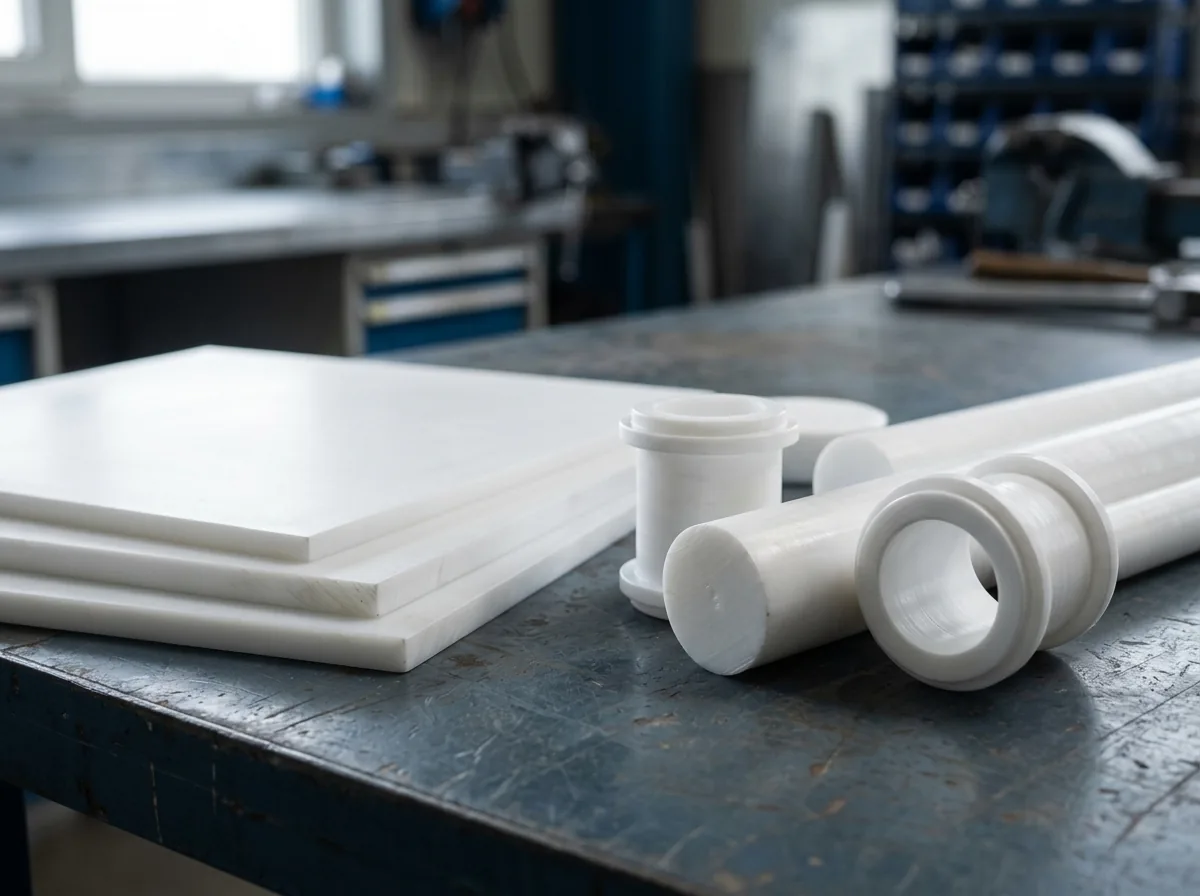
 This image was created with artificial intelligence – marked under Art. 50 of the AI Act, Regulation (EU) 2024/1689. It is a placeholder until the company's photos arrive.
Semiconductor
High-performance plastics and hoses for the semiconductor industry: PTFE, PEEK, PVDF and PP for chemical and thermal applications.
The semiconductor industry places particularly high demands on plastics, hoses and technical components. Purity, chemical resistance, temperature stability and precise processing play a central role in equipment and components for the semiconductor industry.
Martan Plastics supports companies in selecting suitable engineering plastics and high-performance plastics for semiconductor equipment. Depending on the application, PTFE, PEEK, PVDF and PP, among others, as well as custom-manufactured plastic components are used.
What does semiconductor mean?
Semiconductor is the English term for Halbleiter. Semiconductors are materials whose electrical conductivity lies between that of electrical conductors and insulators. They form the basis of modern microchips, transistors, sensors and numerous electronic components.
During the manufacture of these components, production equipment must ensure particularly controlled conditions. Even small particles, unwanted material emissions or contamination can influence sensitive manufacturing processes.
This is why not only the actual semiconductor materials play an important role. The plastics for hoses, lines, equipment components, holders and other components must also be selected to suit the respective process environment.
Hoses for the semiconductor industry
Hoses are relevant in semiconductor equipment particularly where media must be transported reliably within the equipment. Depending on the process, high demands can arise with regard to chemical resistance, temperature resistance and material purity.
For demanding applications, fluoropolymers are therefore used, among others. PTFE plastic is particularly notable for its very high chemical resistance and a broad service temperature range.
Typical requirements for a hose for the semiconductor industry can be:
- high chemical resistance
- low interaction with transported media
- temperature resistance
- smooth and easily controllable surfaces
- low particle and contamination risks
- reliable properties under the respective process conditions
- suitable dimensions for equipment and fluid technology
In addition to PTFE, other fluoropolymers such as PFA can also be used depending on the specific application. Which hose material is suitable cannot be determined as a general rule. Medium, temperature, pressure, purity requirements and design conditions must be considered together.
Which plastics are used in the semiconductor industry?
Different engineering plastics are available for semiconductor applications. The material selection depends on the specific function of the component and the loads during the production process.
| Plastic | Characteristic properties | Typical applications in semiconductor equipment |
|---|---|---|
| PTFE | very high chemical resistance, high temperature resistance, very low coefficient of friction | hoses, seals, insulators, sliding and functional parts |
| PEEK | high mechanical strength, temperature resistance, chemical resistance | precision components, holders, carriers, structural components |
| PVDF | high chemical resistance, good mechanical properties | piping, fluid and equipment components |
| PP | good chemical resistance, low weight, economical processing | tanks, linings and equipment components |
| PFA | very high chemical resistance and good suitability for demanding fluid applications | hoses and media-carrying components |
An overview of further available plastic materials supports you in the initial material selection.
PTFE for hoses and chemically stressed components
PTFE is one of the particularly interesting high-performance plastics for chemically demanding areas of the semiconductor industry.
The material is notable in particular for its very high resistance to numerous chemicals and solvents. It also offers high temperature resistance and very good sliding properties.
PTFE is therefore suitable, for example, for the following components:
- hoses
- seals
- insulation elements
- sliding components
- technical semi-finished products
- individually machined components
The actual suitability of the material should always be verified on the basis of the chemicals used, temperatures and mechanical loads.
PEEK for precise components in semiconductor equipment
Where high mechanical stability is required in addition to chemical and thermal resilience, PEEK plastic can represent a suitable solution.
PEEK combines high strength and rigidity with very good temperature and chemical resistance. As a result, the high-performance plastic is suitable, among other things, for dimensionally accurate and mechanically stressed components.
Typical possible applications are:
- holders
- carriers
- guide elements
- insulation components
- precision parts
- components to drawings or CAD data
Particularly in the case of sensitive equipment components, the combination of material selection and precise machining can be an important prerequisite for reproducible component properties.
PVDF for chemically stressed equipment components
PVDF plastic offers high chemical resistance as well as good mechanical properties.
This makes PVDF interesting for applications in which components come into contact with aggressive media or demanding ambient conditions.
Possible applications include, among others:
- piping components
- pump components
- valve components
- tank components
- media-carrying equipment components
Whether PVDF, PTFE or another fluoropolymer material represents the better solution depends on the specific process conditions.
PP plastic for semiconductor equipment
Polypropylene (PP) can also be used for certain components of semiconductor equipment.
PP has a low density and good resistance to numerous acids, alkalis and other media. At the same time, the material can be processed economically.
Possible areas of application include, for example:
- tanks
- covers
- linings
- structural equipment components
- components with chemical exposure
At particularly high temperatures, with special chemicals or with very high purity requirements, the operating conditions must be examined closely and, if necessary, high-performance plastics or fluoropolymers must be used.
Requirements for plastics in the semiconductor industry
Chemical resistance
Chemicals and process media are used in various manufacturing steps. Plastics for the corresponding equipment areas must be sufficiently resistant to the media used in each case.
Materials must not be selected on the basis of a general statement such as "chemical-resistant" alone. Concentration, temperature and exposure time influence the actual resistance.
Purity and low contamination risks
In semiconductor manufacturing, even the smallest contamination can be problematic. Materials for sensitive equipment areas must therefore be assessed with regard to their suitability for the respective process and cleanroom environment.
Further information on this field of application can be found under Plastics for cleanroom technology.
Temperature resistance
Depending on the process step, plastic components can be exposed to elevated temperatures or temperature fluctuations.
High-performance plastics such as PTFE or PEEK offer significantly greater application possibilities for corresponding requirements than many standard plastics.
Electrical properties
Plastics are also used in semiconductor equipment because of their electrical properties. Depending on the application, insulating or specially modified materials may be required.
Dimensional accuracy and mechanical stability
In precision equipment, plastic components must also meet defined geometric and mechanical requirements.
For structural components, therefore, in addition to chemical resistance, properties such as rigidity, creep behaviour, thermal expansion and wear resistance must also be taken into account.
Plastic machining for components of the semiconductor industry
In addition to the material, processing determines the subsequent function of the component. Martan Plastics offers various methods of plastic machining for this purpose.
Custom components can be manufactured from semi-finished products, for example to drawings or CAD data. Depending on geometry, quantity, material and tolerance requirements, different manufacturing methods may be considered.
For continuous semi-finished products, profiles and tubes, Martan Plastics also offers solutions in the field of extrusion.
This allows material selection, semi-finished product and subsequent machining to be tailored specifically to the requirements of an industrial application.
Semiconductor plastics: which plastic is the right one?
The right plastic for a semiconductor application results from the interaction of several requirements.
Before selecting the material, the following points in particular should be clarified:
- Which chemicals or process media come into contact with the component?
- Which temperatures occur continuously and briefly?
- Is a hose, a semi-finished product or a fully machined component required?
- Which mechanical loads act on the component?
- What are the requirements for purity and surface?
- Are electrical properties relevant?
- Which dimensions and tolerances are required?
- Is it a single part, a small series or a recurring series requirement?
On this basis, for example, PTFE, PEEK, PVDF, PP or other engineering plastics can be compared with one another.
Plastic solutions for the semiconductor industry from Martan Plastics
Martan Plastics supports industrial companies in the selection and processing of engineering plastics and high-performance plastics.
Depending on the project, the solution includes, among other things:
- technical plastic semi-finished products
- high-performance plastics
- plastic hoses and tubes
- profiles and extruded semi-finished products
- cut pieces
- CNC-machined plastic parts
- custom components to drawings
- support with material selection
This gives you a plastic solution tailored to your application for equipment and components of the semiconductor industry.
Frequently asked questions about plastics and hoses for the semiconductor industry
Which hose is suitable for the semiconductor industry?
That depends on the process medium, temperature, pressure and purity requirements. Fluoropolymer hoses are often considered for chemically demanding applications. PTFE and PFA are interesting for numerous demanding fluid applications due to their high chemical resistance.
Which plastics are used in semiconductor equipment?
Typical materials include PTFE, PEEK, PVDF, PP and PFA. The selection depends on chemical exposure, temperature, mechanical requirements, purity and the function of the respective component.
Why is PTFE used in the semiconductor industry?
PTFE offers very high chemical resistance, a broad service temperature range and very good sliding properties. As a result, the material is suitable, among other things, for hoses, seals, insulators and other technical components.
Is PP plastic used for semiconductor equipment?
PP can be suitable for tanks, linings and other chemically stressed equipment components. At particularly high temperature, chemical or purity requirements, high-performance plastics or fluoropolymers may be required.
What does Semiconductor mean in German?
Semiconductor means Halbleiter in German. Semiconductors are the technical basis of microchips, transistors and numerous other electronic components.
What advantages does PEEK offer in the semiconductor industry?
PEEK combines high temperature resistance with very good mechanical properties and high chemical resistance. The material is therefore particularly suitable for precise and mechanically stressed components.
Can plastic parts for semiconductor equipment be manufactured individually?
Yes. Depending on the material and component geometry, plastic components can be manufactured individually to drawings or CAD data, for example by CNC machining or other manufacturing methods.
Request a plastic solution for your semiconductor application
Do you need a hose, a plastic semi-finished product or an individually manufactured component for the semiconductor industry?
Martan Plastics supports you in selecting a suitable material and the right manufacturing method. To do so, please provide us where possible with the medium used, the temperature range, the required dimensions, the quantity and any special requirements for your application.