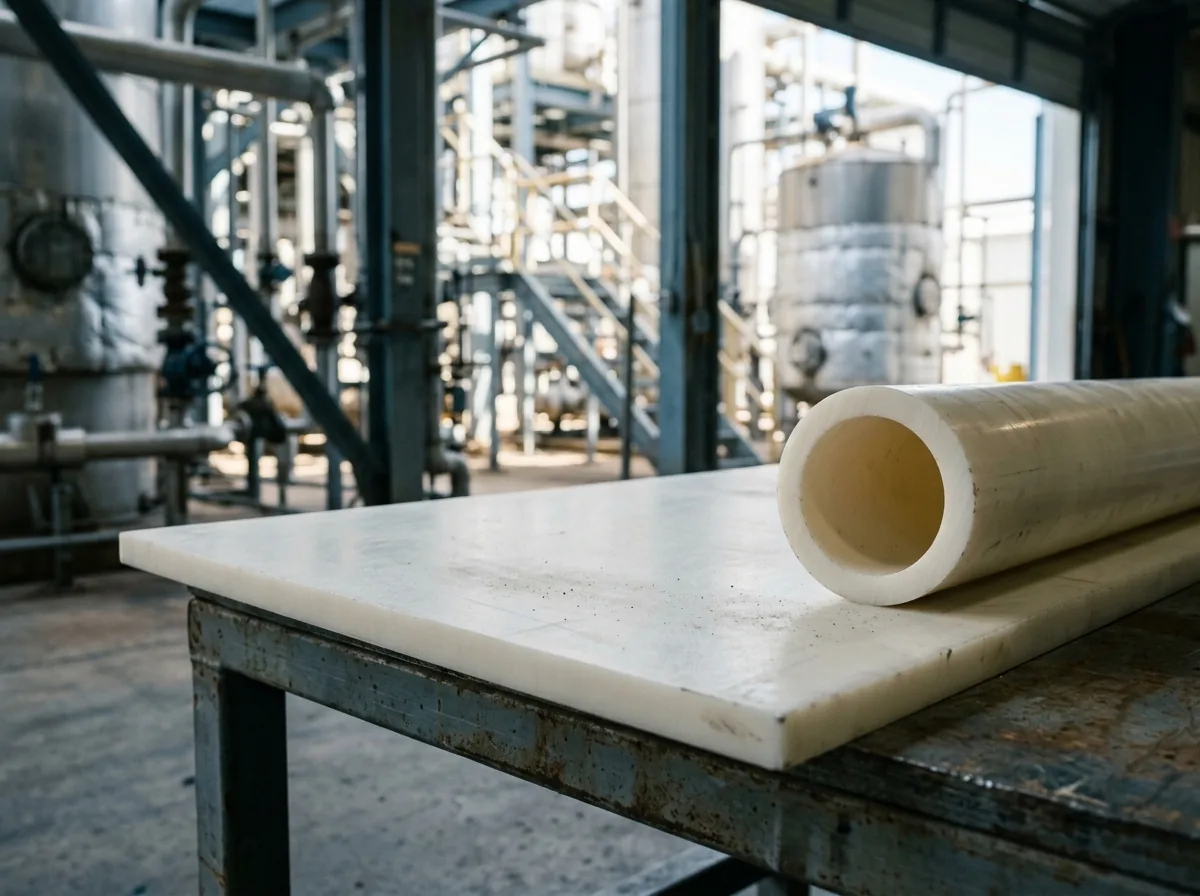
 This image was created with artificial intelligence – marked under Art. 50 of the AI Act, Regulation (EU) 2024/1689. It is a placeholder until the company's photos arrive.
Polyvinylidene fluoride
PVDF plastic: properties, applications & advantages. Discover the high resistance & versatile uses of PVDF.
PVDF plastic combines high chemical resistance with good mechanical strength, temperature resistance and weather stability. The thermoplastic fluoropolymer is therefore used for components that come into permanent contact with aggressive media, moisture, UV radiation or elevated temperatures.
Typical applications range from piping systems, pump components and vessel linings to seals and electrical insulating parts through to components for cleanroom, semiconductor and medical technology. Martan Plastics supplies PVDF as a plastic semi-finished product and, on request, produces cut pieces and precision components from it to drawings or CAD data.
What is PVDF?
PVDF is the abbreviation for polyvinylidene fluoride. The semi-crystalline thermoplastic belongs to the group of fluoropolymers. The firmly bound fluorine atoms within the molecular structure contribute to the high resistance to numerous chemicals, UV radiation and weathering.
Compared with PTFE, PVDF is stiffer, more mechanically resilient and easier to process using thermoplastic methods. Compared with many non-fluorinated engineering plastics, the material offers higher chemical resistance and better long-term stability under demanding environmental conditions.
PVDF is natural-coloured, usually whitish to translucent. Depending on the material type, manufacturing process and modification, different colours, purity grades and approvals are available.
Key properties of PVDF plastic
PVDF is chosen when chemical, thermal and mechanical requirements must be met simultaneously. However, the specific characteristic values differ depending on the manufacturer, material type, processing and test method.
| Property | Typical significance for the application |
|---|---|
| Chemical resistance | Resistant to numerous acids, halogens, oxidising media, hydrocarbons and aqueous solutions |
| Temperature resistance | Depending on the PVDF type and load, suitable for long-term service temperatures up to around 140 to 150 °C |
| Mechanical strength | Higher stiffness and strength than many other fluoropolymers |
| Low water absorption | Dimensions and electrical properties remain comparatively stable under humid conditions |
| UV and weather resistance | Suitable for outdoor components subject to long-term exposure |
| Electrical insulation | Can be used for cable insulation, connectors and electrotechnical components |
| High purity | Special grades are suitable for sensitive processes in semiconductor, pharmaceutical and cleanroom applications |
| Weldability | Enables permanently tight vessel, piping and apparatus constructions |
| Flame-retardant behaviour | Advantageous for electrical, building services and industrial applications |
Chemical resistance
PVDF has very good resistance to many inorganic acids, oxidising chemicals, halogens, alcohols, aliphatic hydrocarbons and salt solutions. The material is therefore frequently used for piping, valves, pump parts, vessels and linings in chemical process engineering.
Nevertheless, chemical resistance is not universal. Strongly alkaline media, amines, certain ketones, esters and polar organic solvents can affect PVDF, particularly at elevated temperature or with longer exposure time. In addition, mechanical stress, pressure, concentration and temperature can change the resistance of a component.
Before use with critical media, the specific PVDF grade should therefore always be tested under realistic operating conditions. A general resistance table cannot fully replace this application-specific assessment.
Temperature resistance
Depending on the material type and operating conditions, PVDF can be used long-term at temperatures of approximately 140 to 150 °C. Short-term temperature peaks may be higher. The actual permissible service temperature depends, among other things, on the mechanical load, the surrounding medium, the component geometry and the expected service life.
As temperature rises, stiffness and strength decrease. For load-bearing or pressure-loaded components, the maximum temperature specification of the raw material must therefore not be used as the sole basis.
Mechanical properties
Within the fluoropolymers, PVDF has comparatively high strength, stiffness and abrasion resistance. The material is therefore suitable not only for coatings and films, but also for mechanically loaded structural parts.
However, PVDF is not a universal substitute for particularly high-load-bearing engineering plastics. Under very high mechanical loads, severe temperature changes or tight tolerances, PEEK may be more suitable, for example.
Water absorption and dimensional stability
The material absorbs only a small amount of water. Its dimensions and electrical properties therefore change significantly less with moisture than those of hygroscopic plastics such as many polyamides.
This property is advantageous for dimensionally accurate components, pump components, electrical insulating parts and applications in water treatment, laboratory and analytical technology.
UV and weather resistance
PVDF is very resistant to UV radiation, ozone and natural weathering. The plastic can therefore be used outdoors without complex additional stabilisation.
Typical applications are façade coatings, roof systems, cable sheathing, covers and components in systems that are permanently exposed to outdoor weathering.
Electrical properties
PVDF has good electrical insulating properties and high dielectric strength. The material is used, among other things, for cable insulation, sensor components, connectors and electrical components.
Certain PVDF forms also exhibit piezoelectric and pyroelectric properties. They can generate electrical charges through mechanical deformation or temperature change respectively. PVDF films prepared accordingly are therefore used, for example, in sensors, acoustic transducers and measurement technology.
Technical characteristic values of PVDF
The following values serve as a general classification. The technical data sheet of the selected PVDF grade and the operating conditions applicable to the component are always binding.
| Characteristic value | Typical range |
|---|---|
| Density | approximately 1.75 to 1.80 g/cm³ |
| Melting temperature | approximately 165 to 177 °C |
| Long-term upper service temperature | depending on grade and load, approximately 140 to 150 °C |
| Water absorption | very low |
| Material structure | semi-crystalline |
| Electrical behaviour | insulating; special forms piezoelectric |
| Weather resistance | very good |
What advantages does PVDF offer?
- Broad chemical resistance: PVDF withstands numerous aggressive media and is suitable for demanding process engineering applications.
- Good mechanical resilience: The material is stiffer and stronger than many other fluoropolymers.
- High temperature resistance: PVDF remains usable even at elevated operating temperatures.
- Very low moisture absorption: This supports stable dimensions and electrical properties.
- Excellent weather resistance: UV radiation, ozone and outdoor weathering affect the material only slightly.
- Good processability: PVDF can be extruded, injection moulded, welded, thermoformed and machined.
- High purity possible: Special types are suitable for sensitive media and controlled production environments.
- Good electrical insulation: PVDF can be used for cables, connectors and electronic components.
Limits and disadvantages of PVDF
A robust material selection must take into account the limits of PVDF as well as its advantages.
- PVDF is more cost-intensive than standard plastics such as PE or polypropylene.
- The maximum service temperature and chemical resistance are below those of PTFE.
- Strong alkalis, amines and certain organic solvents can attack the material.
- At high temperatures, stiffness and mechanical resilience decrease.
- PVDF has a higher density than many standard engineering plastics.
- For food, pharmaceutical or medical applications, an expressly suitable and documented material grade must be selected.
- For pressure-bearing components, creep behaviour, weld factors and safety factors must be taken into account in the design.
Typical applications of PVDF
Chemical plant and apparatus engineering
In chemical mechanical and plant engineering, PVDF is used for components that must safely convey aggressive media or keep them away from metallic structures. These include:
- Piping and pipe fittings
- Valves and valve components
- Pump housings and pump components
- Vessels and vessel linings
- Nozzles, distributors and fluid guides
- Seals and structural installed parts
- Heat exchanger components
Semiconductor and cleanroom technology
High-purity PVDF grades are used for sensitive processes in the semiconductor industry and cleanroom technology. The material is suitable, for example, for piping systems, vessels, fluid distributors and components where low contamination and high chemical resistance are required.
For such applications, the purity grade, extraction behaviour, surface quality and documentation of the respective material type must be checked separately.
Medical, pharmaceutical and laboratory technology
In medical technology, PVDF can be used for filter membranes, hoses, housings, fluid guides and components of analytical devices. The material is also used in pharmaceutical production plants due to its chemical resistance and the availability of high-purity grades.
The fundamental properties of PVDF do not automatically mean that every grade is biocompatible, sterilisable or suitable for direct contact with pharmaceuticals. The approvals, tests and technical verifications of the specific material type are decisive.
Electrical industry and electronics
Due to its insulating capability, temperature resistance and low moisture absorption, PVDF is suitable for applications in electronics and the electrical industry. Typical examples are:
- Cable insulation and cable sheathing
- Connectors and insulating parts
- Sensors and measuring transducers
- Coil formers and electrical functional parts
- Protective components for aggressive industrial environments
Water treatment and filtration
PVDF is used for membranes, filter elements, piping and components in industrial water treatment. Its resistance to numerous chemicals and oxidising cleaning media is particularly advantageous in systems that are regularly cleaned or disinfected.
Here too, operating pressure, temperature, medium and cleaning cycle must be considered together.
Construction industry and outdoor applications
In the construction industry, PVDF is used primarily as a binder for long-lasting coating systems. Such coatings protect façades, metal profiles and roof components from UV radiation, weathering and chemical environmental influences.
PVDF as a semi-finished product and finished part
PVDF can be processed in different delivery forms and dimensions. Depending on the material type and manufacturer, the following semi-finished products are available, among others:
- PVDF sheets
- PVDF rods
- PVDF tubes
- PVDF films
- PVDF welding rods
- PVDF profiles
- PVDF membranes
Cut pieces, contours, housings, brackets, pump parts, seals and other customer-specific components can be produced from the semi-finished products. Martan Plastics supports the selection of suitable plastic semi-finished products and the design of the subsequent machining.
Processing of PVDF
Extrusion
Extrusion is used to produce, for example, PVDF sheets, tubes, rods, profiles, films and cable sheathing. Processing parameters such as material temperature, tool temperature and cooling influence the crystallinity and thus the mechanical properties, shrinkage and dimensional accuracy.
Injection moulding
In injection moulding, complex moulded parts can be produced in larger quantities. Typical applications are valve components, pump parts, connectors, housings and media-conveying components.
The design must take into account the material-specific shrinkage, flow paths, wall thicknesses and the avoidance of critical weld lines.
Welding
PVDF can be joined, among other things, by hot gas, heated tool, infrared or socket welding. This allows tight pipe systems, vessels and apparatus to be produced.
The load-bearing capacity of a welded joint can be below that of the unprocessed semi-finished product. For pressure-bearing or safety-relevant constructions, suitable weld factors, process parameters and tests must therefore be taken into account.
Machining
PVDF can be processed into individual finished parts by plastic machining. These include in particular CNC milling, CNC turning, drilling and sawing.
For tight tolerances, thermal expansion, stresses in the semi-finished product, tool sharpness and the heat generated during machining must be taken into account. Unsuitable cutting conditions can lead to burr formation, deformation or impaired surface quality.
Thermoforming
Sheets and films made from suitable PVDF types can be thermally formed. The process is used, for example, for linings, claddings and geometrically adapted vessel components. The forming temperature and cooling must be controlled in order to avoid uneven wall thicknesses and internal stresses.
PVDF compared with PTFE, PEEK and polypropylene
| Criterion | PVDF | PTFE | PEEK | Polypropylene |
|---|---|---|---|---|
| Chemical resistance | Very good | Exceptionally high | Very good | Good to very good, media-dependent |
| Temperature resistance | High | Very high | Very high | Limited |
| Stiffness | Good | Low | Very high | Medium |
| Weldability | Good | Not weldable using conventional thermoplastic methods | Only with demanding process control | Good |
| Machining | Good | Good, but prone to deformation | Very good | Good |
| Mechanical resilience | Good | Comparatively low | Very high | Medium |
| Cost level | Above standard plastics | High | Very high | Low |
PVDF or PTFE?
PTFE offers higher temperature resistance, broader chemical resistance and particularly low friction values. PVDF, by contrast, is stiffer, stronger, easier to weld and processable using conventional thermoplastic methods.
PVDF is therefore often better suited to load-bearing, welded pipe, vessel and apparatus constructions. PTFE is advantageous when maximum chemical resistance, higher temperatures or particularly good sliding and non-stick properties are decisive.
PVDF or PEEK?
PEEK achieves higher mechanical strength, stiffness and temperature resistance. The material is used for highly loaded precision components, but is significantly more cost-intensive.
PVDF is often the more economical choice when chemical resistance, purity, weldability and weather stability are more important than maximum mechanical performance.
PVDF or polypropylene?
Polypropylene is lighter and more cost-effective. It also has good resistance to many acids and alkalis, but does not achieve the temperature, UV and long-term resistance of PVDF.
PVDF is particularly worth considering when polypropylene is no longer sufficient in terms of temperature, weathering, purity, oxidation resistance or long-term mechanical load.
Which PVDF type is suitable for the application?
The designation PVDF alone is not sufficient for a reliable material selection. Depending on the polymer structure, molecular weight, additives, colour and manufacturing process, the available grades differ considerably.
In particular, the following questions should be answered for the selection:
- Which media does the component come into contact with?
- Which concentrations and temperatures occur?
- Do pressure, tension, bending or dynamic loads act?
- Is the component used indoors or outdoors?
- Which dimensional and surface tolerances are required?
- Does the material need to be welded, machined or formed?
- Are there requirements regarding purity, food contact or biocompatibility?
- Are electrical, fire protection or industry-specific verifications required?
- What service life and safety factors are envisaged?
Only from the combination of these requirements can it be deduced whether PVDF is suitable and which material type, semi-finished product form and processing should be chosen.
Using PVDF correctly for demanding components
PVDF plastic is particularly suitable for applications in which chemical resistance, mechanical stability, low water absorption and long-term weather resistance are required together. Compared with PTFE, the material is easier to weld and to use structurally under load. Compared with polypropylene, it offers higher performance reserves at temperature, UV exposure and demanding media.
Whether PVDF is actually the most economical and technically best solution depends, however, on the specific operating conditions. Medium, concentration, temperature, pressure, mechanical load, component geometry and required approvals must therefore be assessed together before material approval.
Martan Plastics supports you in selecting suitable engineering plastics, suitable semi-finished products and economical manufacturing processes. On the basis of your drawings, CAD data and operating conditions, individual PVDF cut pieces and finished parts can be designed and manufactured.
Frequently asked questions about PVDF plastic
What is PVDF used for?
PVDF is used, among other things, for piping, valves, pump parts, vessels, linings, filter membranes, cable insulation, sensors and components for chemical, semiconductor, cleanroom, electrical and medical technology.
How temperature-resistant is PVDF?
Depending on the material type and operating conditions, long-term service temperatures up to approximately 140 to 150 °C are possible. For mechanically or chemically loaded components, the permissible temperature can be significantly lower.
Is PVDF resistant to all chemicals?
No. PVDF is resistant to numerous acids, oxidising media and hydrocarbons. However, strong alkalis, amines and certain organic solvents can attack the material. Temperature, concentration, exposure time and mechanical stress must also be assessed.
Can PVDF be welded?
Yes. PVDF can be joined, for example, by hot gas, heated tool, infrared or socket welding. This makes the material interesting for tight piping, vessel and apparatus constructions.
Can PVDF be machined?
PVDF can be sawn, drilled, turned and milled. For dimensionally accurate components, heat generation, stresses in the semi-finished product and the comparatively high thermal expansion of the plastic must be taken into account.
What is the difference between PVDF and PTFE?
PTFE is even more chemically and thermally resistant and has lower friction values. PVDF, by contrast, is stiffer, more mechanically resilient and easier to weld and process using thermoplastic methods.
Is PVDF suitable for food or medical technology?
Certain PVDF grades can meet corresponding requirements. However, suitability does not apply across the board to every PVDF material. Required conformities, approvals and test certificates must be verified for the specific material type.