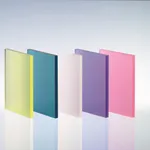
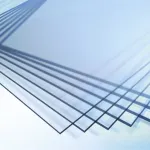
PCT-G plastic
PCT-G (polycyclohexylenedimethylene terephthalate glycol) stands out for its high impact strength, chemical resistance & optical clarity. More details.
PCT-G plastic combines high transparency with pronounced impact toughness, good chemical resistance and comparatively straightforward thermoplastic processing. The amorphous copolyester is particularly suitable for transparent components in which optical quality, break resistance and resistance to cleaning agents must be combined.
PCT-G plastic, often also referred to as PCTG plastic or PCT-G material, belongs to the group of transparent engineering copolyesters and is also searched for internationally under terms such as PCTG material or PCTG plastic.
Typical areas of application are found in medical technology, the food and packaging industry, equipment manufacturing and in electronics. Whether a particular PCT-G grade is approved for food contact, medical applications or a sterilisation process must, however, always be checked on the basis of the respective material data sheet and the required conformity documentation.
What is PCT-G?
PCT-G, often also written as PCTG, is a glycol-modified thermoplastic copolyester. The designation is derived from polycyclohexylenedimethylene terephthalate. The modification largely suppresses crystallisation of the polyester. This produces a predominantly amorphous material with high optical clarity and good processability.
Like PET and PET-G, PCT-G belongs to the group of polyesters. Compared with classic transparent plastics, the material positions itself above all through its combination of toughness, transparency, hydrolysis resistance and chemical resistance.
Properties of PCT-G plastic
| Property | Significance for the application |
|---|---|
| High transparency | Suitable for visible components, transparent housings, containers and covers |
| High impact toughness | Lower risk of breakage under mechanical load and impacts |
| Good chemical resistance | Depending on the grade, resistant to numerous cleaners, greases, oils and other media |
| Good hydrolysis resistance | Advantageous with repeated contact with moisture and aqueous media |
| Low processing shrinkage | Supports the production of dimensionally accurate injection-moulded parts |
| Good surface quality | Enables high-quality visible surfaces and optically demanding components |
| Thermoplastically processable | Suitable for injection moulding, extrusion and other processing methods |
Transparency and optical quality
PCT-G can achieve very high light transmission and low haze. The material is therefore suitable for components in which the contents, a display element or a technical process must remain visible. These include transparent housings, covers, laboratory items, containers and viewing windows.
The actual optical quality depends on the grade used, the wall thickness, the mould surface and the processing conditions. Colourants and functional additives can also influence transparency.
High impact toughness and break resistance
One of the most important properties of PCT-G is its high toughness. The material can absorb impact and shock loads without immediately fracturing in a brittle manner. This makes it interesting for components in which transparent plastics must simultaneously be mechanically load-bearing.
The good break resistance can be advantageous in particular for protective covers, housings, medical components and frequently handled containers.
Chemical resistance and low stress-cracking tendency
Depending on the material grade, PCT-G exhibits good resistance to numerous cleaning agents, disinfectants, oils, greases and aqueous solutions. Compared with some transparent plastics, the copolyester can also have a lower susceptibility to chemically induced stress cracks.
However, there is no unrestricted resistance to all solvents, acids or alkalis. The decisive factors are the specific chemical, its concentration, the exposure time, the temperature and the mechanical stress in the component. For critical applications, resistance tests under real service conditions should therefore be carried out.
Hydrolysis and moisture resistance
Suitable PCT-G grades have good hydrolysis stability. This is relevant above all in applications in which components come into repeated contact with water, cleaning liquids or increased humidity.
Before processing, however, the granules must still be dried in accordance with the manufacturer's specifications. Excessive residual moisture can lead to degradation of the polymer chains during melt processing and thus to a deterioration in the mechanical and optical properties.
Temperature resistance
PCT-G offers good heat deflection resistance for a transparent copolyester. The actually permissible continuous service and short-term temperature is, however, grade-dependent. It is also influenced by the component geometry, the mechanical load and the surrounding medium.
For components permanently subjected to high thermal loads, materials such as polycarbonate, polysulfone or other temperature-resistant engineering plastics may be more suitable. The material selection should therefore not be based solely on the maximum temperature, but on the complete requirement profile.
PCTG material and material designation
The spellings PCT-G, PCTG and PCT G refer in practice to the same material or the same copolyester family. In international data sheets and technical information, terms such as "PCTG material" or "PCTG plastic" are also found. For the specific application, however, the decisive factor is not the designation alone, but the respective material grade with its mechanical, thermal and chemical characteristic values.
Processing PCT-G
Injection moulding
PCT-G can be processed into transparent and intricately shaped components by injection moulding. The good flowability of suitable grades also enables filigree contours and comparatively thin wall thicknesses.
The low processing shrinkage supports good dimensional accuracy. For high-quality visible parts, in particular the material drying, melt temperature, mould temperature, venting and mould surface must be carefully coordinated.
Extrusion
By means of extrusion, suitable PCT-G grades can be used to produce, among other things, transparent sheets, films, profiles and other continuous semi-finished products. The process is particularly suitable for constant cross-sections and larger production volumes.
The exact processability depends on the viscosity and composition of the respective grade. Injection moulding and extrusion grades should therefore not be interchanged without technical testing.
Machining
Depending on the initial form, PCT-G semi-finished products and prefabricated components can be further processed by sawing, drilling, milling or other methods of plastic machining. Sharp tools and an adapted cutting action help to reduce heat input, chipping and stresses in the component.
With transparent parts, clean cut edges and machining that is as low-stress as possible are particularly important. Depending on the later use, additional finishing steps may be required.
Bonding, printing and joining
In principle, PCT-G can be bonded, printed and joined using suitable methods. The surface preparation and the choice of adhesive or printing system must be matched to the material grade used and the later load.
Particularly with solvent-containing adhesives, it must be checked whether stress cracks, haze or changes to the surface can occur. Component trials are therefore advisable before series production.
PCT-G compared with other transparent plastics
PCT-G or PET-G?
PCT-G and PET-G belong to the family of glycol-modified copolyesters and exhibit similar processing properties. PCT-G is often used when higher toughness, better heat deflection resistance or improved resistance to certain chemicals is required compared with a standard PET-G grade.
However, these advantages do not automatically apply to every material pairing. The properties sometimes differ significantly between individual grades and manufacturers. Specific data sheets and application-related tests should therefore be used for the selection.
PCT-G or polycarbonate?
Polycarbonate offers very high impact toughness and is available in numerous engineering grades. PCT-G, by contrast, can offer advantages in chemical resistance, hydrolysis stability, processing and stress-cracking resistance.
Polycarbonate is often the preferred solution when higher temperature resistance, special electrical properties or specific flame-retardant formulations are required. PCT-G is particularly interesting when transparency, chemical contact and high toughness are required together.
PCT-G or PMMA?
PMMA or acrylic glass offers excellent transparency, high light resistance and a comparatively hard surface. PCT-G is generally significantly tougher and less susceptible to breakage, but does not necessarily achieve the scratch resistance and long-term weather resistance of a suitable PMMA grade.
PCT-G can therefore be advantageous for protective covers and mechanically loaded visible parts. For optically particularly demanding outdoor applications, on the other hand, it must be checked whether PMMA or a specially UV-stabilised material is more suitable.
Areas of application for PCT-G
Medical technology and laboratory technology
In medical technology, PCT-G is used for transparent housings, liquid containers, laboratory items, filter housings and other components. The relevant factors here are in particular optical clarity, toughness, hydrolysis stability and resistance to selected cleaning and disinfecting agents.
Individual medical PCT-G or copolyester grades are designed for defined biological tests or sterilisation processes. However, there is no general medical approval of the material name PCT-G. Suitability must be demonstrated for the specific grade, the finished component and the intended application.
Food and packaging industry
Transparency, break resistance and a high-quality surface make PCT-G interesting for containers, packaging components, visible parts and reusable products. In the food industry, only material grades that meet the respectively required specifications for food contact may be used.
In addition to the fundamental material conformity, colourants, additives, processing conditions and the finished product must also be taken into account.
Electronics and equipment manufacturing
In the electronics industry, PCT-G can be used for transparent housings, control and display elements, covers and viewing windows. The material enables a combination of optical clarity and mechanical load-bearing capacity.
If special requirements are placed on flame retardancy, electrical characteristic values or high continuous temperatures, a correspondingly equipped and tested grade must be selected.
Mechanical and plant engineering
In mechanical and plant engineering, PCT-G is suitable, among other things, for transparent protective covers, inspection windows, containers and housing components. Compared with more brittle transparent materials, the high toughness can reduce the risk of breakage damage.
For safety-relevant protective covers, not only the material but also the wall thickness, fastening, possible impact energies and applicable standards must be included in the design.
Advantages and limits of PCT-G
Advantages
- High transparency and low haze
- Very good impact toughness and break resistance
- Good hydrolysis stability
- Resistance to many cleaning and operating media
- Low processing shrinkage
- Good processability in injection moulding and extrusion
- High-quality surfaces for visible components
- Depending on the grade, available for medical applications or food contact
Limits
- Lower scratch resistance than some transparent comparison materials
- Not resistant to all solvents, acids and alkalis
- Temperature resistance strongly dependent on the respective grade
- Material must be carefully dried before melt processing
- Food and medical conformity applies only to correspondingly tested grades
- Long-term UV and weather resistance must be tested on an application-specific basis
When is PCT-G the right material?
PCT-G is a suitable material solution when a transparent component must simultaneously be impact-tough, chemically resistant and capable of being processed to a high quality. The copolyester is particularly interesting for medical components, laboratory items, packaging, transparent housings and protective and visible components.
The selection should always be based on the specific operating conditions. These include temperature, mechanical load, chemical contact, sterilisation processes, optical requirements and necessary approvals. Martan Plastics supports you in selecting suitable plastics and in implementing custom plastic semi-finished products and finished parts.
Frequently asked questions about PCT-G plastic
Is PCT-G transparent?
Yes, PCT-G is an amorphous copolyester which, in suitable grades, achieves high light transmission and very low haze. It is therefore suitable for transparent housings, containers and visible components.
Is PCT-G food-safe?
Not every PCT-G grade is automatically approved for food contact. There are correspondingly compliant grades whose suitability must be checked on the basis of the manufacturer's documentation and the regulations applicable to the end product.
Can PCT-G be sterilised?
Certain medical copolyester grades are suitable for defined processes such as ethylene oxide or gamma radiation sterilisation. Other processes, temperatures or repeated sterilisation cycles can stress the material. The information on the specific material grade is therefore decisive.
Is PCT-G chemically resistant?
PCT-G has good resistance to many cleaning agents, oils, greases and aqueous media. However, the compatibility with a specific chemical depends on concentration, temperature, exposure time and component stress.
What is the difference between PCT-G and PET-G?
Both materials are transparent copolyesters. Depending on the respective grade, PCT-G can offer higher impact toughness, heat deflection resistance or chemical resistance. A reliable comparison is only possible on the basis of the specific material data.
Can PCT-G be machined?
Yes, PCT-G can in principle be sawed, drilled and milled. For clean surfaces and low-stress components, tools, cutting speed and cooling must be adapted to the material.
Are PCT, PCT-G and PCTG the same?
PCT-G and PCTG are different spellings for the glycol-modified copolyester. The shortened designation PCT plastic is sometimes also used, but is less unambiguous in materials terms. For material selection, it should therefore always be checked which specific PCT-G or PCTG grade is meant.