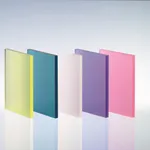
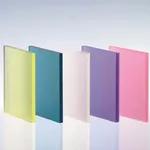
Acrylic glass cut to size
Acrylic sheet cut to size Acrylic cutting Acrylic buy Acrylic sheet Acrylic bonding Acrylic disc Acrylic laser cutting CO2 laser cutting
Our acrylic glass sheets (also known as PMMA) made from weather-resistant, transparent plastic consist of solid material with protective film on both sides, which we will gladly cut/laser to your desired dimensions at fair prices and deliver.
Acrylic glass is weather-resistant and waterproof and is equally suitable for indoor and outdoor applications.
- Acrylic glass is resistant to UV, weathering and ageing, while being comparatively scratch-resistant
- Acrylic glass is a transparent plastic with higher light transmission than glass
- Acrylic glass is eminently suitable for glazing in display construction or furniture construction.
Buying acrylic glass (PMMA) cut pieces is child's play thanks to the cut-to-size configurator from S-. Simply select the desired thickness of your acrylic glass sheet and enter the required dimensions for length and width in millimetres (not centimetres).
The price calculation is carried out immediately after your entry and automatically takes quantity discounts into account, so that depending on the total weight you always receive the most favourable price for you.
Thanks to high material stockholding for our standard delivery programme and fully automated workflows, we are able to offer you particularly favourable prices for your plastic sheets made of acrylic glass cut to size.
The cutting is carried out on one of our computer-controlled panel saws for horizontal cutting with a very low sawing tolerance of just +/-1mm. You only pay for what you order. Thanks to complex offcut optimisation and warehousing, remnants are used for further cuts and are therefore not charged to you.
This too has an effect on the favourable price for our acrylic glass sheets cut to size.
Transparent acrylic glass sheets cut to size
White acrylic glass sheets in opal finish cut to size
Transparent acrylic glass sheets individually laser-cut
Extruded acrylic glass sheets in transparent as standard sheet 3050×2050 mm
Cast acrylic glass sheets in transparent as standard sheet 3050×2050 mm
White acrylic glass sheets in opal finish as standard sheet 3050×2050 mm
White acrylic glass sheets in satin finish as standard sheet 3050×2050 mm
White acrylic glass sheets in opaque finish as standard sheet 3050x 2050 mm
Coloured acrylic glass sheets in opal finish as standard sheet 3050×2050 mm
Coloured acrylic glass sheets in satin finish as standard sheet 3050×2050 mm
Coloured acrylic glass sheets in opaque finish as standard sheet 3050x 2050 mm
Coloured acrylic glass sheets in fluorescent finish as standard sheet 3050x 2050 mm
Tinted acrylic glass sheets in neutral grey tones in transparent finish as standard sheet
Opaque acrylic glass sheets in opaque finish with metallic effect as standard sheet etc.
Just as simple as our conventional acrylic glass cut pieces is the configuration of individual laser parts made of acrylic glass with our laser part configurator. The most common basic shapes are available to you as a preselection, which you can further adapt entirely to your needs depending on the shape. Even drilled holes are placed in no time at all with just a few mouse clicks.
Even more individual? On request, laser parts according to your drawing or laser engravings are also possible. We will gladly advise you comprehensively on the possibilities that we can offer you with our laser service. Simply call us, or send us an email with your enquiry to info@martan.de
Individual milled parts and laser parts made of acrylic glass (PMMA)
Would you like individual shapes made of acrylic glass that are not possible with our laser part configurator because you either require larger dimensions or greater thicknesses?
With our milling service that is no problem at all. With our modern milling centres we are able to produce milled parts up to a maximum format of 3500x1600x80 mm.
In addition, with our 3-axis milling machines we are also able to carry out recesses, countersinks or relief milling. Chamfering (i.e. rounding or bevelling) of cut edges is also possible with our milling service.
Due to the multitude of possibilities, our milling service is currently only available on request. Simply send us your requirements with a construction drawing and tell us the desired quantity, as well as thickness and finish of the acrylic glass sheets. Our experienced sales staff will contact you as soon as possible to provide you with a tailor-made, free quotation.
Delivery & packaging of your acrylic glass sheets
Acrylic glass (PMMA) sheets ordered via our online shop are as a rule cut to the size you ordered and dispatched on the next working day. Depending on the dimensions and total weight of your order, delivery is made either with a parcel service or by freight forwarder on a pallet.
You can see how your sheets will be dispatched in the shopping basket. As soon as your order has been prepared for dispatch, you will receive an email with a tracking number from DHL.
Before packaging, all acrylic glass cut pieces and laser parts are checked for cut edge quality and dimensional accuracy. Your order is then wrapped in recyclable bubble wrap to protect it against transport damage and packed and dispatched with an outer packaging made of sturdy cardboard from recycled paper.
Please dispose of the bubble wrap as well as the strapping tape via the recycling bag or the recycling bin. Please dispose of the cardboard via your paper bin so that it can be recycled again.
Info: Acrylic glass (PMMA) cut to size or as a standard sheet is always supplied with protective film on both sides to protect the surfaces. However, this can easily be removed after processing is complete.
PMMA sheets in use
Acrylic glass is an extremely versatile plastic. Thanks to its UV and weather resistance, it can be used both for indoor applications and for areas of use outdoors. The plastic sheets are considered waterproof and do not rot on contact with water, not even with permanent use in contact with water (or under water).
In the construction industry, acrylic glass is used predominantly as balcony edging or as a light-transmitting privacy screen for balcony partitions.
Among window manufacturers, the lightweight, scratch-resistant plastic is quite often used for patio roofs. In gardening and landscaping, acrylic glass sheets are particularly popular as plastic glazing for greenhouses or garden sheds.
In the automotive industry, acrylic glass is indispensable, as PMMA can be found in virtually every vehicle. Be it as a glass pane for the instrument cluster, as a pane for the touch panel in modern cars. Headlight housings as thermoformed parts, rear lights, indicator lights or plastic panes in lightweight construction (e.g. on some hard tops of convertibles) are partly made from acrylic glass. On caravans or motorhomes, even almost all windows and roof hatches (often called HeKis) consist of double-glazed acrylic glass.
The advertising industry also very gladly makes use of the ease of processing. As a small advertising display for new products, brochures, flyers and business cards, as advertising signs with printing or engraving, as illuminated displays right through to large illuminated letters on company buildings. Even for the effective impact of indirect lighting within shops and retail premises, acrylic glass is put to sensible use by the advertising industry.
Typical examples of the use of acrylic glass
- As a glass replacement with reduced weight for greenhouses, patio roofs and carports
- In the automotive sector for headlight housings, rear lights or instrument covers
- In mechanical engineering as transparent viewing windows and covers for machines and production lines
- As an aquarium or terrarium right through to large-area viewing areas of tank facilities in zoos
- As advertising signs with laser engraving or as illuminated objects in the advertising industry
- and many more besides
What is acrylic glass PMMA?
Acrylic glass is a plastic that is distinguished by very high transparency and very good light transmission. Furthermore, acrylic glass is a waterproof and weather-resistant plastic that is suitable for indoor and outdoor applications. It is therefore frequently used as a transparent plastic pane as a glass replacement. In its natural form, acrylic glass is UV-resistant and thus has the advantage that even permanent UV radiation does not cause the plastic to fade, yellow or become brittle. In addition, up to 98% of UV radiation is blocked by the acrylic glass, so that the ultraviolet radiation does not penetrate the plastic pane. An extremely relevant plus point for glazing of patio roofs, because in this way the patio furniture beneath is also protected from the effect of UV rays.
Acrylic glass, whose chemical name is polymethyl methacrylate, is often also referred to by the chemical abbreviation PMMA. This plastic is obtained by the polymerisation of sulphuric acid, hydrocyanic acid, methanol and acetone. Each individual one of these constituents is harmful to health in itself, but through polymerisation a crystal-clear, transparent and above all health-safe plastic is created that serves predominantly as a synthetically produced glass replacement.
The development of acrylic glass goes back to the first half of the last century. This plastic has thus existed since 1928 and was developed among others by the German company Röhm GmbH, which to this day sells acrylic glass under the brand name Plexiglas®. For this reason, the media and normal linguistic usage often speak of Plexiglas® when acrylic glass is meant. Similar to tissues, however, there are very many other trade names from various manufacturers under which acrylic glass is offered on the market. Brand names such as Acriglas®, Altuglas®, Apex®, Deglas®, Perspex® Plexiglas®, Senocryl®, Tecacryl® are all synonymous with the plastic polymethyl methacrylate and thus exhibit the typical properties of acrylic glass, which differ only insignificantly depending on the manufacturer.
Properties of acrylic glass PMMA
In its natural form, acrylic glass is highly transparent and emits light better than conventional glass. The light transmission is an incredible 92% for transparent acrylic glass. That of real glass is only between 85% and 90% depending on the thickness of the glass pane. The greatest advantage in direct comparison, however, lies in the weight saving, because acrylic glass weighs only about half for the same dimensions and the same thickness. As a result, it is an ideal and cost-effective replacement particularly for glazing where the structural design does not permit a high weight.
As a genuine glass replacement, use outdoors is essential. Thanks to its UV and weather resistance, acrylic glass fulfils these requirements without further ado. The temperature application ranges of acrylic glass also do not restrict this plastic for use outdoors. It is frost-stable and can be used for low temperatures of down to -40°C. Even permanent temperatures of up to +80°C are no problem for acrylic glass sheets.
Thanks to the high surface hardness, acrylic glass sheets are considered, in contrast to most other plastics, to be particularly resistant to scratching. Through special surface coatings, the scratch resistance can moreover be increased still further. However, such additional surface finishing can have a negative effect on bondability with solvent-based adhesives, because these cannot penetrate through the coating in order to soften the plastic for effective bonding.
A further plus point is thermal formability. Acrylic glass is a thermoplastic and as such can be brought into virtually any desired shape without difficulty by thermoforming. With real glass this is only possible at very high temperatures and in complex work steps, which not least has an effect on the cost of production.
- Physical density: approx. 1.19 g/cm³ (depending on the finish)
- Service temperatures: -40 °C to +80 °C
- Fire behaviour: DIN 4102 B2 (normally flammable)
- UV resistance: Yes
- Weather resistance: Yes
- Water resistance: Yes
- Light transmission: approx. 92% (transparent acrylic glass)
- Refractive index: approx. 1.49 (transparent acrylic glass)
Processing of acrylic glass sheets
Acrylic glass PMMA cutting sawing CO2 lasering bending polishing thermoforming
Acrylic glass can be cut to size in a variety of ways. The simplest is cutting to size with a saw and a saw blade with medium toothing at medium speed, as is done on our panel saws for our acrylic glass sheets cut to size. For straight cuts, a hand-held circular saw with a fence or a table circular saw is most suitable. Radii and curved cuts are better achieved with a handy jigsaw.
For milling with a CNC milling machine, a simple milling cutter for metalworking can be used. Here too, the speed should not be selected too high in order to prevent the removed chip from fusing with the cut edge. The feed of the milling head should, depending on the sheet thickness, be in the medium speed range.
Especially with transparent acrylic glass sheets, laser cutting is an excellent method for cutting acrylic glass to the desired size. The greatest advantage of laser cutting lies in the appearance of the cut edge. While material-removing methods such as sawing or milling usually produce a more or less rough, cloudy cut edge, the cut edge appears polished and smooth as a result of contactless cutting with a laser. This affects first and foremost the transparency of the cut edge. The power and speed of the laser depend on many factors. Among other things, it is crucial whether the acrylic glass sheets are cast or extruded. The sheet thickness, as well as the power of the laser unit used, also affect the cutting speed and quality of the cut edge.
Waterjet cutting offers comparable results with regard to cut quality and flexibility as laser cutting, but as a rule can only be implemented without problems for larger sheet formats, since the pressure of the water jet can under certain circumstances result in the acrylic glass sheet shifting or bending.
The least safe method, which is only suitable for small thicknesses, is breaking acrylic glass sheets. Here the cut edges are scored with a scribing tool or a sharp knife and then broken over the edge. However, the risk that the break point does not deliver the desired result is quite high, so we rather do not recommend this method and mention it only for the sake of completeness.
TIP: It is better to buy your acrylic glass sheets directly cut to size at best prices in our online shop or simply send an enquiry.
Drilling acrylic glass
For drilling acrylic glass, a simple cordless screwdriver with a sharp metal drill bit is sufficient. When drilling holes, however, it should be noted that the sheets should rest on a firm, flat surface and the sheet must not wobble, in order to avoid chipping at the drilled holes or cracks in the sheet. Do not exert any pressure on the drill bit. A medium speed of the cordless screwdriver leads to the best results. Too high speeds can lead to too high a temperature, which can bring about a fusing of the drill chip with the drilled hole. Too low speeds can cause chipping and splintering at the edges of the drilled holes.
Installing acrylic glass
The installation of acrylic glass sheets for patio roofs, carports or as balcony privacy screens is carried out in a similar manner to the installation of sheets made of conventional glass. Particularly when screwing the plastic sheets, care should be taken that the screws are not tightened too firmly, because otherwise the sheets can break out at the drilled holes. If the sheets are used as a glass replacement for roofs or as shelf inserts in cupboards or display cabinets, a corresponding thickness must be selected depending on the load-bearing capacity or load. Put simply, the rule is – the lower the thickness, the lower the load-bearing capacity of the sheet. It is important here that it is not the plastic sheet itself but the substructure that is responsible for the load-bearing capacity.
For wall mounting, suitable mounting material should always be used that is able to bear the weight of the sheet. The weight of the acrylic glass sheets depends on the thickness and size of the cut pieces and is displayed to you during the configuration of your acrylic glass sheets cut to size below the price. For information on the load capacity of the screws and wall plugs, please ask the respective manufacturers.
Bonding acrylic glass is very simple. Simple solvent-based adhesives, as well as silicones, MS polymers or even hot glue, are conceivable as suitable adhesives for this. Before bonding our acrylic glass sheets, the protective film should be removed at the points to be bonded.
Both acrylic glass with acrylic glass and acrylic glass with other plastics. After the adhesive has cured, the bond points are firmly and securely welded to one another and, if applied correctly, absolutely waterproof. In this way, for example, terrariums or aquariums can also be bonded, in that the sheets are welded at the bond points. Furthermore, after curing has taken place, the adhesive has completely evaporated, so that this does not have a negative effect on the recyclability of the plastic.
Note: Thermoformed parts or laser-cut acrylic glass cannot be bonded with solvent-based adhesives, as this leads to stress cracks.
Thermoforming acrylic glass
As a thermoplastic plastic, acrylic glass can be thermally formed excellently. Through thermoforming, acrylic glass can thus be brought into virtually any desired shape, which is permanently retained after cooling.
For thermoforming, temperatures of between 150°C and 190°C are recommended. The heating duration depends on the total thickness of the acrylic glass sheet. For simple folds or bending around a radius, lower temperatures achieved by heating with a hot air gun can already deliver the desired result. Since PMMA draws moisture from the environment, the sheets should be pre-dried before thermoforming. In addition, the protective film must be removed before thermoforming, as it is not thermoformable.
Cleaning acrylic glass
Acrylic glass is best cleaned with a soft cloth and a neutral cleaner.
Even if the surface of acrylic glass sheets is quite resistant to scratching, the use of microfibre cloths or scouring sponges should be avoided, because these can nevertheless leave fine scratches on the very smooth surface. The low chemical resistance of PMMA to solvents can, when using harsh cleaners, particularly if these are based on alcohol or solvents, lead to stress cracks at edges and surfaces. This can lead to stress fracture and thus render the sheet unusable. We therefore strongly advise against the use of such cleaning agents and recommend lukewarm water and neutral household cleaners or soap-containing washing-up liquids instead.
Stubborn soiling can be removed with solvent-free white spirit or the like. Here too, urgent care should be taken that a soft cleaning cloth is used in order to avoid scratches.
Environmental compatibility of acrylic glass
Acrylic glass can be fully recycled in various ways. If this plastic is separated by type, new acrylic glass sheets can be produced from the plastic waste. In order to produce transparent plastic sheets from recycled material, however, acrylic glass must also be sorted by colour and filtered in a complex process. Even small quantities of coloured or opal offcut remnants can impair the transparency or colour of the recycled sheets.