PEEK Materials Science
PEEK material science explained: structure, mechanical and thermal properties, chemical resistance, processing and areas of application.
PEEK (polyetheretherketone) is a semi-crystalline thermoplastic high-performance plastic from the polyaryletherketone (PAEK) family. Its molecular structure combines high temperature resistance with mechanical strength, low creep tendency and high resistance to numerous chemicals.
This PEEK materials science guide explains how structure and crystallinity influence the properties of the material, which thermal and mechanical characteristic values are relevant for design, and what should be taken into account in processing and material selection.
Further information on available grades, cut pieces and technical characteristic values can be found on our page on PEEK plastic.
Structure and morphology of PEEK
PEEK is a semi-crystalline representative of the polyaryletherketones (PAEK). Two structural features determine the behaviour of the material:
- Crystalline regions provide stiffness, hardness and high temperature resistance.
- Amorphous regions contribute to toughness and controlled deformability.
The high degree of crystallinity gives PEEK its remarkable dimensional stability. Even under temperature changes and continuous mechanical load, the material remains dimensionally stable – a decisive advantage for precision components.
The ratio between crystalline and amorphous regions is influenced, among other things, by processing and cooling conditions. Crystallisation therefore has a direct effect on properties such as stiffness, dimensional stability and thermal behaviour.
Two characteristic temperature ranges are particularly relevant in materials science: the glass transition temperature of PEEK is approximately in the range of 143 to 145 °C, the melting temperature at around 340 to 343 °C. The specific values can vary depending on material type, modification and test method.
This combination of semi-crystalline structure and high melting temperature is one of the reasons why PEEK can also be used under demanding thermal conditions.
Mechanical properties
The most important characteristic values include:
- high tensile strength
- very good flexural and compressive strength
- low creep tendency
- high impact toughness
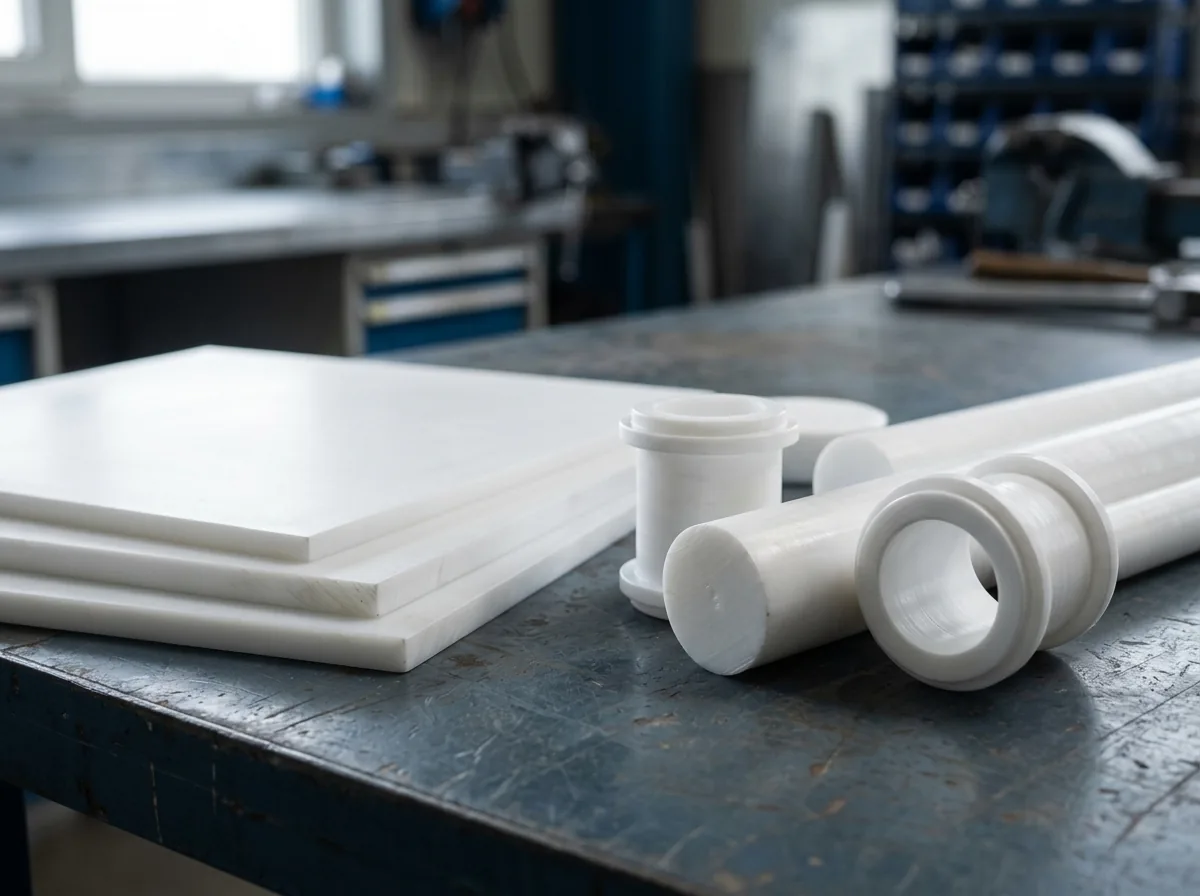
These properties make PEEK an alternative to metals – especially where weight is to be reduced. Semi-finished products such as sheets and rods are provided via thermoplastic plastic semi-finished products and serve as the starting basis for precise milled and turned parts.
Further classification is offered by the article High-performance plastics – the future in mechanical engineering, which assesses PEEK in comparison with other materials.
Thermal resistance
PEEK can withstand continuous temperatures of around 250 °C. Short-term temperatures above 300 °C are possible. Thanks to the rigid molecular chain and the crystalline structure, the material hardly loses any strength even under continuous heat.
A technical comparison within the high-performance plastics can be found in the article PEEK vs. PPS vs. PSU.
Chemical resistance
PEEK is resistant to:
- acids and alkalis
- fuels
- solvents
- hydraulic oils
- cleaning agents
This makes it suitable for environments with aggressive media – particularly in plant and process engineering. In addition, the article Chemical resistance provides a broader overview.
For detailed material comparisons, the article PEEK or PTFE – chemical resistance is also recommended.
Tribology: friction, abrasion and wear
PEEK possesses excellent tribological properties. Particularly low friction coefficients and high abrasion resistance make it ideal for:
- bearings
- sliding guides
- rails
- sealing rings
A more in-depth consideration of friction mechanics is offered by the article wear-resistant plastics.
Processing of PEEK
Extrusion
Extrusion produces rods, sheets and tubes – a typical starting point for CNC machining. Further information is provided by the page on extrusion technologies.
CNC machining
Complex geometries can be precisely machined. Particularly relevant are:
The article Plastic machining – which processes? helps with the selection of suitable processes.
Injection moulding
For high volumes, PEEK is processed by injection moulding. Due to extremely high melting temperatures, specialised machines are necessary for this.
Additional guidance is offered by the article Material selection for high-performance plastics.
Limits of the material
Despite many advantages, PEEK has clear limitations:
- high price compared with standard engineering plastics
- high energy requirement during processing
- limited bondability without pre-treatment
- anisotropic properties with non-optimised crystallisation
However, these limits are often acceptable when weight saving, temperature stability or chemical resistance are the priority.
Industrial fields of application
PEEK is used in numerous key industries:
- mechanical engineering
- aerospace
- medical technology
- electronics and sensor technology
- defence industry
The combination of temperature stability, strength and resistance makes the material extremely versatile.
FAQ
What makes PEEK unique? The combination of high temperature resistance, mechanical performance and chemical resistance is rarely found to this extent.
Is PEEK easy to machine? Yes – with the use of suitable tools and parameters, highly precise parts can be produced.
Can PEEK replace metal? In many cases yes, especially when weight is to be reduced or corrosion is a problem.
Which semi-finished products are available? Sheets, rods and tubes made from extruded material are typical.