PEEK vs. PTFE: The best materials for chemical resistance compared
PEEK or PTFE? Find out which plastic offers the best chemical resistance – comparison, properties & applications.
When selecting engineering plastics for use in chemically demanding environments, many engineers, buyers and designers come up against the question: PEEK or PTFE? Both materials are considered particularly resistant to chemicals – but which properties really distinguish them? And which material is better suited to your application?
What is chemical resistance?
Chemical resistance describes a material's ability to withstand aggressive substances such as acids, bases, solvents or fermenting media without decomposing or losing its properties. This property is crucial, particularly in chemical engineering, medical technology, the food industry and electronics.
Properties of PEEK
Polyetheretherketone (PEEK) is a high-performance plastic, distinguished by the following characteristics:
- Very high temperature resistance (up to approx. 250 °C)
- Excellent mechanical strength
- Good dimensional stability
- High resistance to hydrolysis and chemicals
- Very good radiation and abrasion resistance
Chemical resistance of PEEK: PEEK is resistant to many organic and inorganic chemicals, including concentrated acids, alkalis, ketones, esters and aliphatic hydrocarbons. However, PEEK shows weaknesses against strongly oxidising acids such as nitric acid.
Properties of PTFE
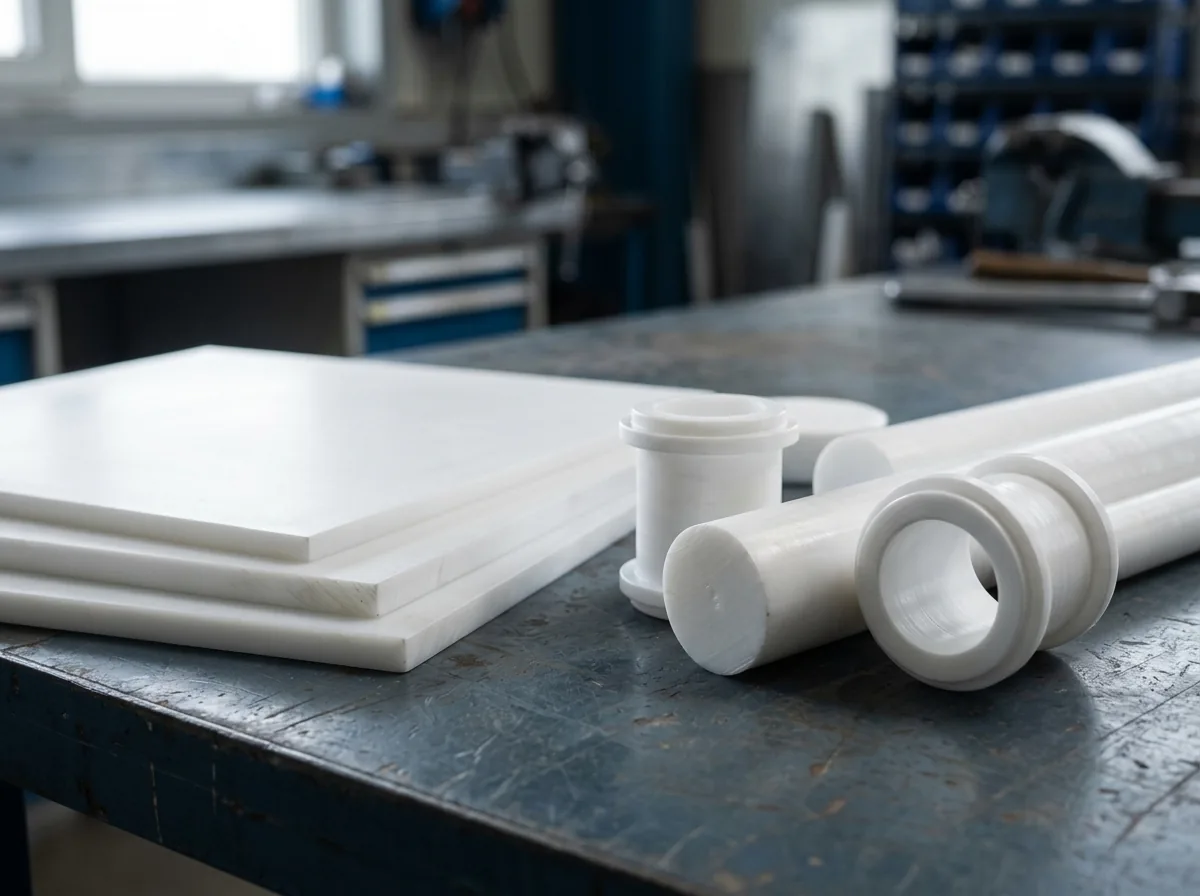
Polytetrafluoroethylene (PTFE), better known under the trade name Teflon®, is a fluoropolymer with the following properties:
- Outstanding chemical resistance (almost universally resistant)
- Extremely low coefficient of friction
- Service temperatures up to approx. 260 °C
- Excellent electrical insulation properties
- Low mechanical strength
Chemical resistance of PTFE: PTFE is considered one of the most chemical-resistant plastics of all. It withstands almost all industrially used chemicals, including hydrogen fluoride, concentrated acids and bases, as well as aggressive solvents. The only exceptions are molten alkali metals and elemental fluorine at high temperatures.
PEEK vs. PTFE: a direct comparison
| Property | PEEK | PTFE |
|---|---|---|
| Chemical resistance | Very good, but not universal | Almost universally resistant |
| Temperature resistance | up to approx. 250 °C | up to approx. 260 °C |
| Mechanical strength | Very high | Rather low |
| Abrasion resistance | High | Low |
| Coefficient of friction | Medium | Very low |
| Machinability | Demanding | Relatively easy |
Which material for which application?
PEEK is particularly suitable when...
- high mechanical loads occur
- a long-lasting component in an aggressive environment is required
- a combination of chemical and temperature resistance is necessary
PTFE is ideal when...
- maximum chemical resistance is the top priority
- good sliding properties matter
- the mechanical load is low
Conclusion: PEEK or PTFE?
The decision PEEK vs. PTFE ultimately depends on the specific application. Both materials impress with excellent chemical resistance, but with different strengths. While PTFE is hard to beat on universal resistance, PEEK scores with mechanical strength and temperature resilience. Anyone wishing to combine both should examine the requirements in detail or seek advice.
FAQ
Which chemicals is PEEK not resistant to?
Strongly oxidising substances such as concentrated nitric acid or sulphuric acid can attack PEEK.
Is PTFE more expensive than PEEK?
No, as a rule PTFE is significantly cheaper. The more complex production and the high performance capability make PEEK a premium material.
Can PEEK and PTFE be combined?
In some designs both materials are combined, e.g. PTFE as a coating on a PEEK carrier, in order to utilise the advantages of both materials.