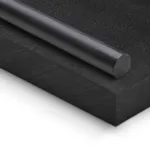
High-temperature plastics
High-temperature plastics such as PEEK, PPS, PEI and PAI as semi-finished products and finished parts. Material selection and machining by Martan Plastics.
High-temperature plastics are designed for applications in which conventional engineering plastics reach their limits due to permanently elevated temperatures, mechanical loads or aggressive media.
Martan Plastics supplies temperature-resistant plastics as semi-finished products, cut pieces and individually machined finished parts. We support you in selecting a suitable material for your specific operating conditions.
What are high-temperature plastics?
High-temperature plastics are thermally particularly resilient materials that largely retain their mechanical and chemical properties even at elevated service temperatures.
The high-temperature plastics frequently used include PEEK, PPS, PEI, PAI, polyimides, PES, PPSU and PSU.
Properties of high-temperature-resistant plastics
Depending on the respective material, high-temperature plastics offer the following properties:
- High temperature resistance: suitable for permanently elevated service temperatures
- Mechanical strength: high stiffness and load-bearing capacity
- Dimensional stability: low deformation under temperature changes
- Chemical resistance: resistant to numerous aggressive media
- Wear resistance: suitable for moving and mechanically stressed components
- Electrical insulation: good electrical properties in selected materials
- Low weight: lower density than many metallic materials
High-temperature plastics in comparison
| Material | Typical properties | Typical applications |
|---|---|---|
| PEEK | High temperature resistance, strength and chemical resistance | Mechanical engineering, medical technology and semiconductor technology |
| PPS | Low water absorption, high dimensional accuracy and media resistance | Pump components, housings and electrical components |
| PEI | High stiffness, good electrical properties and flame retardancy | Electrical engineering, aviation and technical housings |
| PAI | Very high strength, wear resistance and dimensional stability | Bearings, seals and precision components |
| Polyimide | Very high thermal stability and good electrical insulation | Electronics, vacuum technology and semiconductor industry |
| PPSU | High impact strength, hydrolysis resistance and sterilizability | Medical technology and healthcare |
The actual suitability depends on the material quality, the duration of load and the specific operating conditions.
Manufacturing processes
Depending on the material and component, high-temperature plastics are processed by different methods. Typical processes are:
- injection moulding
- extrusion
- pressing
- sintering
- machining
- additive manufacturing
The choice depends on, among other things, material, geometry, tolerances and quantity.
Temperature-resistant plastics at a glance
The permissible service temperature always depends on the specific material quality, the duration of load and the ambient conditions. Nevertheless, high-temperature plastics can be roughly classified according to their thermal application range.
| Material | Typical thermal application range | Special features |
|---|---|---|
| PEEK | up to about 250 °C | high strength and chemical resistance |
| PPS | up to about 220 °C | very low water absorption and high dimensional accuracy |
| PEI | up to about 170 °C | high stiffness and good electrical properties |
| PAI | up to about 260 °C | very high strength and wear resistance |
| Polyimide | depending on grade up to about 300 °C and above | very high thermal stability |
| PPSU | up to about 180 °C | high impact strength and good hydrolysis resistance |
| PSU | up to about 160 °C | good dimensional stability and electrical properties |
For applications above 200 °C, PEEK, PPS, PAI and polyimides in particular come into consideration. At temperatures around 300 °C, the selection is considerably more limited and must always be checked on the basis of the specific continuous load, mechanical stress and ambient conditions.
Which plastic is heat-resistant up to 300 °C?
For service temperatures up to about 300 °C, special polyimides and selected high-temperature materials in particular come into consideration. The decisive factor is whether the temperature is reached continuously or only briefly. In addition, mechanical load, chemical contact and the component geometry influence the actual suitability.
High-temperature plastics or high-performance plastics?
The terms are closely related but not entirely synonymous. High-temperature plastics are selected in particular for their thermal resilience.
High-performance plastics can additionally offer special mechanical, chemical, electrical or tribological properties. Many high-temperature plastics are therefore also among the high-performance plastics.
Further information can be found on our page on high-performance plastics.
Which high-temperature plastic is suitable?
The selection must not be made solely on the basis of the maximum temperature. The interaction of all operating conditions is decisive.
| Requirement | Important selection criteria |
|---|---|
| Thermal load | Continuous service temperature, peak temperature and duration of load |
| Mechanical load | Pressure, tension, bending, impact load and creep behaviour |
| Chemical contact | Medium, concentration, temperature and contact duration |
| Friction and wear | Sliding partner, speed, surface pressure and lubrication |
| Dimensional accuracy | Thermal expansion, water absorption and required tolerances |
| Electrical requirements | Insulation capability, dielectric strength and flame retardancy |
Delivery forms and machining
Depending on the material, high-temperature plastics are available as sheets, rods, tubes, profiles and other plastic semi-finished products.
Martan Plastics manufactures individual components from these to drawing or technical specifications. Possible processes include CNC milling, CNC turning, drilling and waterjet cutting.
Further information can be found in the plastic machining section.
Application areas of high-temperature plastics
High-temperature-resistant plastics are used wherever components must remain reliable and dimensionally accurate even under thermal load.
- bearings, guides and wear-stressed machine parts
- seals, valve seats and pump components
- electrical insulators and connectors
- components for furnaces, drying systems and hot gas areas
- components for cleanroom and semiconductor systems
- sterilizable components for medical applications
- lightweight replacement parts for metallic components
Mechanical and plant engineering
In mechanical and plant engineering, high-temperature plastics are used for bearings, guides, seals and structural components.
Electrical industry and electronics
In the electrical industry, temperature resistance, electrical insulation, dimensional stability and flame retardancy are particularly relevant.
Semiconductor and cleanroom technology
In the semiconductor industry, materials with high purity, low outgassing and good resistance to chemicals and temperatures are used.
Medical technology
For medical technology, selected temperature-resistant materials are available that enable repeated cleaning and sterilization processes.
Aerospace
In aerospace, high-temperature plastics enable lightweight and thermally resilient components.
High-temperature plastics from Martan Plastics
Martan Plastics supplies high-temperature plastics as semi-finished products, cut pieces and machined finished parts. We support you in selecting a material that matches the thermal, mechanical and chemical requirements of your application.
For a technical review, we need the most precise possible details on:
- continuous and peak temperature
- duration of load
- mechanical stress
- contact with chemicals or media
- dimensions and tolerances
- desired quantity
Send us your drawing or technical requirements. Together we will check which high-temperature plastic is suitable for your application.