Hard-coated polycarbonate sheets in practice
How hard-coated polycarbonate sheets perform in the field: test methods, scratch and chemical resistance, service life and specification tips.
Hard-coated polycarbonate sheets in practice: definition and application profile
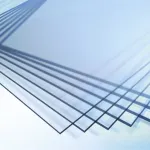
Hard-coated polycarbonate sheets are transparent or translucent sheets made of polycarbonate whose surface is finished with a hard, usually inorganic-organic coating. The aim is a significantly increased resistance to abrasion, scratching and chemicals while retaining the high impact strength of the base material. Typical applications are protective glazing, machine enclosures, control panels, luminaire covers, vehicle glazing and architectural elements.
The material core determines toughness and heat deflection resistance, the hard coating controls optics and surface function. For a well-founded preliminary selection you will find material data on polycarbonate under Polycarbonate, and industry-relevant applications for example in Transport engineering.
Material structure and coating systems
Structure of the hard coating
Hard coatings on polycarbonate often consist of a primer layer for adhesion, an inorganic-organic hardcoat layer based on siloxane or acrylate and optionally a topcoat for additional functions such as antifog or anti smudge. The layer thickness is typically in the range of about 3 to 15 µm in practice. Curing takes place thermally or by UV, depending on the system. Adhesion to the PC surface is decisive, as it determines the resistance to delamination under climatic and media exposure.
Optical and mechanical parameters
The coating changes optical parameters only slightly, but delivers clear gains in surface hardness and abrasion resistance. Important parameters for the specification are:
- Light transmission in percent, mostly 85 to 90 for clear sheets, comparable to uncoated PC.
- Haze as the degree of turbidity, the aim being low initial values and a small increase in the abrasion test.
- Surface hardness by pencil hardness or instrumented scratch test.
- Adhesion of the layer by cross-cut, ideally class 0 to 1.
Side marking and UV function
For outdoor applications, the UV-exposed side is often produced with a UV-absorbing layer. A permanent side marking prevents installation errors. Background knowledge on weather resistance can be found in the articles High-performance plastics outdoors and Resistance to UV radiation.
Performance change over the life cycle
Influencing factors in the field
Performance development over time is determined by several factors: micro-abrasion from cleaning, dust and sand, localised scratches from hard particles, chemical contact during disinfection or vandalism, UV irradiation as well as thermal and climatic cycles. In addition, mechanical stresses from installation, cold bending or thermal expansion act as drivers for stress cracks at unprotected edges.
Measurable drift variables
It is practical to specify defined limit values for ageing and use. Typical, realistic target values for high-quality hard coatings are:
- Taber abrasion ΔHaze after 100 cycles CS 10F, 500 g load: ≤ 5 to 10 percent depending on application.
- Pencil hardness according to ASTM D3363: 3H to 6H, depending on system.
- Cross-cut adhesion ISO 2409: class 0 to 1 before and after climate change tests.
- UV weathering ISO 4892, 1000 to 3000 h: yellowness index and transmission within the agreed window, no delamination or cracking.
Test and approval methods
Standardised test methods are decisive for the comparability of quotations and for acceptance at goods receipt. Methodological principles and test planning are covered in more depth in the articles Hardness testing methods, reliable results in plastics testing as well as the overview on plastics testing and on chemical resistance.
| Test objective | Standard/method | Measured variable | Practical guide value |
|---|---|---|---|
| Abrasion | ASTM D1044 or D4060, Taber CS 10F | ΔHaze in percent after n cycles | ≤ 5 to 10 percent at 100 cycles |
| Relative abrasion | Bayer test, DIN 52347 | Bayer ratio vs glass | 2 to 4 for high-quality hardcoats |
| Scratch hardness | ASTM D3363 | Pencil hardness H to 9H | 3H to 6H common |
| Instrumented scratch test | ISO 1518 2 | Critical load in N | To be agreed application-specifically |
| Adhesion | ISO 2409 | Class 0 to 5 | 0 to 1 before and after climate |
| Chemicals | ISO 175, ASTM D5402 MEK rubs | Weight change, optical defects, rub cycles | No cracks, limited turbidity |
| UV weathering | ISO 4892 2 xenon, ISO 4892 3 UV A | ΔTransmission, ΔYI, cracks | No delamination, ΔYI within target |
| Climate change | IEC 60068 series, 85/85 | Adhesion, cracks, haze | No damage, class 0 to 1 |
| Impact strength | ISO 6603, instrumented impact | Energy to break, appearances | No layer detachment |
Scratch resistance in application
In practice, the combination of coating system and cleaning concept decides the scratch appearance after years. Microfibre cloths, sufficiently wet cleaning and particle removal before wiping significantly reduce the haze increase. Dry cleaning on dusty surfaces promotes micro-scratches.
For surfaces with wiping movements, such as sliding doors or moving windows, separate dimensioning is worthwhile. Increased pencil hardness is not automatically synonymous with better Taber abrasion performance. Check both parameters for the realistic load.
Do: Rinse off loose particles before wiping, use soft microfibre, use mild cleaning agents.
Do: Define cleaning intervals in the maintenance specification, test test areas under real conditions.
Dont: Wipe dry, use scouring agents or hard pads, use strongly alkaline or solvent-based cleaners without a preliminary test.
Question: Is 6H always better than 3H pencil hardness? Answer: Only for fine surface scratches, for abrasion under particle load the Taber haze increase is more meaningful.
Question: How many cleaning cycles are realistic? Answer: Depends on location and soiling, conservatively assume 1 to 2 per week in industrial environments and replicate in the test.
Question: Is there a scratch-resistant side and an inner side? Answer: Both sides are often coated, with UV function the outer side is clearly marked.
Chemical resistance in practice
The hard coating significantly extends media resistance, but the polycarbonate substrate remains sensitive to some organic solvents and alkaline media. Short-term contacts are often uncritical, longer exposure times or stress states can trigger stress cracks. Therefore test relevant cleaners and process chemicals in advance.
| Chemical | Contact | Assessment | Note |
|---|---|---|---|
| Isopropanol 70 percent | Wiping, short-term | Mostly suitable | No standing puddles, wipe afterwards |
| Ammonia cleaner, diluted | Wiping | With caution | Preliminary test, rapid drying |
| Acetone, MEK | Contact | Not suitable | Risk of cracks, matting |
| Alcohol-free disinfection | Wiping | Mostly suitable | Check data sheet |
| Petrol, aromatic | Contact | Not suitable | Stress cracks possible |
The decisive factor is the combination of medium, temperature, exposure time and internal stress. Test on embedded coupons, for example according to ISO 175 and optionally with a pre-stressed specimen, in order to assess environmental stress cracking realistically.
Service life in the field and expected values
Under Central European outdoor conditions, high-quality hard-coated polycarbonate sheets achieve service lives in the range of about 8 to 15 years in many applications, depending on UV irradiation, cleaning frequency, exposure and installation. Indoors, significantly longer service lives are realistic, provided suitable cleaners are used.
Serious service life statements are derived via correlations from UV weathering, climate change tests and application-related abrasion and cleaning cycles. Agree end of life criteria, for example maximum haze increase, minimum transmission, no delamination, defined scratch appearance in the field of view. This makes acceptance objectifiable and suppliers comparable.
Design, processing and quality control
Processing
Coated surfaces are more sensitive to mechanical loads than the core. Therefore cutting to size, drilling and milling should be carried out with sharp tools, high cutting quality and protective films. Suitable methods and notes on machining can be found under Plastics machining, as well as on laser cutting and waterjet cutting.
Thermoforming and bending
Thermal forming of already hard-coated sheets is possible only within narrow limits. Usually parts are first formed and then coated. For cold bending, a generous minimum radius applies in order to avoid microcracks in the layer. Edges should be deburred and polished in order to reduce stress peaks. Bonding and printing require system-compatible primers.
Goods receipt and in-process control
A 100 percent visual inspection against reflected light, measurement of layer performance on retained samples and random adhesion and scratch tests on edge sections are recommended. Define clear acceptance criteria and document test equipment and batch traceability.
Checklist for the specification
With the following points you avoid misunderstandings in tendering and acceptance. Supplementary principles on transparent materials and on material selection can be found under transparent engineering plastics and in the guide Material selection for plastic components.
- Define PC base type, sheet thickness, colour and optical specification.
- Coating structure, both sides or one side, clearly mark the UV-exposed side.
- Specify Taber abrasion conditions and limit values, pencil hardness, adhesion before and after climate.
- Define UV weathering profile and permissible changes in transmission and YI.
- Agree chemical list with type and duration of contact, test specimens and acceptance criteria.
- Attach cleaning and maintenance specification as part of the specification.
- Request quality evidence, test certificates and retained samples per batch.
Frequently asked questions
How is scratch resistance of hard-coated polycarbonate sheets tested in a practical way?
Combine Taber abrasion according to ASTM D1044 or D4060 for ΔHaze with pencil hardness according to ASTM D3363 and optionally ISO 1518-2 for critical scratch load. Agree concrete parameters such as friction wheel, load and cycles.
Which chemicals are critical for polycarbonate despite hard coating?
Acetone, MEK, aromatic hydrocarbons and strongly alkaline media. Short-term contacts with isopropanol or mild cleaners are often uncritical, avoid longer exposure times under stress.
What service life is realistic outdoors?
Depending on UV intensity, cleaning and installation quality, about 8 to 15 years are achievable. Decisive are UV protection of the coated side, suitable cleaning and defined end-of-life criteria.
Can hard-coated sheets be hot-formed or cold-bent?
Thermoforming before coating is to be preferred. Process already coated sheets only with a large bending radius. Tight radii and high strains lead to microcracks and delamination.
How should cleaning be carried out in order to minimise micro-scratches?
Rinse off dust, wipe wet with soft microfibre and mild cleaner, no scouring agents or dry cleaning. Remove residues and dry the surface.
What must a data sheet contain at minimum?
Coating structure, both sides or one side, Taber abrasion conditions and limit values, pencil hardness, adhesion, UV weathering profile, initial optical values, cleaning recommendations and chemical compatibility.