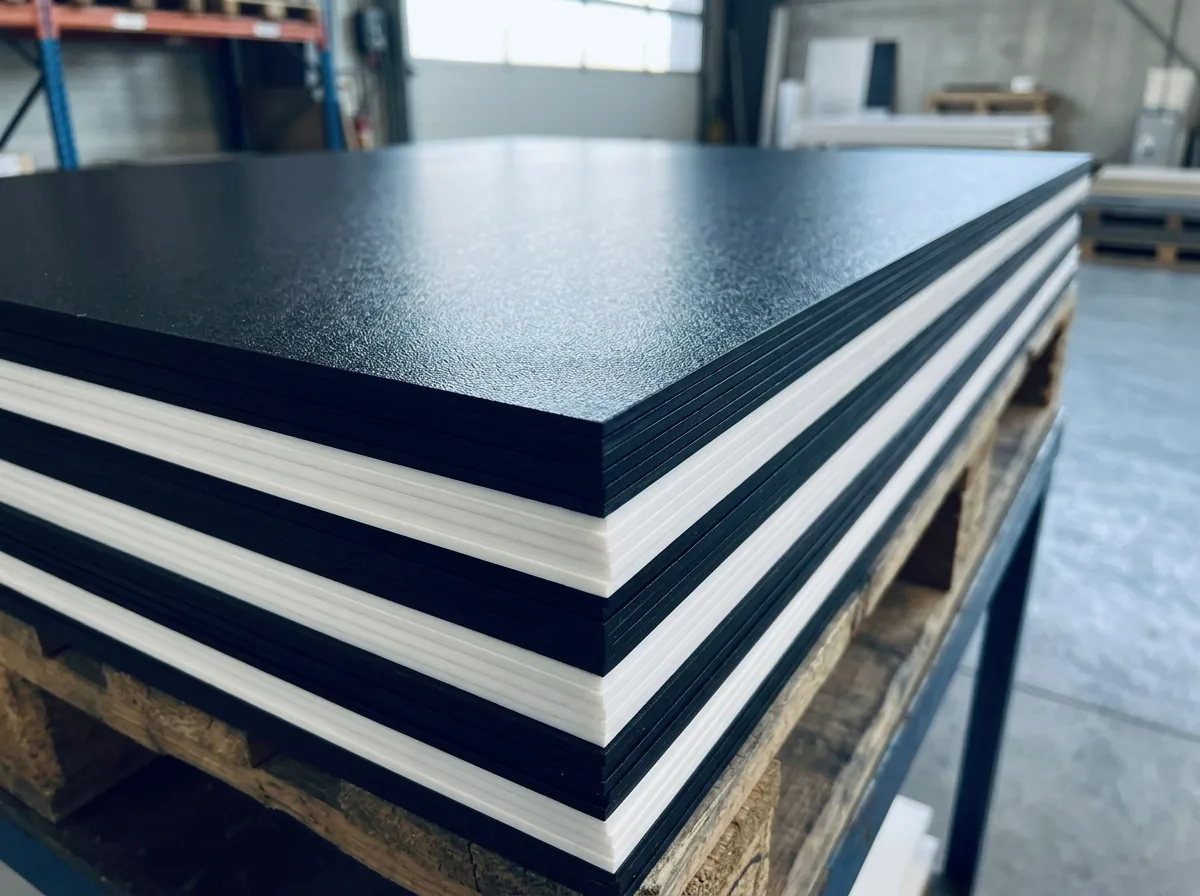
 This image was created with artificial intelligence – marked under Art. 50 of the AI Act, Regulation (EU) 2024/1689. It is a placeholder until the company's photos arrive.
ABS plastic sheets compared with high-performance plastics
How ABS plastic sheets compare to high-performance plastics. Costs, mechanical properties and areas of application.
The choice of the right plastic is a central factor for the success of technical and industrial projects. ABS plastic sheets represent a particularly attractive option here, as they combine solid mechanical properties with ease of processing and a favourable price.
They are a versatile material that is used in a wide variety of industries – from mechanical and vehicle engineering through electronics to advertising technology. Compared with high-performance plastics such as PEEK, POM or PA, ABS sheets offer both advantages and disadvantages that should be carefully weighed up when choosing a material.
In this comprehensive article you will learn everything important about ABS plastic sheets: their chemical and mechanical properties, processing and machining, costs, typical areas of application as well as advantages and disadvantages compared with high-performance plastics. You will also receive valuable tips on selecting the right material for your project.
What is an ABS plastic sheet?
ABS stands for acrylonitrile butadiene styrene and is a thermoplastic plastic that consists of three main components: acrylonitrile, butadiene and styrene. Acrylonitrile gives the material chemical resistance and rigidity, butadiene provides high impact strength and flexibility, while styrene improves surface hardness, optical quality and ease of processing. The ABS plastic sheet is an industrially manufactured sheet made from this material, which is available in different thicknesses and colours.
They are characterised by a uniform density, stable shape and smooth surfaces and can be supplied both in flat standard sheets and in customised cut pieces. Thanks to these properties, ABS sheets are particularly suitable for applications where mechanical load capacity, dimensional stability, an attractive appearance and easy further processing are required. In addition, ABS sheets can be used for thermoforming, milling, drilling or adhesive bonds and are suitable both for prototypes and for series production.
Detailed properties of ABS plastic sheets
- High flexural and impact strength
- Temperature range from -20 °C to +80 °C
- Good chemical resistance to fats, oils and many solvents
- Electrical insulation for electronic applications
- Smooth, dimensionally stable surface, easy to paint, print or laminate
- Easy machining: milling, drilling, thermoforming, cutting, laser cutting
- Economical solution for large-volume projects
- Recyclability improves the environmental balance
What are high-performance plastics?
High-performance plastics are highly specialised materials that have been developed for demanding applications in which standard plastics such as ABS are not sufficient. They are characterised by exceptionally high mechanical strength, extremely good chemical resistance, high temperature resistance and in some cases very good electrical insulation. Typical representatives are PEEK (polyetheretherketone), PA (polyamide), POM (polyoxymethylene), PTFE (polytetrafluoroethylene) or PPS (polyphenylene sulphide).
These plastics are used in highly specialised areas such as aerospace, medical technology, the chemical industry, automotive engineering, mechanical engineering and electronics. They withstand extreme loads, including high temperatures, aggressive chemicals, continuous stress, abrasion or high mechanical loads.
High-performance plastics are often used where long service life, reliability and safety are required under demanding operating conditions. Because of these outstanding properties, they are significantly more expensive compared with standard plastics such as ABS, but they offer the necessary performance for critical applications.
Comparison with high-performance plastics
High-performance plastics (e.g. PEEK, PA, POM, PTFE) offer higher mechanical strength, temperature and chemical resistance. The comparison shows key differences:
| Property | ABS plastic sheet | High-performance plastic |
|---|---|---|
| Temperature resistance | -20 °C to +80 °C | up to +250 °C (e.g. PEEK) |
| Impact strength | High | Very high |
| Chemical resistance | Good, but sensitive to strong acids/bases | Very high, resistant to almost all chemicals |
| Machining | Easy (milling, drilling, laser cutting) | Demanding, special tools required |
| Costs | Low to medium | High |
| Weight | Light | Light to medium, depending on the plastic |
| UV resistance | Limited | High (UV-stabilised variants available) |
| Surface appearance | Very good, easy to paint and print | High-quality, but more sensitive to machining |
Typical areas of application for ABS plastic sheets
- Mechanical engineering: covers, protective sheets, housings for components
- Vehicle engineering: interior trim, instrument panels, boot liners, prototype parts
- Electronics & electrical engineering: device housings, PCB carrier plates, protective caps
- Advertising technology & design: signs, displays, POS materials, illuminated advertising
- Prototype construction & model making: cost-effective and easy-to-machine models
- Medical technology (not sterilisable): device covers, demonstration models
Processing, cut to size and machining
The machining of ABS plastic sheet is versatile and can be carried out both with standard tools and specialised machines. The sheets can be milled, drilled and sawn without difficulty; for thicker sheets, the use of a saw with fine toothing is recommended in order to achieve clean cut edges.
Thinner sheets under three millimetres can be made thermoformable by targeted heating, whereby complex shapes and contours can be produced. For stable connections, special ABS adhesives or thermal welding can be used, creating durable and load-bearing joints.
The surfaces can subsequently be sanded, polished, painted, printed or laminated in order to achieve the desired appearance and functionality. During all machining steps, heat generation should be taken into account in order to avoid deformation, stress cracks or material distortion. Thanks to this flexibility, ABS is suitable both for prototypes and for series production and can be adapted to individual project requirements, from simple cut pieces to complex, shaped components with high precision.
Cost overview and economic efficiency
ABS plastic sheets are very inexpensive compared with high-performance plastics. Thin sheets from three to ten millimetres in thickness cost about 20 to 50 euros per square metre, while thicker sheets from ten to twenty millimetres are 40 to 80 euros per square metre. Special colours or special variants can cause additional costs.
High-performance plastics such as PEEK, PTFE or POM start at several hundred euros per square metre, making ABS sheets an economical choice when there are no extreme mechanical or chemical requirements. Thanks to the low material costs and the easy processing, projects with ABS sheets can be implemented cost-efficiently without having to compromise on quality and stability.
Tips for material selection
- Check mechanical load: ABS is suitable for high impact resistance; high-performance plastics for extreme loads
- Note the temperature range: ABS for moderate temperatures; high-performance plastics for high continuous loads
- Chemical resistance: check whether acids or bases come into contact
- UV and weather resistance: only use UV-stabilised variants for outdoor use
- Machining and assembly: ABS can be machined flexibly; high-performance plastics require special tools
Summary
ABS plastic sheets represent an economical, flexible and versatile solution for a wide range of industrial applications. They combine good mechanical properties, moderate temperature and chemical resistance as well as easy processing, making them ideally suited for many standard applications. The easy machining, the diverse surface options and the comparatively low material costs make ABS an attractive material for housings, protective sheets, prototypes, advertising technology and many other areas of application.
For applications with extreme requirements – for example high continuous loads at high temperatures, aggressive chemicals or UV-intensive outdoor applications – high-performance plastics such as PEEK, PA, POM or PTFE are better suited. Ultimately, the right material choice depends on the specific requirements of your project, the desired mechanical properties, the chemical load, the planned machining and the budget. With the right choice, you can make optimum use of the advantages of ABS and realise economically efficient, long-lasting solutions.
Frequently asked questions
What is the difference between ABS and polycarbonate? ABS is cheaper, easier to process, but offers lower temperature resistance and chemical resistance than polycarbonate.
Can ABS plastic sheets be used outdoors? Only to a limited extent. They are not permanently UV-resistant and can fade or become brittle under strong sunlight. UV-stabilised variants are available.
How thick should ABS sheets be for mechanical engineering? That depends on the load. Typically 3–10 mm for covers and 10–20 mm for load-bearing sheets.
Can ABS sheets be glued or welded? Yes. Special adhesives for ABS or thermal welding are suitable for stable connections.
Which colours are available? As standard black, white, grey, but many manufacturers offer individual colour variants.
How environmentally friendly is ABS? ABS can be recycled, whereby it can be processed into new sheets or granules. The degree of recycling depends on local possibilities.
Can ABS be made heat-resistant? Through additives or special mixtures, the short-term temperature resistance can be increased, but permanently it remains significantly below high-performance plastics.