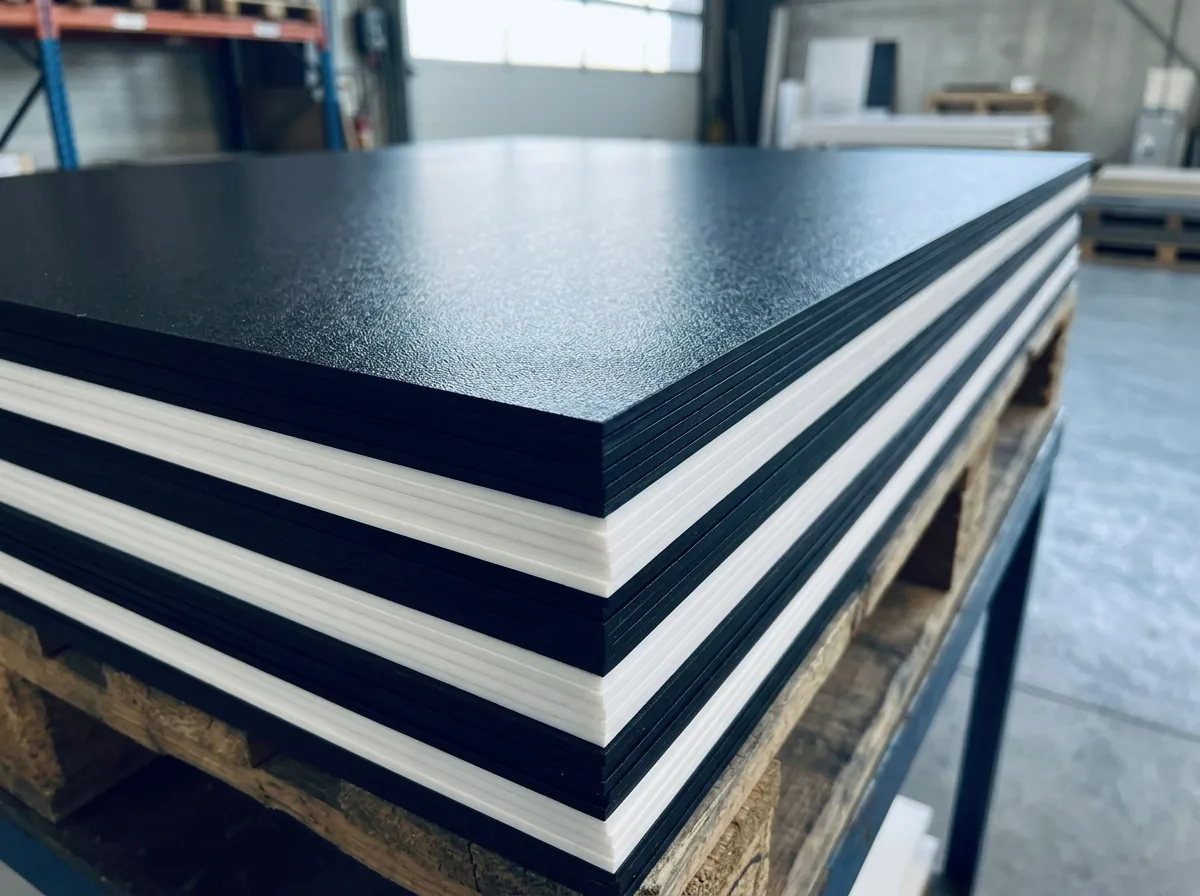
 This image was created with artificial intelligence – marked under Art. 50 of the AI Act, Regulation (EU) 2024/1689. It is a placeholder until the company's photos arrive.
ABS - acrylonitrile butadiene styrene
ABS (acrylonitrile butadiene styrene) is a versatile plastic with high impact strength. More about its properties & applications.
ABS plastic is a versatile engineering thermoplastic that combines high impact strength, good rigidity and a high-quality surface. The full name of the material is acrylonitrile butadiene styrene.
ABS is used for housings, covers, panels, technical construction parts and individually manufactured plastic components. The material has a low weight of its own, is easy to machine and offers numerous options for surface finishing.
Martan Plastics supplies ABS as a plastic semi-finished product, cut to size and as a precisely machined finished part. You will find an overview of other materials in our Materials and engineering plastics section.
What is ABS plastic?
ABS is an amorphous thermoplastic plastic consisting of the three basic components acrylonitrile, butadiene and styrene. The individual components influence the properties of the material:
- Acrylonitrile increases strength as well as resistance to heat and various chemical influences.
- Butadiene improves impact strength and the material's behaviour under mechanical loads.
- Styrene ensures good processability, rigidity and consistent surface quality.
The combination of these properties makes ABS particularly suitable for technical components where impact resistance, design freedom and a high-quality surface are required.
Properties of ABS plastic
ABS is one of the economically interesting engineering plastics. The material is dimensionally stable, comparatively light and still impact-resistant at low temperatures. At the same time, it can be machined and finished using common processes.
| Property | Assessment of ABS |
|---|---|
| Impact strength | high |
| Rigidity | good |
| Surface quality | very good |
| Machining | very good |
| Thermal formability | very good |
| Electrical insulation | good |
| Chemical resistance | moderate, depending on the medium |
| Weather and UV resistance | limited in standard grades |
The exact characteristic values depend on the respective ABS grade, the material modification, the temperature and the operating conditions. For design applications, the specific material data of the intended material should therefore always be taken into account.
Mechanical properties
ABS has high impact and notched impact strength. Components made of ABS can absorb short-term impacts and mechanical loads without breaking immediately. At the same time, the material offers good rigidity and sufficient strength for many technical designs.
Under permanently high mechanical loads, pronounced friction or tight dimensional tolerances, other materials may be more suitable. For gears, plain bearings or heavily stressed precision parts, for example, POM plastic is often used.
Thermal properties
ABS is predominantly suitable for applications in the low to medium temperature range. The permissible continuous service temperature depends on the respective material grade and the load on the component.
As temperatures rise, the rigidity of the material decreases. In addition, thermal expansion must be taken into account in the design of larger components. For applications with permanently high temperatures, various high-temperature plastics are available within our range.
Chemical resistance
ABS is resistant to water, aqueous salt solutions and many diluted acids and alkalis. However, contact with certain solvents, ketones, esters, aromatic hydrocarbons and concentrated chemicals can lead to stress cracks, deformation or damage to the surface.
Chemical resistance should therefore always be tested on the basis of the specific medium, its concentration, the duration of exposure and the operating temperature.
Is ABS oil-resistant?
ABS generally has good resistance to many oils and greases. However, the actual compatibility depends on the type of oil, any additives it contains, the temperature and the duration of exposure. For technical contact with lubricants, hydraulic oils or other operating media, the resistance of the specific ABS grade should therefore be checked on the basis of the material data.
Surface quality and colouring
ABS has a consistent, high-quality surface and can be coloured well. In addition to smooth surfaces, textured, matt or glossy versions are possible. The material is also suitable for painting, printing, coating and metallising.
These properties make ABS particularly interesting for visible housings, panels, covers and design components.
Advantages of ABS at a glance
- High impact and notched impact strength
- Good rigidity and dimensional stability
- Low weight of its own
- Very good machinability
- Good thermal formability
- High-quality and consistent surfaces
- Can be painted, printed and coated well
- Available in different colours and versions
- Electrically insulating
- Economical solution for numerous technical applications
Limits of the material
ABS is not the optimal solution for every technical application. Standard ABS has only limited weather and UV resistance. With permanent outdoor use, the material can fade, become brittle and lose mechanical performance without suitable stabilisation or coating.
Alternative materials may also be required at high temperatures, under permanent friction, with highly concentrated chemicals or with very tight dimensional tolerances.
The most important limitations include:
- Limited UV and weather resistance in standard grades
- Limited service temperature
- Sensitivity to certain solvents
- Higher thermal expansion than metallic materials
- Only conditionally suitable for highly sliding or wear-intensive components
- Flammability without appropriate flame-retardant equipment
Machining ABS plastic
ABS can be processed very well both by machining and thermally. As a result, simple cut pieces, drilled holes and milled parts can be produced just as complex three-dimensional components can.
You will find detailed practical information in our technical article on the correct processing of ABS sheets.
Sawing and cutting to size
ABS sheets can be cut to size with suitable circular, band or jigsaws. Sharp tools, a suitable tooth pitch and a controlled feed reduce heat generation and ensure clean cut edges.
Milling and drilling
ABS is well suited to machining. Sharp tools and suitable cutting parameters should be used when milling and drilling. Excessive heat generation must be avoided, as it can lead to smearing, melting or stresses in the component.
Thermal forming
As an amorphous thermoplastic, ABS can be thermoformed, bent and otherwise thermally shaped well after controlled heating. The material is therefore often used for large-area panels, housing parts and moulded parts.
Bonding and welding
ABS can be permanently joined with suitable adhesives. Depending on the component geometry and requirements, various welding processes are also possible. Before processing, the joint surfaces should be clean, dry and free from grease or other contamination.
Painting, printing and coating
The consistent surface of ABS provides good conditions for paints, printing and decorative coatings. Metallised surfaces are also possible. Suitable cleaning and, if necessary, pre-treatment is required before any surface treatment.
ABS in injection moulding
ABS is very well suited to processing by injection moulding. Thanks to its good flowability, both simple moulded parts and complex geometries with high-quality surfaces can be produced. Typical applications are housings, covers, technical moulded parts and components for the electrical and automotive industries. The required processing temperatures depend on the respective ABS grade.
Temperature resistance of ABS plastic
The temperature resistance of ABS depends on the respective material grade and the mechanical load. Standard ABS is typically used for applications with moderate operating temperatures. Depending on the ABS grade, the continuous service temperature is often in the range of about 80 to 100 °C. At higher temperatures, rigidity decreases and the material increasingly begins to deform. For permanently higher service temperatures, specially heat-resistant ABS grades or alternative high-temperature plastics should be used.
Available ABS grades and colour versions
ABS is available in several material and colour versions for different requirements. These include ABS NAT POLYLAC® PA-757, ABS BLACK POLYLAC® PA-757 J01, ABS WHITE POLYLAC® PA-757 A 01 and ABS GREY POLYLAC® PA-717 C. In addition, ABS NATURAL NOVODUR® P2 MC 000000 and ABS BLACK NOVODUR® P2 H AT provide further ABS grades for the production of technical plastic parts. The suitable material selection depends, among other things, on the desired colour, the mechanical requirements, the intended manufacturing process and the conditions in later use.
ABS sheets and semi-finished products
ABS is offered in particular in the form of sheets. These can be supplied in different dimensions, material thicknesses, colours and surface versions and then further processed individually.
Typical delivery and processing forms are:
- ABS sheets in standard formats
- Sheets cut to size
- Rectangular and contour-cut pieces
- CNC-milled components
- Drilled and machined construction parts
- Thermally formed panels and housings
- Prototypes, individual parts and series parts
You will find further information on structure, advantages and selection in our guide on the mechanical properties of ABS plastic sheets.
You can select standard sheets directly in the ABS sheets and plastic cut-to-size section.
Typical applications of ABS
ABS is used wherever impact-resistant, light and visually high-quality plastic parts are required. The good machinability enables economical use both for one-off production and in series production.
Mechanical and plant engineering
In mechanical and plant engineering, ABS is used for machine panels, protective covers, control housings, bezels, brackets and structural components. The low weight facilitates assembly and reduces the mass of moving or large-area components.
Electrical industry and electronics
In the electrical industry, ABS is suitable for device housings, switch covers, installation components and control panels, among other things. This makes use of the material's electrical insulation effect, good surface quality and design freedom.
For applications with special fire protection requirements, a correspondingly flame-retardant and approved material grade must be used.
Vehicle construction
In vehicle construction, ABS is used for interior panels, consoles, covers, housings and other moulded parts. The combination of impact strength, low weight and good surface finishing is particularly interesting for visible components.
Housing and device construction
ABS is suitable for technical housings, protective hoods, control consoles and covers. Individual geometries and surface designs can be realised by milling, bonding, thermoforming and painting.
Prototypes and small series
Thanks to its good machinability, ABS is suitable for sample parts, functional prototypes and small series. Changes to geometry, hole patterns or contours can be implemented without expensive moulds.
ABS compared with other plastics
The selection of a suitable plastic depends on the mechanical load, the service temperature, the chemical environment, the tolerance requirements and the desired surface.
| Material | Typical strength | Suitable applications |
|---|---|---|
| ABS | Impact strength and surface quality | Housings, panels, covers and prototypes |
| POM | Dimensional accuracy, sliding properties and wear resistance | Gears, guides, bearings and precision parts |
| PP | Chemical resistance and low weight | Containers, apparatus engineering and chemically stressed components |
| PC | Very high impact strength and transparency | Protective screens, transparent covers and safety components |
| PA | Strength and wear resistance | Mechanically stressed machine parts and construction elements |
ABS is particularly suitable when a high-quality surface, good impact strength and easy processing are more important than maximum temperature resistance or particularly high wear resistance.
ABS cut to size from Martan Plastics
Martan Plastics supports industrial customers in the selection and processing of suitable engineering plastics. ABS can be supplied as a standard semi-finished product, as a dimensionally accurate cut piece or as a fully machined finished part.
Depending on the drawing, quantity and requirement, we produce simple sheet cut pieces, CNC-machined contours, drilled holes, recesses and complex plastic components. Both individual parts and prototypes as well as recurring series can be implemented.
The following factors in particular should be taken into account when selecting the suitable ABS grade:
- Mechanical and dynamic load
- Service and ambient temperature
- Contact with chemicals, cleaning agents or oils
- Indoor or outdoor use
- Fire protection requirements
- Desired colour and surface texture
- Dimensions and required tolerances
- Subsequent machining or surface finishing
On the basis of these requirements, it can be assessed whether ABS is suitable for the planned component or whether an alternative engineering plastic should be used.
Frequently asked questions about ABS plastic
What does the abbreviation ABS stand for?
ABS stands for acrylonitrile butadiene styrene. This is a thermoplastic plastic that combines the properties of its three basic components.
Is ABS an engineering plastic?
Yes. Due to its good mechanical properties, impact strength, dimensional stability and versatile processability, ABS is classified as an engineering plastic.
Is ABS plastic impact-resistant?
ABS has high impact and notched impact strength. However, the actual load capacity depends on the material grade, the component geometry, the temperature and the duration of the load.
Can ABS be used outdoors?
Standard ABS has only limited UV and weather resistance. For permanent outdoor use, UV-stabilised grades, suitable coatings or alternative plastics are required.
Can ABS be milled and drilled?
ABS can be milled, drilled, sawn and otherwise machined very well. Sharp tools and suitable machining parameters prevent excessive heat generation.
Can ABS be bonded?
ABS can be reliably joined with suitable adhesive systems. The choice of adhesive depends on the load, the component geometry and the ambient conditions.
Is ABS chemically resistant?
ABS is resistant to water and various diluted chemicals. However, certain solvents and concentrated media can attack the material. Compatibility should therefore be tested for the specific application.
What is the difference between ABS and POM?
ABS is lighter, impact-resistant and particularly well suited to housings, panels and visible parts. POM offers higher rigidity, better sliding properties and higher wear resistance. POM is therefore more often used for gears, guides, bearings and dimensionally accurate functional parts.
In which colours is ABS available?
ABS can be produced in numerous colours. White, black, grey and individually coloured versions are among those frequently available. The actual availability depends on the material grade, the dimension and the required quantity.