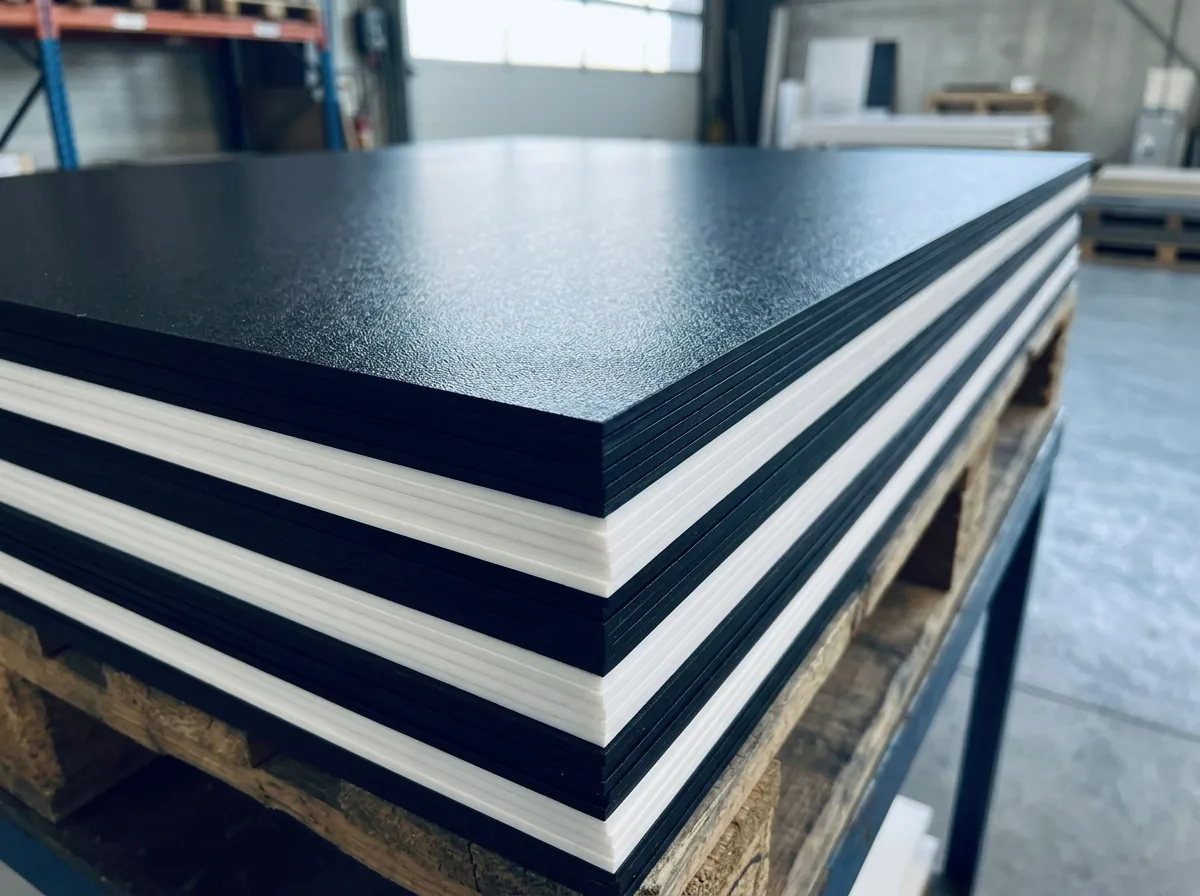
 This image was created with artificial intelligence – marked under Art. 50 of the AI Act, Regulation (EU) 2024/1689. It is a placeholder until the company's photos arrive.
PS plastic
What is PS plastic? Everything about properties, technical data, applications and the differences between polystyrene, GPPS and HIPS.
PS plastic is the short name for polystyrene. The thermoplastic material is one of the most frequently used standard plastics and is used above all because of its good formability, high surface quality and economical processing.
Unmodified polystyrene is hard, rigid and, with suitable material quality, transparent. At the same time, the material reacts comparatively sensitively to impacts, notches, elevated temperatures and certain chemicals. For applications with higher mechanical requirements, impact-modified polystyrene is therefore often used.
Whether PS is suitable for a component depends not only on the price or the desired shape. Decisive factors are load, temperature, contact media, ambient conditions, wall thickness and the intended manufacturing process.
What is PS plastic?
PS stands for polystyrene. The material is produced by the polymerisation of styrene and belongs to the group of thermoplastic plastics. Thermoplastics soften when heated and can therefore be repeatedly formed.
Polystyrene has an amorphous molecular structure. The polymer chains do not form pronounced crystalline regions. This structure enables high transparency and a uniform surface in unfilled standard types.
PS is offered under various designations depending on its composition and processing:
- standard polystyrene
- normal polystyrene
- GPPS
- crystal polystyrene
- impact-resistant polystyrene
- HIPS
- expanded polystyrene
- extruded polystyrene
These variants differ considerably. A general statement such as "component made of polystyrene" is therefore often not sufficient for a technical material selection.
What do GPPS, HIPS, EPS and XPS mean?
Polystyrene is not just a single material. The designation covers several materials, some of which have very different properties and areas of application.
GPPS: transparent standard polystyrene
GPPS stands for General Purpose Polystyrene. It is largely unmodified standard polystyrene.
GPPS is typically:
- transparent
- hard
- rigid
- dimensionally stable
- easy to colour
- electrically insulating
- comparatively brittle
The material is used, among other things, for transparent containers, packaging, covers, displays and moulded parts that are not exposed to high impact loads.
HIPS: impact-modified polystyrene
HIPS stands for High Impact Polystyrene. In this material, polystyrene is modified with elastomeric or rubber-like constituents.
This makes the material significantly more impact-resistant and less prone to breakage. In return, HIPS is normally not transparent.
Detailed information on this material variant can be found at:
https://martanplastics.com/werkstoffe/high-impact-polystyrene/
HIPS is used, among other things, for housings, claddings, displays, thermoformed parts, trays and packaging inserts.
EPS: expanded polystyrene
EPS is a foamed polystyrene. It consists of many foamed particles bonded to one another and has a very low density.
Typical areas of application are:
- thermal insulation
- protective packaging
- transport containers
- moulded parts for shock absorption
- lightweight construction applications
In general usage, EPS is often referred to by a well-known brand name. Technically, however, it is expanded polystyrene.
XPS: extruded polystyrene
XPS is foamed in a continuous extrusion process. Compared with EPS, it usually has a more uniform and closed cell structure.
The material is used above all as a compression-resistant insulating material. For compact technical components made of polystyrene, on the other hand, GPPS or HIPS are more relevant.
Properties of PS plastic
Standard polystyrene combines high rigidity with good surface quality and economical processing. Its limits lie mainly in its low impact strength and limited heat resistance.
Mechanical properties
Unmodified PS is hard and rigid. Under uniform, static load, the material can remain dimensionally stable. Under impact load or at sharp-edged notches, however, there is an increased risk of fracture.
Particularly critical are:
- impact loads
- falling objects
- notches
- sharp-edged transitions
- high point loads
- dynamic alternating loads
For mechanically stressed components, it should therefore be checked whether HIPS, ABS, polycarbonate or an engineering design plastic is more suitable.
Optical properties
Unmodified GPPS can have high transparency and pronounced surface gloss. The material is therefore suitable for applications in which contents remain visible or a smooth, high-quality surface is desired.
However, transparency can be lost through colouring, fillers, additives or impact modification.
Weight and density
Compact polystyrene typically has a density of approximately 1.04 to 1.06 g/cm³. The material is therefore only slightly above the density of water.
Foamed variants such as EPS and XPS have a considerably lower bulk density due to their high air content.
Water absorption
PS absorbs only a small amount of water. As a result, dimensions and electrical properties change comparatively little under normal humidity conditions.
However, low water absorption does not automatically mean that the material is suitable for any permanent contact with water, cleaning agents or aqueous chemicals. Here, the specific material quality must be checked.
Electrical properties
Polystyrene has good electrical insulating properties. It is therefore also used for insulating housings, covers and electrotechnical moulded parts.
For an electrotechnical application, the following must also be taken into account:
- service temperature
- tracking resistance
- wall thickness
- fire behaviour
- required approvals
- humidity load
- possible electrostatic charging
Temperature resistance
PS plastic is only limited in temperature resistance. Even at moderately elevated temperatures, rigidity and dimensional stability can decrease.
The actually permissible service temperature depends on the specific material type, the load, the component geometry and the duration of load. For components permanently exposed to heat, standard PS is often not the suitable choice.
If the component is to be used at higher temperatures, ABS, polycarbonate, PPE blends or high-performance plastics, among others, may be considered depending on the requirement.
Information on polycarbonate can be found at:
https://martanplastics.com/werkstoffe/polycarbonat/
PPE is often used as a blend with polystyrene in order to specifically coordinate heat deflection temperature, dimensional stability and processability, among other things:
https://martanplastics.com/werkstoffe/polyphenylenether/
Weathering and UV resistance
Unmodified polystyrene is only of limited suitability for long-term outdoor use. UV radiation and weathering can lead to discolouration, surface changes and increasing embrittlement.
For outdoor applications, a UV-stabilised grade, suitable surface protection or a more weather-resistant plastic is required.
Chemical resistance
PS is generally resistant to water and various aqueous media. However, the material shows low resistance to numerous organic solvents.
Critical examples include:
- aromatic hydrocarbons
- chlorinated hydrocarbons
- ketones
- esters
- certain fuels
- essential oils
- solvent-based cleaners
- adhesives with unsuitable solvents
On contact, the material can swell, form stress cracks, deform or be completely dissolved.
Before use, therefore, not only the name of a chemical should be checked. Concentration, temperature, exposure time, existing component stress and interactions with cleaning processes are also relevant.
Typical technical data of PS plastic
The following table shows typical guide values for compact standard polystyrene. The actual characteristic values can deviate depending on manufacturer, material type, additives, colouring and test method.
| Property | Typical guide range |
|---|---|
| Density | approx. 1.04–1.06 g/cm³ |
| Tensile strength | approx. 35–60 MPa |
| Modulus of elasticity | approx. 2,800–3,500 MPa |
| Water absorption | low |
| Glass transition temperature | approximately 90–105 °C |
| Transparency | high with GPPS |
| Impact strength | low with standard PS |
| Electrical insulation | good |
| UV resistance | limited without stabilisation |
| Shrinkage during processing | comparatively low |
The glass transition temperature must not be equated with a generally permissible continuous service temperature. A component can deform under mechanical load well below this temperature.
For design purposes, therefore, the characteristic values of the specifically offered material are decisive.
Advantages of PS plastic
PS is particularly interesting when an economical, rigid and readily formable plastic is required for moderate operating conditions.
The most important advantages include:
- economical standard plastic
- high rigidity
- good dimensional accuracy
- low water absorption
- smooth surfaces
- high transparency with GPPS
- good colourability
- good electrical insulation
- good suitability for injection moulding
- good suitability for thermoforming
- comparatively low processing shrinkage
- generally thermoplastically recyclable
The material can be processed efficiently in large quantities. As a result, polystyrene is widespread, particularly in packaging, housings, single-use products and large-area moulded parts.
Disadvantages and limits of polystyrene
The advantages must not obscure the fact that standard PS is not a highly loadable engineering plastic.
Important limitations are:
- low impact strength
- pronounced notch sensitivity
- limited heat deflection temperature
- restricted UV and weathering resistance
- sensitivity to many solvents
- risk of stress cracking
- limited suitability for dynamically loaded components
- partly unfavourable fire behaviour
- low reserves under permanent mechanical load
Standard PS should therefore not be selected solely on the basis of its favourable price. Premature fracture or temperature-related deformation can quickly cancel out the supposed material saving.
What is PS plastic used for?
PS is used both compact and foamed. The specific applications depend strongly on the respective material variant.
Packaging
Polystyrene is used for trays, cups, containers, display packaging, trays and packaging inserts.
For packaging with possible food contact, an expressly suitable and compliant material quality is required. The general material designation PS is not sufficient proof of food conformity.
Housings and covers
HIPS is often used for large-area housings, device claddings and covers. The material can be formed well and offers a uniform surface.
For more heavily loaded housings, ABS can be the technically better alternative:
https://martanplastics.com/werkstoffe/abs/
Displays and advertising technology
The smooth surface, good printability and easy formability make PS or HIPS interesting for:
- sales displays
- signage
- decorative elements
- information carriers
- product presentations
- exhibition stand construction
Electrical and electronic products
Polystyrene can be used for insulating housing parts, covers and components, provided that temperature, fire protection and mechanical load permit this.
Model making and prototypes
PS sheets and HIPS sheets are used in model making as well as for display models, claddings and simple prototypes. Thin sheets can be cut, glued and thermally formed.
Insulation and protective packaging
Foamed polystyrene variants are used for thermal insulation and for protecting sensitive products. These materials are not to be equated with solid PS sheets or technical moulded parts.
PS plastic as sheet, film and moulded part
Polystyrene is available in various delivery forms. These include, among others:
- sheets
- films
- roll stock
- profiles
- injection-moulded parts
- thermoformed parts
- foamed moulded parts
- cut pieces
Which delivery form is sensible depends on the quantity, component size, wall thickness, geometry and desired manufacturing process.
An overview of industrial plastic semi-finished products can be found at:
https://martanplastics.com/loesungen/kunststoffhalbzeuge/
How is PS plastic processed?
Polystyrene can be processed using several industrial processes. Injection moulding, extrusion and thermoforming are particularly widespread.
Injection moulding
PS has good flow behaviour and can be economically processed into complex moulded parts by injection moulding. The comparatively low shrinkage facilitates the production of dimensionally accurate components.
The process is particularly suitable for larger quantities, in which the cost of the tool is spread over many components.
Further information:
https://martanplastics.com/loesungen/spritzguss/
Extrusion
Films, sheets and profiles can be produced continuously by extrusion. The material is melted and passed through a shaping tool.
Information on the extrusion process can be found at:
https://martanplastics.com/loesungen/extrudieren/
Thermoforming and vacuum forming
PS and especially HIPS can be formed well thermally. In this process, a sheet or film is heated and adapted to a tool with the aid of pressure, vacuum or mechanical shaping.
Typical products are:
- packaging trays
- trays
- interior claddings
- housing shells
- displays
- covers
Bonding and joining
PS can generally be bonded. However, the choice of adhesive must be made carefully, because certain solvents can attack the plastic or cause stress cracks.
Before series application, a joining trial with the specific material, the intended adhesive and the actual surface preparation is recommended.
Can PS plastic be milled, drilled and sawn?
Compact polystyrene can be machined. Due to its brittleness, however, standard PS requires adapted tools and machining parameters.
The following points should be observed during machining:
- use sharp tools
- avoid notches and chipping
- clamp the component with low stress
- prevent excessive heat generation
- maintain sufficiently large edge distances
- adapt feed and speed to the material thickness
- do not deform the workpiece through high clamping forces
Excessively high temperatures can melt the cut edge. Excessively high mechanical loads, on the other hand, can cause chipping and cracks.
For precise components or recurring series, machining should be carried out by a manufacturing company specialising in plastics.
Further information on the machining of engineering plastics:
https://martanplastics.com/loesungen/kunststoffbearbeitung/
PS, HIPS, ABS or polycarbonate?
The materials are sometimes used for similar housing, cladding and display applications. However, their load capacity differs significantly.
| Requirement | PS or GPPS | HIPS | ABS | Polycarbonate |
|---|---|---|---|---|
| Transparency | high possible | normally no | normally no | high possible |
| Rigidity | high | good | good | good |
| Impact strength | low | significantly improved | high | very high |
| Surface quality | very good | very good | very good | good |
| Heat resistance | limited | limited | higher | significantly higher |
| Thermoformability | good | very good | good | possible |
| Material costs | mostly low | low to medium | medium | higher |
| Outdoor application | only limited | only limited | type-dependent | type-dependent |
When is standard PS sensible?
Standard PS is suitable when:
- a transparent or high-gloss surface is desired
- only a low mechanical load occurs
- the component is not exposed to elevated temperature
- there is no contact with critical solvents
- economical production is the priority
When is HIPS more sensible?
HIPS is often more suitable when:
- the component may be exposed to impacts
- high transparency is not required
- large-area parts are thermoformed
- housings, claddings or trays are manufactured
- an economical alternative to ABS is sought
When should ABS be chosen?
ABS offers advantages when higher impact strength, mechanical load capacity or temperature resistance is required.
Detailed material information:
https://martanplastics.com/werkstoffe/abs/
When is polycarbonate more suitable?
Polycarbonate is an option when very high impact strength, transparency and higher thermal load capacity must be combined.
https://martanplastics.com/werkstoffe/polycarbonat/
Is PS plastic food-safe?
PS can be available in food-safe grades. However, this does not mean that every polystyrene product is automatically suitable for food contact.
Decisive factors are:
- specific material type
- additives and colourants used
- intended type of food
- contact duration
- contact temperature
- single or repeated use
- supplier's declaration of conformity
- applicable legal requirements
For food applications, suitable evidence should always be obtained for the specific material and the intended use.
Is PS plastic recyclable?
Polystyrene is a thermoplastic and generally materially recyclable. The material can be shredded, processed and melted down again.
Practical recyclability, however, depends on several factors:
- single-grade collection
- degree of contamination
- existing coatings
- combination with other plastics
- adhesives used
- colourants and additives
- regional collection and recovery structures
- economically available recycling routes
Particularly with lightweight foamed products, collection and transport can be complex in relation to the amount of material.
Recycling-friendly design should therefore avoid material composites, hard-to-remove bonds and unnecessary coatings wherever possible.
Selecting the suitable polystyrene
For material selection, at least the following requirements should be known:
- What static and dynamic forces act on the component?
- Can impacts or drop loads occur?
- What continuous and peak temperatures arise?
- Does the material come into contact with chemicals, cleaners or oils?
- Is the component used indoors or outdoors?
- Is transparency required?
- What surface quality is needed?
- Does the material have to be printed, painted or bonded?
- Are food, electrical or fire protection approvals required?
- What quantity is to be manufactured?
- Is injection moulding, vacuum forming or mechanical machining intended?
- What tolerances must be maintained?
Material selection should always be based on the specific application. General statements about polystyrene are not sufficient, particularly for loaded components or components subject to approval requirements.
An overview of further engineering plastics can be found at:
https://martanplastics.com/werkstoffe/
Using PS plastic correctly for industrial components
PS plastic is an economical and versatile standard thermoplastic. GPPS in particular impresses with transparency, rigidity and a high-quality surface. HIPS, on the other hand, offers significantly better impact strength and is suitable for housings, claddings, trays and thermoformed parts.
The limits of polystyrene lie in its heat resistance, solvent resistance and – in the case of unmodified types – its brittleness. For mechanically, thermally or chemically demanding applications, HIPS, ABS, polycarbonate or other engineering plastics should be included in the comparison.
Martan Plastics supports companies in the selection of suitable plastic materials as well as in the manufacture of semi-finished products, cut pieces and individually machined plastic components.
POLYSTYRENE 454N as an impact-resistant PS variant
POLYSTYRENE 454N is an impact-modified polystyrene for applications in which standard PS is not sufficiently loadable due to its brittleness. The material type combines increased toughness with good flow behaviour, comparatively high heat resistance and a glossy surface. As a result, POLYSTYRENE 454N is particularly suitable for the economical production of housings, claddings and technical moulded parts by injection moulding. Whether the material is suitable for a specific component must be checked on the basis of the actual mechanical load, the service temperature, the wall thickness and the required material approvals.
Frequently asked questions about PS plastic
What does PS mean in plastic?
PS is the material abbreviation for polystyrene. It is an amorphous thermoplastic plastic that is available in compact, impact-modified and foamed form.
Is PS a thermoplastic?
Yes. Polystyrene belongs to the thermoplastics. The material softens when heated and can be formed again under suitable conditions.
Is PS plastic transparent?
Unmodified standard polystyrene or GPPS can be transparent. Impact-modified HIPS is normally not transparent due to its multiphase material structure.
What is the difference between PS and HIPS?
Standard PS is hard, rigid and often transparent, but comparatively brittle. HIPS is modified with elastomeric constituents and is therefore considerably more impact-resistant. HIPS is normally opaque.
What temperature can PS plastic withstand?
The permissible temperature depends on the material type, load, component geometry and duration of use. Standard PS is only limited in heat resistance and can deform even at moderately elevated temperatures. The technical data sheet of the specific grade is decisive.
Is polystyrene suitable for outdoor use?
Unmodified polystyrene is only of limited UV and weathering resistance. For longer-term outdoor applications, a stabilised grade, suitable protection or a more weather-resistant plastic is required.
Is PS plastic impact-resistant?
Standard PS has only a low impact strength. For impact-stressed applications, HIPS, ABS or polycarbonate is often used.
Can polystyrene be milled?
Compact polystyrene can be milled, drilled and sawn. Due to its brittleness and heat sensitivity, sharp tools, suitable cutting parameters and low-stress clamping must be used.
Is PS plastic chemically resistant?
PS is resistant to water and various aqueous media, but is attacked by many organic solvents. A resistance test is required for the specific application.
Is polystyrene food-safe?
Certain PS grades can be suitable for food contact. However, specific proof of conformity is required for the material type used and the intended contact conditions.
Which is better: PS or ABS?
PS is usually more economical and can be transparent as GPPS. ABS, on the other hand, is more impact-resistant, mechanically more loadable and generally more temperature-resistant. The better choice depends on the requirements of the component.
Is PS plastic recyclable?
Polystyrene is generally thermoplastically recyclable. Whether actual recovery is possible depends on single-grade purity, contamination, material composites and available recycling routes.