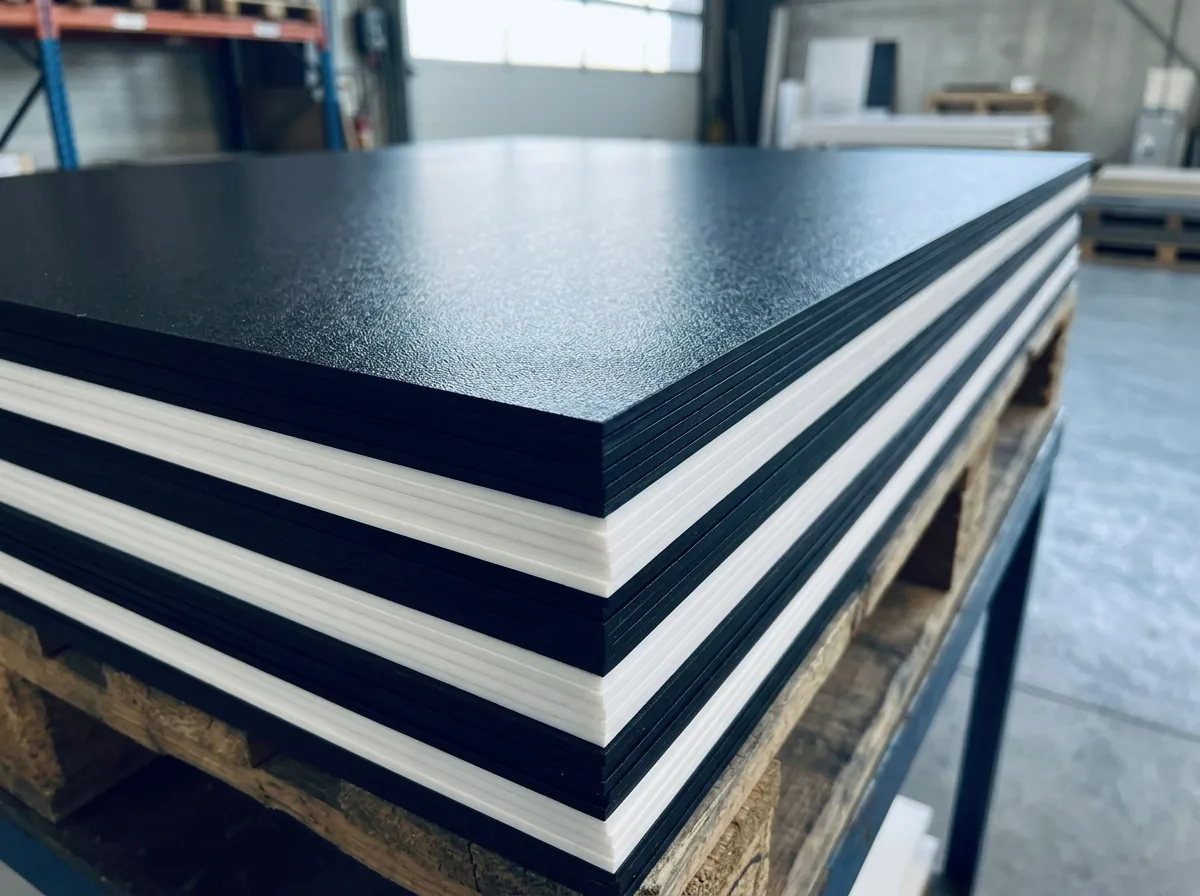
 This image was created with artificial intelligence – marked under Art. 50 of the AI Act, Regulation (EU) 2024/1689. It is a placeholder until the company's photos arrive.
High Impact Polystyrene
HIPS plastic in detail: properties, comparison, applications and clear decision-making guidance. Choose the right material now.
High Impact Polystyrene, or HIPS for short, is an impact-modified polystyrene. The thermoplastic combines good stiffness with significantly higher impact resistance than standard polystyrene. At the same time, HIPS can be processed, thermoformed, printed and machined economically.
HIPS plastic is used primarily for housings, panels, displays, packaging and thermoformed moulded parts. The material is particularly suitable for applications where a uniform surface, low weight and economical material costs are more important than particularly high temperature or chemical resistance.
As part of thermoplastic semi-finished products, HIPS can be deformed by heating and then cooled again. This makes the material suitable both for prototypes and small batches and for recurring industrial series components.
| Term | Meaning |
|---|---|
| HIPS | High Impact Polystyrene |
| German | High Impact Polystyrene / impact-resistant polystyrene |
| Material type | thermoplastic |
| Polymer | modified polystyrene |
| Abbreviation | HIPS plastic |
What is HIPS plastic?
HIPS stands for High Impact Polystyrene and is also referred to in German as impact-resistant or impact-modified polystyrene. The base material is polystyrene, which is modified by adding elastomeric or rubber-like components.
Unmodified polystyrene has good stiffness and surface quality, but reacts comparatively brittle to impacts. The elastomer phases finely distributed in HIPS can absorb part of the energy that occurs. As a result, the material breaks less quickly under mechanical stress and achieves higher impact resistance.
HIPS is generally opaque. It is often offered in white, black or custom colours. Depending on material quality and manufacturing process, smooth, matt, glossy or textured surfaces are possible.
Properties of HIPS at a glance
HIPS offers a balanced property profile for economical components with moderate technical requirements:
- higher impact resistance than standard polystyrene
- good stiffness and dimensional stability
- low density and therefore low component weight
- very good thermoforming and vacuum-forming properties
- uniform, easily designed surface
- good printability and paintability
- good machinability
- low water absorption
- electrically insulating basic properties
- economical material for larger quantities
The actual behaviour depends on the respective HIPS type, sheet thickness, temperature, duration of load and ambient conditions. Technical values should therefore always be checked against the specific data sheet.
Technical values of HIPS
| Property | Typical range |
|---|---|
| Density | approx. 1.03–1.06 g/cm³ |
| Tensile strength | approx. 18–30 MPa |
| Modulus of elasticity | approx. 1,500–2,500 MPa |
| Elongation at break | strongly type-dependent, usually significantly higher than standard PS |
| Vicat softening temperature | often approx. 85–100 °C |
| Continuous service temperature | application-dependent, often up to about +70 to +80 °C |
| Behaviour at low temperatures | increasing embrittlement possible as temperature falls |
| Water absorption | low |
| Transparency | generally opaque |
| UV and weather resistance | limited without stabilisation |
The values are for guidance and are not to be understood as binding design data. For continuous mechanical load, elevated temperatures or safety-relevant components, the specific material quality must be assessed separately.
What advantages does HIPS offer?
Good impact resistance with sufficient stiffness
HIPS is considerably less sensitive to impacts than unmodified polystyrene. This makes it suitable for housings, covers and panels that are exposed to occasional mechanical loads during transport, assembly or use.
Very good suitability for vacuum forming
One of the most important properties of HIPS is its good thermoformability. Heated HIPS sheets can be formed over tools comparatively evenly. This allows larger, thin-walled and geometrically complex components to be manufactured economically.
Typical applications are interior panels, packaging inserts, device housings and moulded parts. Further information on corresponding applications can be found in the vacuum forming technology section.
Uniform and finishable surfaces
HIPS has a closed, uniform surface. Depending on the material version, it can be printed, painted, coated or laminated. This is particularly relevant for displays, signage and visible housing parts.
Because of these properties, HIPS is often used in advertising technology as well as in display and shopfitting. For outdoor applications, however, it must be checked whether a sufficiently UV-stabilised quality is available.
Economical processing
HIPS can be processed using established industrial methods. The comparatively low material and processing costs make the material particularly interesting for larger quantities. Depending on component geometry, HIPS can be an economical alternative to higher-performance but more expensive engineering plastics.
HIPS sheets and HIPS semi-finished products
For industrial further processing, HIPS is often used as sheet or film. The available dimensions, thicknesses, colours and surfaces depend on the manufacturer and the respective material quality.
HIPS sheets can be used for, among other things:
- thermoformed housing shells
- technical panels
- machine covers
- display elements and advertising media
- packaging inserts
- trays and moulded packaging
- model-making and prototype parts
- interior fittings and visible parts
Dimensionally accurate cut pieces reduce the effort involved in further processing. Depending on geometry and quantity, HIPS sheets can be sawn, milled, drilled or thermally formed. Martan Plastics supports industrial customers in selecting and further processing suitable plastic semi-finished products.
Processing of HIPS
Thermoforming and vacuum forming
In thermoforming, a HIPS sheet is heated evenly and then brought into the desired shape using vacuum, compressed air or mechanical tools. After cooling, the component retains its geometry.
For an even wall thickness distribution, material thickness, heating, tool geometry and draw ratio must be matched to one another. With deep or heavily contoured moulded parts, the material can thin out locally. Radii and transitions should therefore already be taken into account during design.
Sawing, milling and drilling
HIPS can be machined with suitable tools. Sharp cutting edges, a controlled feed rate and the lowest possible heat generation help to achieve clean edges.
At high processing temperatures, the material can smear or adhere to the tool cutting edge. The processing parameters should therefore be adapted to sheet thickness, tool and HIPS quality. For complex contours and dimensionally accurate components, professional plastic machining is advisable.
Bonding and joining
Depending on the application, HIPS can be bonded, mechanically fastened or thermally joined. The choice of adhesive must be matched to the material surface, the load and the ambient conditions.
Solvent-based adhesives can dissolve HIPS or cause stress cracks. A practical joining trial with the intended material and adhesive is therefore advisable before series production.
Printing, painting and coating
The surface of HIPS is generally well suited to printing and coating processes. Depending on material quality, cleaning or pre-treatment may be necessary to achieve even adhesion.
For paints, printing inks and cleaning agents, chemical compatibility must be checked. Aggressive solvents can attack the surface or trigger stress cracks.
Typical applications of HIPS plastic
Packaging and moulded inserts
HIPS is used for trays, packaging inserts, transport packaging and other thermoformed packaging components. The material enables short mould cycles and economical production of high quantities.
Whether HIPS may be used for direct contact with food or medical products depends on the specific material quality and the required approvals. A general HIPS designation is not sufficient for this.
Housings and covers
Device housings, control panels, interior panels and technical covers are among the most common areas of use. HIPS is particularly interesting when a component is to be large-area, light and visually uniform, but is not exposed to extreme mechanical or thermal loads.
In mechanical and plant engineering, HIPS is suitable, for example, for panels and covers outside heavily loaded functional areas.
Displays and advertising technology
The good printability and surface quality make HIPS a suitable material for sales displays, presentation elements, signage and indoor advertising. The material can be printed, laminated or provided with films.
Vehicle and interior components
Thermoformed HIPS parts can be used for interior panels or non-safety-relevant covers. For components in vehicle construction, temperature changes, fire protection, ageing, emissions and mechanical loads must be assessed separately, among other things.
Models and prototypes
The ease of processing also makes HIPS interesting for design models, functional prototypes and prototypes. Changes to geometries can often be implemented more quickly and cost-effectively than with materials that are harder to machine.
Chemical resistance of HIPS
HIPS has limited chemical resistance. Against water, dilute acids and dilute alkalis, the material can be sufficiently resistant depending on concentration, temperature and exposure time.
Particularly problematic are numerous organic solvents, fuels, aromatic hydrocarbons, ketones and certain oils. These media can cause HIPS to swell, dissolve or develop stress cracks.
A general statement on resistance is therefore not sufficient. When in contact with chemicals, the following factors should be checked:
- type and concentration of the medium
- temperature
- duration and frequency of contact
- mechanical stress in the component
- specific HIPS quality
- cleaning and disinfection procedures
Temperature resistance of HIPS
HIPS is not one of the high-temperature plastics. As temperature increases, stiffness and dimensional stability decrease. Even well below the softening temperature, continuous load can lead to deformation.
For components near heat sources, motors, lighting systems or heated equipment, the real component temperature must be considered. Heat build-up, duration of load and mechanical stress must also be included.
For permanently higher temperatures, high-temperature plastics are available, among others. These are more capable, but are in a significantly higher price range.
UV and weather resistance
Standard HIPS is only of limited suitability for permanent outdoor applications without suitable stabilisation. UV radiation can lead over time to colour changes, surface ageing and a decrease in impact resistance.
For outdoor use, a UV-stabilised quality approved for the respective application should be selected. Alternatively, coatings or other materials may be advisable. Good printability alone does not mean that a HIPS sheet is automatically permanently weather-resistant.
Electrical properties and fire behaviour
HIPS is generally electrically insulating. However, the actual electrical values depend on material type, temperature, moisture and component geometry.
Standard HIPS is also flammable. For applications with fire protection requirements, specially equipped or correspondingly classified qualities must be used. A general material designation does not replace testing in accordance with the required standard or fire protection class.
HIPS compared with ABS, PET and PC
| Criterion | HIPS | ABS | PET | PC |
|---|---|---|---|---|
| Impact resistance | good | higher | type-dependent | very high |
| Stiffness | good | good | good to high | good |
| Thermoformability | very good | good to very good | good | possible, but more demanding |
| Temperature resistance | limited | higher than HIPS | type-dependent higher | significantly higher |
| Transparent version | normally no | normally no | possible | possible |
| Surface quality | very good | very good | very good | very good |
| Price level | comparatively low | higher | higher | significantly higher |
HIPS or ABS?
ABS plastic generally offers higher impact resistance, better heat deflection resistance and greater mechanical reserves. HIPS is often the more economical choice when the component is only exposed to moderate loads and needs to be particularly easy to vacuum form.
For robust housings, brackets and more heavily stressed structural parts, ABS is usually better suited. For displays, packaging inserts and large-area interior panels, HIPS can offer economic advantages.
HIPS or PET?
PET is available in various versions and can offer advantages in transparency, strength and barrier properties, among other things. HIPS, by contrast, is opaque, often easier to print and particularly economical for certain vacuum forming applications.
HIPS or polycarbonate?
Polycarbonate has a significantly higher impact resistance and temperature resistance. It is suitable for more demanding protective covers, viewing windows and heavily loaded housings. HIPS is cheaper and makes sense for applications where these performance reserves are not required.
Limits of HIPS
HIPS is not a universal engineering plastic. Its most important limits are:
- limited heat deflection resistance
- limited UV and weather resistance
- limited resistance to organic solvents
- lower strength than many engineering plastics
- possible creep under continuous load
- embrittlement possible at low temperatures
- standard qualities are flammable
- not automatically approved for food or medical applications
For heavily loaded bearings, gears, sliding guides or precision parts, other engineering plastics are usually better suited. HIPS plays to its strengths above all in large-area, thermoformed and visually designed components.
Typical mistakes when selecting HIPS
Considering only the maximum temperature
What matters is not solely a limit temperature stated in the data sheet. Continuous load, wall thickness, heat build-up and mechanical stress can lead to deformation even at lower temperatures.
Assuming outdoor suitability
Standard HIPS is not automatically UV and weather resistant. For outdoor applications, the specific material quality must be checked.
Assessing chemicals in general terms
Low water absorption does not mean that HIPS is resistant to any cleaning agents, oils or solvents. Stress cracks can occur especially under mechanical stress.
Underestimating wall thicknesses during vacuum forming
During vacuum forming, the material is distributed over the tool surface. Deep contours and tight radii can lead to locally greatly reduced wall thicknesses. The starting thickness must therefore be selected on the basis of the later component geometry.
Recycling and sustainability
As a thermoplastic, HIPS can generally be shredded, reprocessed and processed again. Production residues and single-grade cut pieces can be returned to recycling processes comparatively well.
However, practical recyclability depends on colour, contamination, coatings, adhesives, composite materials and the available recycling infrastructure. A component is therefore not sustainable simply because the base material is thermoplastic.
Material-efficient design, optimised cut planning, a long service life and single-grade separability can improve the ecological balance. Further information on the company's measures can be found in the sustainability section.
When is HIPS the right choice?
HIPS is particularly suitable when the following requirements come together:
- The component is to be manufactured economically.
- Good impact resistance is required, but extreme loads do not occur.
- The surface is to be uniform, printable or coatable.
- The component is vacuum formed or thermally formed.
- The material is used predominantly indoors.
- The operating temperature remains moderate.
- There is no permanent contact with aggressive solvents.
- A low component weight is desired.
HIPS is less suitable for permanently high temperatures, heavy UV exposure, aggressive chemicals, high static loads or particularly high requirements for wear resistance and dimensional accuracy.
Relationship between HIPS and PPE materials
HIPS and PPE are independent plastics, but are connected to one another via technical polymer blends. HIPS is an impact-modified polystyrene, while PPE stands for polyphenylene ether and is characterised above all by its high heat deflection resistance, low water absorption and good dimensional stability. Pure PPE is comparatively difficult to process and is therefore often combined with polystyrene or impact-resistant polystyrene. Such PPE/PS blends combine the properties of PPE with the better processability and impact resistance of styrene-based plastics. This material group includes, among others, PPE GREY NORYL® 7310-960, PPE BLACK NORYL® 7310-701, PPE BLACK NORYL® SE1 701, PPE RED NORYL® SE1 604 and PPE BLACK NORYL® V0 150B 701. For applications with higher requirements for stiffness and dimensional stability, glass-fibre-reinforced variants such as PPE GV10% BLACK NORYL® GFN1 701, PPE GV20% NAT. NORYL® GFN2 801, PPE GV20% BLACK NORYL® GFN2 701, PPE GV30% NAT NORYL® GFN3 801 and PPE GV30% BLACK NORYL® GFN3 701 are available. The range is complemented by flame-retardant versions such as PPE GV10% BLACK NORYL® GFN1 SE1 701, PPE GV20% NAT NORYL® GFN2 SE1 801, PPE GV20% BLACK NORYL® GFN2 SE1 701, PPE GV30% NAT NORYL® GFN3 SE1 801 and PPE GV30% BLACK NORYL® GFN3 SE1 701. HIPS is therefore not to be equated with NORYL®, but as a styrene-based material or blend partner it can have a technical proximity to certain PPE materials.
Selecting HIPS for industrial components
The selection of the suitable HIPS quality should not be based solely on price or individual table values. What matters is the interaction of component geometry, manufacturing process, wall thickness, temperature, mechanical load, media contact and desired surface.
Martan Plastics supports companies in selecting suitable plastics, semi-finished products and manufacturing processes. Via the material overview you can compare HIPS with other standard, engineering and high-performance plastics.
FAQ on HIPS plastic
What does HIPS mean?
HIPS stands for High Impact Polystyrene. This is a polystyrene modified with elastomeric components that has higher impact resistance than standard polystyrene.
Is HIPS a thermoplastic?
Yes. HIPS is a thermoplastic. The material softens when heated and can therefore be vacuum formed or thermoformed, among other things.
What is HIPS used for?
Typical applications are device housings, machine panels, displays, signage, packaging inserts, trays, interior panels as well as model and prototype parts.
Is HIPS suitable for outdoor use?
Standard HIPS has only limited UV and weather resistance. For longer-term outdoor applications, a suitable UV-stabilised quality or a more weather-resistant plastic should be selected.
Is HIPS food-safe?
Not every HIPS quality is approved for food contact. What matters is the specific material type, its declaration of conformity and the conditions of the intended contact.
Can HIPS be vacuum formed?
Yes. Very good thermoformability is one of the most important advantages of HIPS. The material is often used for vacuum-formed housings, panels, trays and packaging parts.
Which is better: HIPS or ABS?
That depends on the application. HIPS is usually more economical and very easy to vacuum form. ABS usually offers higher mechanical load capacity and better temperature resistance.
Is HIPS transparent?
HIPS is normally opaque due to the elastomer phases it contains. For transparent components, materials such as PET, PETG, PMMA or polycarbonate are more suitable.
Can HIPS be recycled?
HIPS is generally thermoplastically recyclable. Actual recycling depends on single-grade purity, contamination, coatings and available take-back or recycling routes.
Frequently asked questions about High Impact Polystyrene (HIPS)
What exactly is High Impact Polystyrene?
High Impact Polystyrene, or HIPS for short, is an impact-modified polystyrene. By adding rubber components, the material gains significantly better resistance to impacts and mechanical loads than classic polystyrene.
What is HIPS typically used for?
HIPS is often used for packaging, advertising displays, housing parts, interior panels, covers as well as vacuum-formed parts and prototypes. The material is particularly suitable for applications where a good surface, economical processing and solid impact resistance are required.
What advantages does HIPS offer over standard polystyrene?
The greatest advantage lies in the significantly higher impact resistance. HIPS reacts more robustly to mechanical effects, is less brittle and can therefore be used in significantly more practical applications. In addition, the material remains very easy to form and economical.
How does HIPS differ from ABS?
ABS generally offers higher mechanical reserves and better temperature resistance. HIPS scores instead with very good surface quality, easier processing and usually lower material costs. For many standard applications, HIPS is therefore a very attractive solution.
Is HIPS suitable for outdoor use?
HIPS is used predominantly indoors. Under permanent UV exposure and weather influence, standard qualities reach their limits. For outdoor applications, the material selection should therefore always be checked with regard to UV resistance and long-term behaviour.
Is HIPS food-safe?
Whether HIPS is suitable for food contact depends on the respective version and the corresponding approvals. For applications in this area, the specific material data and approvals of the respective product should always be checked.
Can HIPS be thermoformed?
Yes, that is precisely one of the great strengths of the material. HIPS can be thermoformed very well and is therefore often used for vacuum forming applications. This makes the material particularly interesting for packaging, displays and series moulded parts.
Can HIPS be machined well?
HIPS can be sawn, milled, punched, printed and bonded very well. This makes the material suitable both for industrial series production and for prototypes, individual parts and dimensionally accurate cut pieces.
Which thicknesses are common for HIPS sheets?
The suitable thickness depends heavily on the application. Thinner sheets are often used in the display and packaging sector, thicker sheets rather for technical components, covers or housing parts. What matters is the load, the shaping and the desired stability.
Is HIPS recyclable?
Yes, HIPS can be recycled in the plastics cycle. Production residues, offcuts and certain used components can be reprocessed and used again. In this way, the material supports economical and resource-saving processes.
When is HIPS the right material choice?
HIPS is particularly suitable for indoor applications with moderate mechanical load, good surface requirements and economical series production. When formability, appearance and efficiency are the priority, HIPS is often a very suitable choice.
When should a different material be chosen instead?
At high temperatures, heavy UV exposure, very high impact loads or special chemical requirements, a different material may be more advisable. In such cases, ABS, PET or PVC are often considered, depending on the technical framework conditions.