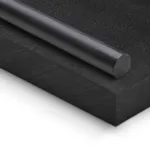
Polyetheretherketone (PEEK)
Polyetheretherketone stands for extreme temperature resistance, high strength and chemical resistance. Properties & applications explained.
Polyetheretherketone, or PEEK for short, is a thermoplastic high-performance plastic for technically demanding applications. The material combines high mechanical strength with excellent temperature and chemical resistance. PEEK is suitable for components that are used permanently under mechanical load, at high temperatures or in aggressive media.
Typical operating conditions are where standard or engineering plastics reach their limits. PEEK retains its properties even under continuous load and shows a very low tendency to creep. In addition, the material impresses with good wear and sliding properties as well as high dimensional stability.
PEEK is used primarily in industry, including in mechanical engineering, in medical technology, in aerospace as well as in chemical process engineering. Through the combination of performance and process reliability, PEEK ranks among the highest material class in the plastics sector.
An classification of comparable high-performance plastics can be found in the overview of engineering plastics.
Properties of PEEK
Mechanical properties
PEEK is characterised by high mechanical strength and rigidity. The material is suitable for components with permanent mechanical load and high dimensional requirements. Even under cyclic stress, the structure remains stable.
The low tendency to creep makes PEEK particularly suitable for precise functional parts, where dimensional stability is required over long periods. Reinforced variants with glass or carbon fibres further increase the load-bearing capacity.
Thermal properties
PEEK has a high continuous service temperature and remains mechanically loadable even at elevated temperatures. Short-term temperature peaks are reliably tolerated without the material properties changing significantly.
The high heat deflection temperature enables use in environments in which many other plastics lose their strength or become brittle.
Chemical resistance
The material is resistant to a wide range of chemicals. These include oils, greases, fuels as well as many acids and alkalis. Even under chemical load, the mechanical performance is retained.
This resistance predestines PEEK for applications in the chemical industry as well as for components with regular media contact.
An overview of alternative high-performance materials can be found in the section high-performance plastics.
Areas of application of PEEK
PEEK is used in industrial applications where high mechanical, thermal and chemical requirements come together. The material is suitable for functional components that must work reliably on a permanent basis.
Mechanical and plant engineering
In mechanical engineering, PEEK is used for bearings, guides, gears, insulators and structural components. The combination of wear resistance and dimensional stability supports a long service life of the components.
Medical technology
In medical technology, PEEK is used for implants, instruments and device components. The material is suitable for applications with high requirements for purity, temperature resistance and process reliability.
Chemical industry
Due to the high chemical resistance, PEEK is used for seals, valve components and components with direct media contact. Even with aggressive substances, the functionality is retained.
Aerospace
In aerospace, PEEK is used for lightweight, highly loadable components. The high temperature resistance and the favourable strength-to-weight ratio support use in demanding environments.
For components with a sealing function, the combination with technical seals is suitable.
PEEK compared to other high-performance plastics
PEEK belongs to the highest performance class of thermoplastic plastics. Compared to other high-performance plastics, the material is characterised by a balanced combination of mechanical strength, temperature resistance and chemical resistance.
PEEK and PTFE
PTFE offers very good sliding properties and high chemical resistance, but has a lower mechanical strength. PEEK is therefore better suited for load-bearing or structurally loaded components.
PEEK and PPS
PPS is frequently used for series components with elevated temperature requirements. PEEK additionally offers a higher continuous service temperature as well as better creep and fatigue resistance.
PEEK and PI
Polyimides achieve very high temperature resistances, but are more complex to process. PEEK combines high thermal load capacity with good processability in the injection moulding and machining process.
A systematic overview of comparable materials can be found in the section high-performance plastics.
Processing and machining of PEEK
PEEK can be processed with established thermoplastic methods and is suitable both for series production and for the manufacture of precise individual parts. Due to the high melting temperature, controlled process conditions are required.
Injection moulding
In injection moulding, PEEK is used for complex geometries and larger quantities. Processing requires high mould and melt temperatures, but offers very good reproducibility and dimensional accuracy.
Machining
Semi-finished products made of PEEK can be machined. Typical processes are turning, milling and drilling. The good dimensional stability supports tight tolerances on functional parts.
Additive manufacturing
For special applications, PEEK is also used in high-temperature 3D printing. This process is suitable for prototypes, small series and complex component geometries.
For custom-made components made of high-performance plastics, the section plastic cut pieces offers a suitable addition.
PEEK for seals and functional parts
PEEK is suitable for seals and functional parts in applications with high thermal, mechanical and chemical requirements. The material supports reliable sealing even with changing loads and temperatures.
Typical applications are back-up rings, slide rings, valve seats as well as dimensionally stable sealing elements. The low tendency to creep and high dimensional stability ensure a constant function over long periods of use.
In combination with elastomers, PEEK is frequently used as a back-up or guide material in order to limit extrusion and increase the service life of sealing systems.
An overview of suitable solutions can be found in the section seals.
Advantages and limits of PEEK
Advantages in industrial use
PEEK offers high mechanical strength, very good temperature resistance as well as pronounced chemical resistance. The material supports a long service life of components and stable function under continuous load.
The combination of dimensional stability, wear resistance and process reliability is suitable for precise functional parts in demanding environments. Even with complex geometries, reproducibility remains high.
Material limits
PEEK belongs to the highest performance class of thermoplastic plastics and is associated with higher material and processing costs. Its use is recommended above all where the material properties provide a clear technical added value.
For applications with moderate requirements, alternative engineering plastics are available as an economical solution.
Selection aid – when is PEEK the right material?
PEEK is suitable for applications with permanently high requirements for temperature resistance, mechanical load capacity and chemical resistance. The material is used wherever failure risks are to be minimised and long service lives are to be achieved.
Typical selection criteria are high continuous temperatures, high mechanical loads, tight tolerances as well as contact with aggressive media. Even with safety-relevant components, PEEK offers high process reliability.
For applications with lower requirements, more economical materials can often be used. A structured pre-selection is offered by the overview of plastics.
Frequently asked questions about PEEK
What is PEEK?
PEEK is the abbreviation for polyetheretherketone. It is a thermoplastic high-performance plastic for applications with high mechanical, thermal and chemical requirements.
Up to what temperature can PEEK be used?
PEEK is suitable for continuous use at high temperatures and retains its mechanical properties even under continuous thermal load. Short-term temperature peaks are reliably tolerated.
Is PEEK chemical-resistant?
PEEK shows a very high resistance to many chemicals, including oils, greases, fuels as well as numerous acids and alkalis. As a result, the material is suitable for applications with permanent media contact.
What is PEEK typically used for?
PEEK is used, among other things, in mechanical engineering, in medical technology, in the chemical industry as well as in aerospace. Typical components are bearings, seals, guides, valve components and structurally loaded functional parts.
Is PEEK suitable for seals?
PEEK is suitable for dimensionally stable seals, back-up rings and functional parts in sealing systems. The material supports high dimensional stability and a long service life under pressure and temperature. Further information can be found in the section seals.
Are there alternatives to PEEK?
For applications with lower requirements, other engineering or high-performance plastics come into consideration. A structured overview is offered by the section high-performance plastics.