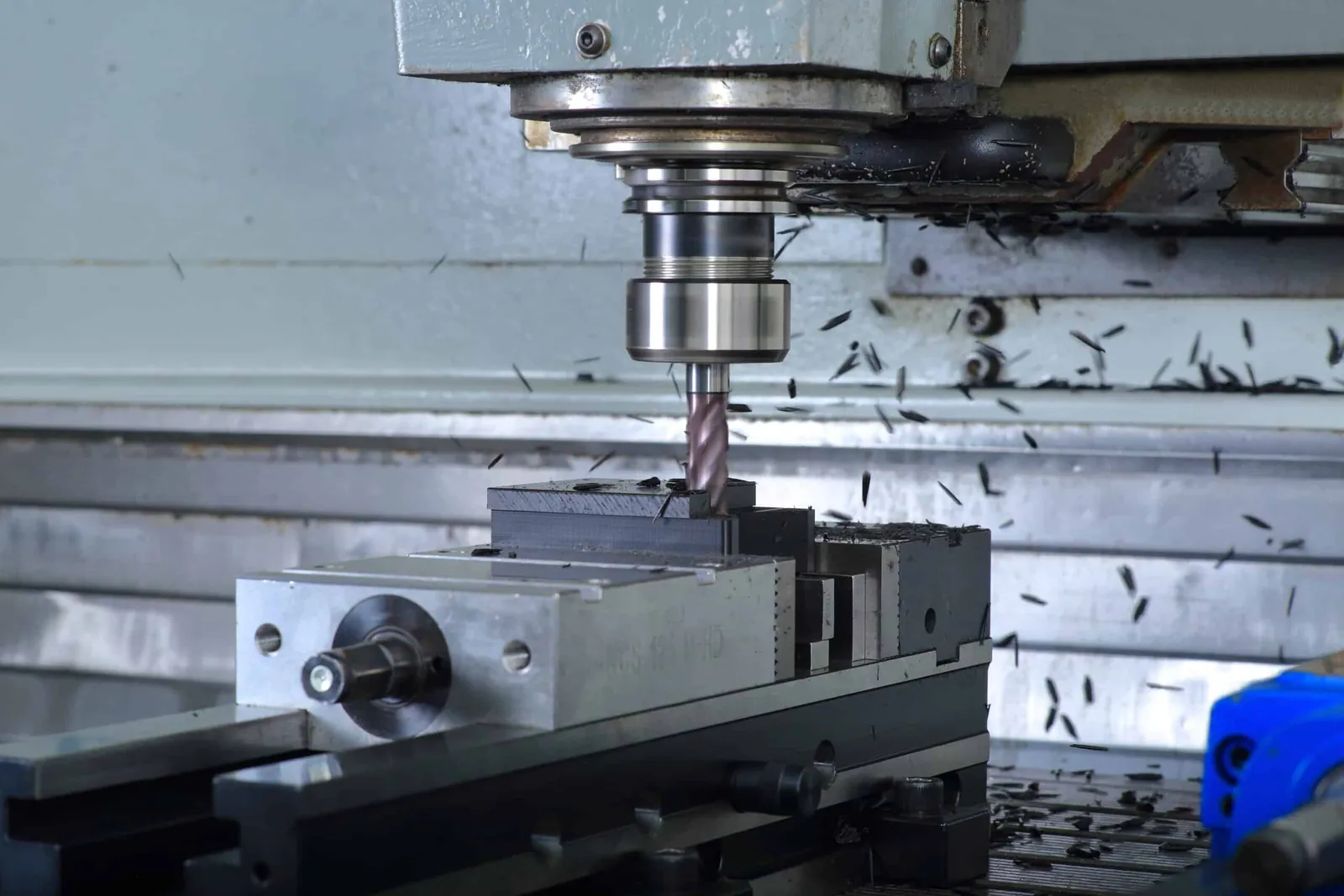
This image was created with artificial intelligence – marked under Art. 50 of the AI Act, Regulation (EU) 2024/1689. It is a placeholder until the company's photos arrive.
CNC aluminium cut to size
Precise CNC cutting of aluminium sheets: how computer-controlled manufacturing enables complex contours, holes and dimensional accuracy.
CNC cut pieces are the most precise and efficient form of component manufacturing for many industrial applications. When aluminium, plastic or composite sheets have to be produced exactly to drawing, CNC technology offers reproducible quality that cannot be achieved with conventional cutting methods. Decision-makers benefit from high dimensional accuracy, clean edge quality and the option of obtaining complex geometries completely ready for assembly. This makes CNC cutting a decisive building block in modern manufacturing chains – from prototypes and small batches through to industrial series production.
What does CNC cutting mean?
CNC cutting describes the precise, digitally controlled machining of sheet materials using computer-aided machines. At its centre is a fully automated process: CAD data is prepared in CAM software, toolpaths are calculated and then transferred to the machine control system with millimetre accuracy. This creates a machining operation that runs repeatably, stably and with extreme precision, independently of manual influences.
CNC cutting goes far beyond simply separating a material. The machine can mill contours, place precise hole patterns, integrate countersinks, machine pockets or produce functional surfaces – all in one continuous process. In contrast to classic cutting methods such as circular saws or band saws, the result is not just rectangular sheets but complex components to engineering drawings.
CNC cutting is particularly relevant for materials such as aluminium or engineering plastics, since these place different demands on feed rate, cooling and clamping depending on the alloy or material behaviour. The digital control reliably compensates for these influences and enables consistent results – even for delicate components or those with demanding geometries.
The combination of software precision, powerful spindle technology and optimum tool selection creates a manufacturing process that corresponds exactly to the requirements of modern industry. Companies receive components that are both geometrically exact and qualitatively consistent – regardless of whether a single part or a large series is produced.
Advantages of CNC cutting over conventional methods
Conventional cutting – for example with a circular saw or band saw – only allows right-angled cuts and limited precision. CNC cutting considerably extends these possibilities:
- Higher dimensional accuracy: The CNC control ensures constant repeat accuracy, even for complex components.
- Complex contours: Radii, internal cut-outs, pockets, chamfers or engravings are produced in a single operation.
- Clean edge quality: Optimum cutting speeds, feed rates and tool selection enable CNC machining to achieve burr-free, uniform edges.
- Components ready for assembly: Cut pieces can be supplied with fit holes, threads or countersinks.
- Gentle on the material: Lower heat generation with high-quality tools reduces the risk of distortion.
- Process stability: Automation enables consistent series results and minimises sources of human error.
For manufacturing companies, this means less reworking of aluminium, lower reject rates and shorter assembly times.
Suitable materials for CNC cutting
CNC machining centres process a wide range of industrially relevant materials. Particularly in demand are:
Aluminium
Aluminium is one of the most machinable materials in CNC cutting and combines high precision with very good surface results. Alloys such as EN AW-5083, **EN AW-**5754, **EN AW-**6061 or **EN AW-**6082 can be reliably milled without any noteworthy burr formation or thermal distortion. The high dimensional stability makes aluminium ideal for components that require an exact fit or high flatness. At the same time, the low weight enables economical handling and assembly, while the good machinability produces clean contours, exact holes and uniform edges.
Threads, countersinks and fits can be incorporated directly, which makes costly reworking unnecessary. Aluminium therefore remains the preferred choice in mechanical engineering, enclosure technology, automation and fixture construction.
Engineering plastics
Engineering plastics are frequently used in CNC cutting for functional components that require electrical insulation, low friction or specific mechanical properties. Materials such as POM, PE1000, PVC, PC, PA6 or PMMA offer different advantages depending on the requirement. POM stands out for its high dimensional stability and excellent accuracy, while PE1000, with its very good sliding properties and high impact strength, is ideal for moving applications.
PVC and PC are often used for covers, protective hoods and structural elements, as they can be milled cleanly and show low heat generation. Plastics generally react more strongly to temperature changes, which makes the right choice of feed rate, speed and clamping technology decisive. Modern vacuum tables and decoupled clamping systems prevent vibration and minimise distortion, so that thin sheets can also be machined precisely.
Composite and special sheets
Composite materials such as HPL, aluminium composite sheets or glass-fibre-reinforced sheets (GRP/CFRP) require an adapted machining strategy. The combination of different layers – for example hard surface layers and soft core materials – places particular demands on tool geometry and cutting speed. HPL sheets are often used in technical applications or in the machine environment, as they offer high surface hardness and good chemical resistance. Aluminium composite sheets are suitable for structural applications, enclosures or cover panels and, despite their sandwich construction, can be milled precisely provided that tools with high cutting-edge stability are used.
Glass-fibre or carbon-fibre reinforced sheets require particularly wear-resistant diamond or carbide tools, as the fibres have an abrasive effect. With the right tool selection, however, these materials can also be machined cleanly – including exact contours, milled grooves or functional cut-outs. HPL, aluminium composite sheets or glass-fibre-reinforced sheets can also be milled precisely. The layer structure of these materials requires adapted tool geometries in order to achieve clean milled edges along the surface layers.
Typical machining steps in the CNC process
CNC cutting often comprises several coordinated steps:
- CNC milling: Production of outer contours, internal cut-outs and pockets.
- Drilling: Exact positioning of fastening holes, sensor holes and fit holes.
- Countersinks: For screw connections and flush bolting.
- Thread cutting: Directly in aluminium or suitable plastics.
- Edge machining: Chamfers for easier assembly or to remove sharp edges.
- Engraving: Markings, serial numbers or orientation points.
- Deburring: Clean, burr-free edges for safe further processing.
The major advantage: many of these steps are integrated into a single program sequence. This reduces production time and sources of error.
Tolerances and quality requirements
Depending on the material, tool and machine configuration, CNC cut pieces achieve very high precision. Aluminium generally achieves the tightest tolerances, often in the range of ±0.1 mm or even below, as the material is dimensionally stable and can be machined in a controlled way. Engineering plastics behave differently: they react more strongly to temperature, tend towards slight distortion with incorrect parameters and therefore usually achieve tolerances in the range of ±0.2–0.3 mm. These differences must be taken into account in the design, especially when components made from different materials are later combined with one another.
Alongside dimensional accuracy, surface quality is a decisive factor in the functionality of the component. Good CNC machining produces smooth, uniform cut edges without fraying, without chatter marks and without thermally induced discolouration. For demanding functional surfaces, the choice of milling strategy – for example finishing in several finer passes – can further improve the result. Holes and fits must also be produced exactly cylindrical, as even the smallest deviations can affect assembly accuracy or tightness.
Another factor is clamping technology: a stable, vibration-free fixing of the sheet enables reproducible results throughout the entire order. Vacuum tables, grip mats or multi-point clamping systems prevent micro-movements and ensure a clean surface. If these points are consistently observed, CNC components of high quality are produced that can be used in assembly, automation or mechanical engineering without additional reworking.
Requirements for drawings and data
High-quality CAD data is the basis for a smooth CNC process. The decisive factors are:
- File formats: DXF and DWG preferred, alternatively STEP for 3D contours.
- Unambiguous dimensions: All relevant dimensions must be clearly defined.
- Minimum internal radii: depending on the milling cutter diameter (e.g. Ø 6 mm → minimum radius 3 mm).
- Material details: alloy, sheet thickness and desired surface.
- Tolerance specifications: general tolerances to ISO 2768 or customer-specific.
- Layer structure: separation of contour, engraving and holes facilitates CAM programming.
Incomplete drawings cause queries, loss of time and potential errors in production.
CNC cutting in series production
CNC machining reveals its economic advantages particularly clearly in the series production of aluminium. Once a component has been programmed and set up, the same process can be repeated any number of times with absolutely identical quality. The set-up costs are distributed across all parts in a series, resulting in falling unit costs, while the dimensional accuracy remains unchanged from component to component. The machine works to exactly the same toolpaths, which guarantees uniform surfaces, clean edges and reproducible hole patterns.
A further advantage lies in the high process reliability. Automated tool changes, constant cutting parameters and modern monitoring systems ensure that even large series can be produced without loss of quality. Production fluctuations, such as can occur with manual methods, are almost completely eliminated. This gives companies a high degree of planning certainty for delivery times, repeat parts and spare part production.
Particularly for assemblies that are frequently reordered or required in identical form over long periods, CNC series production is a particularly reliable solution. It ensures that every component corresponds exactly to the original sample, which speeds up assembly processes, reduces errors and stabilises the entire production flow. At the same time, the constant quality enables more precise costing, as both rejects and reworking are significantly reduced.
Typical sources of error and how to avoid them and how to avoid them
Common errors in CNC cutting are:
- internal radii that are too small: lead to collisions or incomplete contours.
- unsuitable materials: too soft, too brittle or thermally unstable.
- missing tolerance specifications: make production more difficult and lead to deviations.
- insufficient clamping: creates vibrations and chatter marks.
Clean drawings, the right material selection and optimised machining strategies allow these errors to be reliably avoided.
Cost factors in CNC cutting
The costs are made up of several components:
| Factor | Influence on costs |
|---|---|
| Material | alloy, thickness, cut size |
| Set-up time | setting up, tool changes, zero points |
| Contour complexity | more milling paths = higher machine time |
| Tool diameter | influences level of detail and speed |
| Quantity | larger volumes significantly reduce unit costs |
| Engravings / additional machining | increase machine time |
Complex geometries, small radii or many tool changes increase the machining time. Series production lowers costs through process repetition.
Practical examples
- Mechanical engineering: precision sheets for fixtures, base plates and mounting systems.
- Enclosure construction: front panels, control panels and enclosure cut-outs.
- Automation: sensor holders, guide elements and positioning modules.
- Electrical engineering: insulating sheets, carrier plates and cover elements.
- Prototyping: individual parts for functional models and test setups.
CNC cut pieces as a quality and economic factor
CNC cutting combines technological precision with economic efficiency and is therefore the most convincing solution for many industrial applications. The fully digitally controlled process produces components whose dimensional accuracy, edge quality and repeat accuracy are clearly superior to conventional methods. Companies benefit not only from exact contours and components ready for assembly, but also from constant quality across individual parts and series. Particularly in areas such as mechanical engineering, enclosure technology or automation, this precision leads to reliably functioning assemblies, lower susceptibility to errors and a more efficient production flow.
CNC cutting also offers clear economic advantages: automated sequences reduce reworking, rejects and set-up times, while series production enables plannable unit costs. At the same time, CNC technology opens up design freedom – complex geometries, precise hole patterns or functional millings can be realised without additional operations. This shortens assembly times and makes the entire production process more stable and more predictable.
Implement your CNC requirements: request a personal consultation now or configure your aluminium parts with CNC cutting directly online!
FAQ
Which file formats are required? DXF and DWG are standard; STEP for 3D is optional.
Which tolerances are usual? Aluminium very tight, plastics depending on the material.
Are there minimum quantities? Individual parts as well as series are possible.
How quickly can production take place? Depending on material and capacity, a few days to a series run.
Which minimum internal radii are realistic? The radius depends on the smallest milling cutter used. Internal radii of 2–3 mm are typical; very fine contours require smaller tools and increase the machining time.
Can threads be produced directly in the cut piece? In aluminium yes, and in many plastics as well. Thread capability depends on the material and the wall thickness.
How are components clamped during CNC cutting? Often via vacuum tables or multi-point clamping systems. Stable clamping is decisive for dimensional accuracy and clean surfaces.
Can engravings or lettering be integrated? Yes, CNC machines can mill engraving contours directly. Ideal for series identification, logos or functional markings.
Which materials cause particularly high tool wear? Glass-fibre-reinforced sheets, HPL and abrasive plastics significantly increase wear and require special carbide or diamond tools.