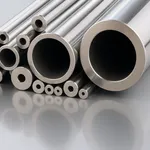
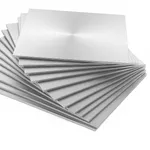
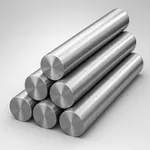
This image was created with artificial intelligence – marked under Art. 50 of the AI Act, Regulation (EU) 2024/1689. It is a placeholder until the company's photos arrive.
EN AW-6061 – versatile aluminium alloy
Everything about EN AW-6061 (AlMg1SiCu): properties, strength, machining, corrosion behaviour and comparison with 6082 & 7075.
The aluminium alloy EN AW-6061 is a proven material that has established itself in industry, mechanical engineering and aviation for decades. Its success lies in the optimal balance of strength, weight, machinability and corrosion protection. Hardly any other alloy offers a comparable combination of technical performance and availability. In contrast to pure aluminium types, EN AW-6061 combines structural stability with ease of processing. This makes the alloy suitable for demanding applications where both precision and cost-effectiveness count.
With its ability to be thermally treated and mechanically refined, it is the basis for a wide range of modern manufacturing processes – from CNC machining to additive processes and lightweight structures.
What is EN AW-6061?
EN AW-6061 is a hardenable aluminium alloy from the AlMg1SiCu (3.3211) material group. It combines the advantages of several metallic elements: magnesium and silicon provide hardenability, copper increases strength and thermal conductivity of aluminium. The result is a material that is lightweight, stable and durable at the same time.
This combination enables both good formability and excellent mechanical values after heat treatment. The alloy is offered in various tempers – such as T4 (solution heat-treated, naturally aged), T6 (solution heat-treated, artificially aged) or T651 (stress-relieved). This allows the material to be precisely adapted to the respective requirements, whether for load-bearing structures, dynamically stressed components or precise CNC components.
In addition to standardisation according to EN 573-3 and EN 485-2, EN AW-6061 is known in international industry as Aluminium 6061 or AlMg1SiCu – a designation that is established worldwide in data sheets, machine catalogues and production plans.
Mechanical properties and strength
EN AW-6061 is known for its medium to high strength combined with good toughness. The material is easy to form and yet has high structural stability. This makes it ideal for applications where both weight saving and strength are required.
Typical characteristic values (T6 temper)
| Property | Value (typical T6) | Unit |
|---|---|---|
| Density | 2.70 | g/cm³ |
| Tensile strength Rm | 260–310 | MPa |
| Yield strength Rp0.2 | 240 | MPa |
| Elongation at break A | 8–12 | % |
| Thermal conductivity | approx. 170 | W/m·K |
| Modulus of elasticity | 70 | GPa |
| Hardness (Brinell) | approx. 95 | HB |
Behaviour under load
Under static load, EN AW-6061 shows predictable deformation behaviour. Even under dynamic stress – for example in vehicle frames or aircraft structures – the material retains a high fatigue strength. At the same time, it remains ductile enough to withstand sudden impact or bending loads without fracture. The material remains dimensionally stable up to approx. 150 °C; above this temperature, strength decreases measurably – an important factor for thermally stressed components.
Corrosion resistance and weathering behaviour
A key advantage of EN AW-6061 is its excellent corrosion resistance. Even in contact with moisture, air or saline environments, the surface remains stable and oxidation-resistant. The protective layer of aluminium oxide forms automatically and regenerates itself when damaged, which makes the material particularly resistant. In the maritime industry, EN AW-6061 is preferred because it shows no deep corrosion even under prolonged exposure to salt water. For applications with particularly high requirements, the surface can additionally be anodised or powder-coated to achieve even stronger protection and an attractive appearance. Outdoors too – for example in façade elements, transport components or fixtures – the material demonstrates an above-average service life.
Welding, brazing and machining
The weldability of EN AW-6061 is considered good to very good, particularly when using modern TIG and MIG processes. It is important to choose a suitable filler material, such as EN ISO 18273 – S Al 4043 (AlSi5), to avoid cracking and distortion. Due to the moderate heat input, the structure and strength are largely retained, which is particularly crucial for load-bearing components. When brazing, however, the alloy is more sensitive – copper content influences the flow behaviour of the brazing filler, which is why alternative joining processes are often used.
In CNC machining, EN AW-6061 impresses with excellent cutting behaviour. Chips break short, tool life is high, and surfaces can be cleanly milled or polished. The material is therefore ideal for precise milled parts with tight tolerances, e.g. ±0.05 mm, and for applications where dimensional accuracy and visual quality are equally crucial. Typical machining processes include CNC milling, turning, drilling, thread cutting and grinding – always with excellent surface quality.
Heat treatment and hardening
Like all AlMgSi alloys, EN AW-6061 is hardenable. Hardening refers to the process of solution and precipitation heat treatment, in which finely distributed precipitates form that increase strength. Through targeted heat treatment, strength can be increased considerably.
Heat treatment tempers
- T4: solution heat-treated and naturally aged – good formability, medium strength
- T6: solution heat-treated and artificially aged – high strength, stable dimensional accuracy
- T651: stress-relieved after hardening – ideal for precision cut pieces and CNC manufacturing
The T6 temper is the standard in mechanical and vehicle engineering. Through controlled stress-relief annealing, internal stresses can be reduced, which improves dimensional accuracy in large cut pieces.
Surface quality and anodisability
An outstanding feature of EN AW-6061 is its very good anodisability. During anodising, a uniform, transparent oxide layer forms that serves both as corrosion protection and as a decorative finish. Compared to high-strength alloys such as 7075, 6061 shows a more uniform surface structure, which makes decorative applications possible in architecture, machine cladding or vehicle engineering. Anodised 6061 components are characterised by high colour uniformity, resistance to scratches and good adhesion of paint or powder coatings. Mechanical surface treatments – such as fine grinding, brushing or high-gloss polishing – can also be carried out without difficulty. This produces components that are not only functional but also aesthetically convincing.
Comparison with other aluminium alloys
| Alloy | Main constituents | Tensile strength (T6) | Corrosion resistance | Weldability | Typical application |
|---|---|---|---|---|---|
| EN AW-6061 | Mg 1 %, Si 0.6 %, Cu 0.3 % | 260–310 MPa | very good | good | Mechanical engineering, vehicle engineering, aviation |
| EN AW-6082 | Mg 1 %, Si 1 %, Mn 0.5 % | 290–340 MPa | very good | very good | Profiles, structures, railings |
| EN AW-7075 | Zn 5.5 %, Mg 2.5 %, Cu 1.6 % | 500–560 MPa | moderate | poor | Aviation, motorsport, high-load parts |
Technical assessment
While EN AW-7075 scores with maximum strength, EN AW-6061 occupies the optimal middle ground between stability and machinability. 6082 is somewhat stronger and can be welded better, but 6061 convinces with its better surface quality and lower cracking tendency. This makes the material outstandingly suitable for components with aesthetic requirements and mechanical stress at the same time.
Practical example: EN AW-6061 in modern vehicle engineering
In vehicle engineering, EN AW-6061 has developed into one of the most important materials for structurally load-bearing components. One example is frame structures and suspension parts in e-bikes or motorcycles, where weight saving is crucial. In automotive engineering too, the alloy is found in chassis components, battery carriers and body parts.
Thanks to the high strength at low weight, engineers can reduce wall thicknesses without losing stability. This leads to more efficient vehicles with lower energy consumption. In motorsport, EN AW-6061 is also used for brackets, air ducts and tanks, where vibration resistance and dimensional accuracy are indispensable.
Typical areas of application
- Mechanical and plant engineering
- Vehicle and motorcycle engineering (frames, suspensions, body parts)
- Aerospace components
- CNC-milled structural parts, fixtures and housings
- Robotics, automation, sensor housings
- Outdoor and marine construction (railings, supports, covers)
- Model making, prototyping and toolmaking
Particularly in prototype manufacturing and in lightweight construction, EN AW-6061 plays a key role, as it has a high strength-to-weight ratio and can be precisely machined.
Sustainability and recyclability
Aluminium is considered one of the most sustainable engineering materials. EN AW-6061 can be recycled almost endlessly without its material properties being significantly impaired. Recycling requires only around 5 % of the energy needed for primary aluminium production and causes significantly lower CO₂ emissions.
In industry, sustainable aluminium is increasingly used in closed material cycles – components are melted down after their life cycle and processed into new aluminium semi-finished products. With EN AW-6061 too, the long service life helps to conserve resources: components rarely need to be replaced, which further improves the environmental balance. Through these properties, the material fulfils all the requirements of modern, resource-efficient production.
Future prospects and new applications
With the progress of manufacturing technologies, EN AW-6061 is gaining ever new fields of application. In additive manufacturing (3D printing), initial powder variants are being developed in order to produce complex geometries directly from this alloy.
In the field of robotics and automation technology, the material plays a central role, as it is lightweight, electrically conductive and at the same time stable. In addition, 6061 is gaining importance in energy technology – for example in frames for photovoltaic modules or components in wind turbines. The combination of durability, recyclability and precision makes EN AW-6061 a material with great future potential, particularly with regard to sustainable production processes.
Decision aid: When is EN AW-6061 the right choice?
EN AW-6061 offers an ideal solution when strength, weight, machinability and corrosion protection are equally crucial. It is the right choice when:
- high surface quality is required,
- components are to be load-bearing and at the same time visually appealing,
- precise CNC machining with tight tolerances is necessary,
- a long-term weather-resistant material is sought.
For applications with maximum strength, EN AW-7075 can be an alternative, while EN AW-6082 offers advantages in very welding-intensive projects. You can obtain EN AW-6061 from us as cut-to-size aluminium sheet in various thicknesses and dimensions – configurable to the millimetre and available immediately.
Versatile, robust and precise
EN AW-6061 is a versatile material that is used in almost all industrial sectors. It combines technical performance, cost-effectiveness and sustainability in one material. The alloy convinces through its excellent machinability, high surface quality and above-average corrosion resistance.
Thanks to its versatility, it remains the first choice for companies seeking precise, durable and sustainable solutions – whether in mechanical engineering, aviation or vehicle engineering. With EN AW-6061, you choose a material that combines reliability, precision and future viability.
FAQ – Frequently asked questions about EN AW-6061
What does the designation EN AW-6061 T6 mean? It describes an aluminium alloy according to European standard (EN AW) with the alloy number 6061 in the T6 temper – i.e. solution heat-treated and artificially aged for maximum strength.
Is EN AW-6061 seawater-resistant? Yes, the alloy offers good resistance to seawater, moisture and environmental influences – especially in anodised condition.
What alternatives are there to EN AW-6061? EN AW-6082 offers higher strength and better weldability, while EN AW-7075 is suitable for extreme loads.
Can EN AW-6061 be anodised? Yes, the material is very good for anodising and produces uniform, decorative layers – ideal for visible components.
What is EN AW-6061 best suited for? For load-bearing, precise and visually high-quality components that must be permanently durable – from mechanical engineering to aviation.