Plastics compared: PET, PVC, PE – properties and applications
PET vs. PVC vs. PE – Learn about the differences, properties and applications of the three most important plastics.
Quick comparison PE vs PET: PE offers high impact strength and very good chemical resistance. PET stands out for higher rigidity, better temperature resistance and greater dimensional stability. The choice of material depends on mechanical load, temperature range and precision requirements.
PE and PET are among the most frequently used engineering plastics. Both materials differ significantly in structure, mechanical properties and temperature behaviour. Anyone searching for "PE vs PET" or "difference PE and PET" needs a clear technical classification with a concrete application recommendation.
This comparison provides a structured decision-making aid for industrial applications.
PE vs PET – the direct comparison
Polyethylene (PE) is a semi-crystalline thermoplastic from the polyolefin group. Polyethylene terephthalate (PET) belongs to the polyester group and has a more rigid molecular structure. This results in different fields of application.
Technical comparison PE and PET
| Criterion | PE (polyethylene) | PET (polyethylene terephthalate) |
|---|---|---|
| Density | 0.91–0.96 g/cm³ | approx. 1.38 g/cm³ |
| Rigidity | low to medium | high |
| Impact strength | very high | medium |
| Tensile strength | medium | high |
| Temperature resistance | -50 °C to +80 °C | -40 °C to +120 °C |
| Continuous service temperature | up to approx. 80 °C | up to approx. 115–120 °C |
| Chemical resistance | very high | good |
| Moisture absorption | very low | low |
| Wear resistance | good | very good |
| Transparency | mostly opaque | transparent possible |
| Dimensional stability | medium | high |
| Recyclability | very good | very good |
Difference PE and PET – explained technically
The difference between PE and PET lies in the chemical structure.
PE has a simple hydrocarbon chain. The material is characterised by high toughness, very good chemical resistance and low weight.
PET contains ester groups in the polymer structure. This results in higher rigidity, better dimensional stability and increased temperature resistance.
While PE reacts more flexibly, PET remains more dimensionally stable under load.
When is PE suitable?
PE offers advantages with:
- high impact load
- chemically stressed components
- sliding and wear applications
- moisture-intensive environments
- weight-optimised designs
Typical applications:
- containers and tanks
- pipelines
- sliding profiles
- protective covers
- wear strips
PE is particularly suitable for robust designs with mechanical stress.
When is PET suitable?
PET plays to its strengths with:
- high dimensional accuracy
- mechanically stressed precision parts
- increased continuous service temperature
- transparent components
- applications in the food environment
Typical applications:
- machine parts
- gears
- guide elements
- transparent covers
- packaging components
PET delivers higher rigidity and better dimensional stability under thermal load.
PE vs PET – recommendation by application
| Application | Suitable material |
|---|---|
| Chemically stressed environment | PE |
| High impact stress | PE |
| Dimensionally stable precision parts | PET |
| Increased temperature load | PET |
| Transparent components | PET |
| Sliding and wear applications | PE |
| Food contact | PET or PE depending on approval |
Summary for practice
PE stands for toughness, chemical resistance and cost-effectiveness.
PET stands for rigidity, temperature resistance and dimensional accuracy.
The choice of material depends on mechanical load, temperature range and requirements for dimensional stability.
Advantages and disadvantages at a glance
PE stands out for very high impact strength, excellent chemical resistance and extremely low water absorption. The low weight and cost-effective availability make the material particularly attractive for robust standard applications in mechanical and plant engineering. Limitations become apparent above all under higher temperature load and in structural components that require high dimensional stability under static load in the long term.
PET is characterised by high rigidity, very good dimensional stability and an increased continuous service temperature. The material is suitable for precise components with tight tolerance requirements and also offers good wear resistance as well as transparent versions. Compared with PE, PET reacts more sensitively to strong impact load and shows lower resistance to certain alkalis or sustained stress.
Extended technical data
| Property | PE-HD | PET |
|---|---|---|
| Coefficient of friction (dry) | approx. 0.2–0.3 | approx. 0.3–0.4 |
| Water absorption (24h) | < 0.01 % | approx. 0.1–0.2 % |
| Linear thermal expansion | approx. 1.5–2.0 x10⁻⁴ /K | approx. 0.6–0.8 x10⁻⁴ /K |
| Stress crack resistance | very high | medium |
PE shows lower moisture absorption and better stress crack resistance. PET has lower thermal expansion and higher dimensional stability.
Standards and material reference
- PE: DIN EN ISO 1873
- PET: DIN EN ISO 2580
These standards define material data and test methods and support standardised material selection in the industrial environment.
PE and PET in various variants
PE variants
- PE-HD (HDPE): higher rigidity, frequently used in tank and apparatus construction
- PE-UHMW (PE 1000): extremely high wear resistance, ideal for sliding and conveyor technology
- PE-LD: softer version with higher flexibility
PET variants
- PET (semi-crystalline): high strength and good dimensional accuracy
- PET-G: improved impact strength and good transparency
The choice of the right variant influences mechanical properties more than the base material comparison alone.
Mechanical data in detail
| Data | PE-HD | PET |
|---|---|---|
| Modulus of elasticity | approx. 800–1,200 MPa | approx. 2,700–3,000 MPa |
| Tensile strength | approx. 20–30 MPa | approx. 50–75 MPa |
| Notched impact strength | very high | medium |
| Heat deflection temperature | approx. 70–80 °C | approx. 110–120 °C |
PET exhibits significantly higher rigidity and strength. PE offers better impact strength under dynamic load.
Machining and production
Machining
- PE can be milled and turned very well, tends to build up material when heated.
- PET enables more precise contours with less post-deformation.
Welding and bonding
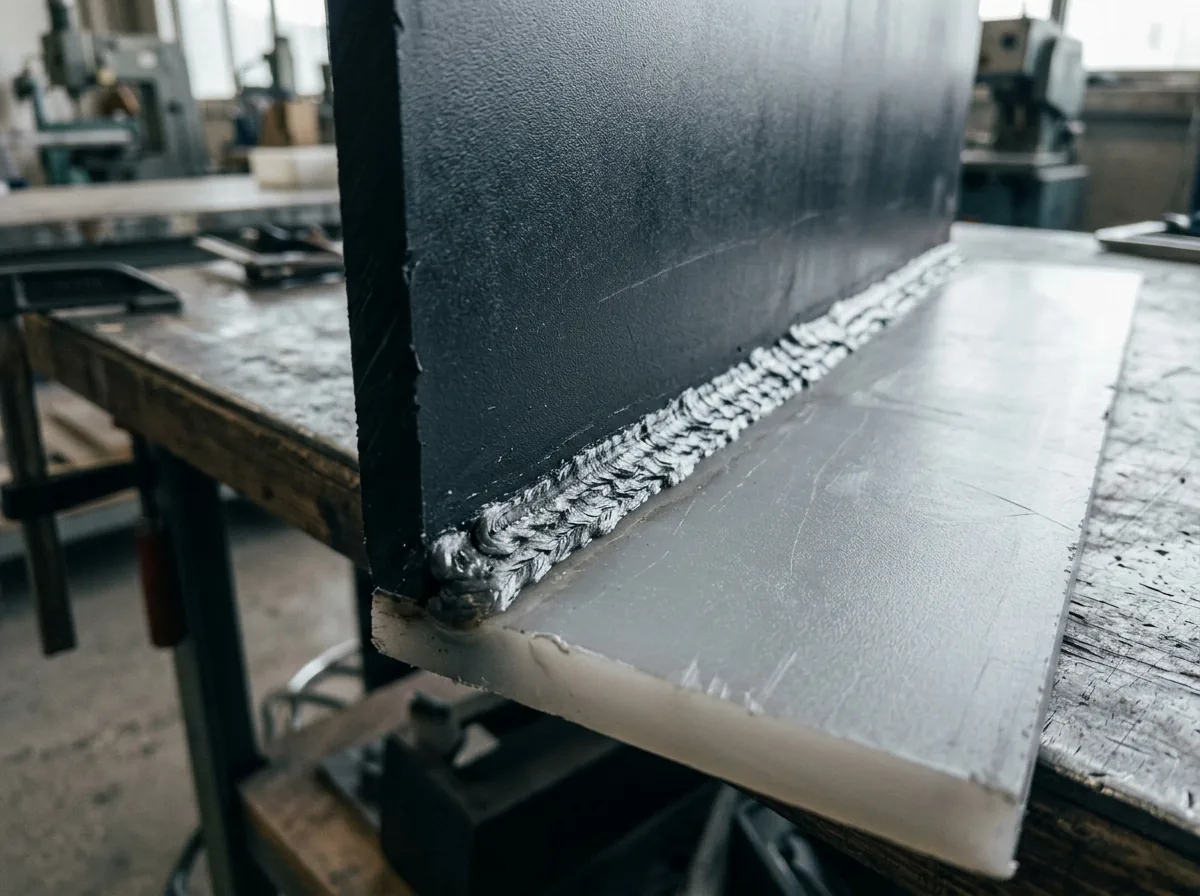
- PE can be welded well.
- PET is often joined mechanically or bonded.
Thermoforming
- PET is well suited for dimensionally stable deep-drawn parts.
Decision guide: PE or PET?
- Is the continuous service temperature above 90 °C? → consider PET.
- Is there high impact load or chemical exposure? → prefer PE.
- Is high dimensional accuracy required? → use PET.
- Is wear due to friction relevant? → consider PE-UHMW.
Practical examples from industry
- Conveyor technology: PE-UHMW for slide rails
- Packaging machines: PET for dimensionally stable guide elements
- Chemical tanks: PE-HD due to high media resistance
- Transparent protective cover: PET-G
This differentiated consideration creates a reliable basis for decisions in design and purchasing.
Chemical resistance in practical comparison
| Medium | PE | PET |
|---|---|---|
| Water | very resistant | resistant |
| Acids (diluted) | very resistant | resistant |
| Alkalis | very resistant | limited resistance |
| Alcohols | resistant | resistant |
| Oils and greases | very resistant | resistant |
| Aromatic solvents | limited resistance | limited resistance |
PE is particularly suitable for applications with continuous media exposure. PET shows advantages in dimensionally stable components with moderate chemical stress.
Long-term behaviour and creep tendency
Under continuous static load, PE shows more pronounced creep behaviour. PET has higher rigidity and lower deformation over time. For structural components under continuous load, PET offers higher dimensional stability.
Temperature and environmental influences
PE remains impact-resistant at very low temperatures. PET offers higher heat deflection temperature in the upper temperature range. UV-stabilised types of both materials are available for outdoor applications.
Food and hygiene suitability
Both materials are available in suitable grades for food contact. PET is frequently used in the packaging sector. PE is used in tanks, pipes and hygienic design elements.
Design recommendations for engineers
- For dynamic impact load: prefer PE.
- For precise guide elements: use PET.
- For sliding pairs with low friction: consider PE-UHMW.
- For increased operating temperatures: take PET into account.
- For continuous chemical load: choose PE.
PE vs PET – summary for decision-makers
PE stands for high impact strength, outstanding chemical resistance and cost-effective implementation of robust designs.
PET stands for high rigidity, better temperature performance and precise dimensional accuracy under static load.
The selection is made on the basis of load profile, temperature range, chemical exposure and requirements for dimensional stability.
With this structured analysis, the comparison covers technical data, standards reference, production, long-term behaviour and concrete application recommendations, thus providing a comprehensive basis for decisions in industrial applications.
Calculation example: deflection comparison PE vs PET
A rectangular sheet with the same geometry and identical load is assumed. Under the same load, the deflection depends largely on the modulus of elasticity of the material.
PE-HD: modulus of elasticity approx. 1,000 MPa PET: modulus of elasticity approx. 2,800 MPa
Since deflection is inversely proportional to the modulus of elasticity, PE deforms about 2.5–3 times more than PET under identical load. For load-bearing structural elements with low tolerance, PET therefore offers clear advantages.
Calculation example: weight difference
With identical component volume, the different density has a direct effect on weight.
PE: approx. 0.95 g/cm³ PET: approx. 1.38 g/cm³
A component made of PET is around 40–45 % heavier at the same volume than a comparable PE component. For weight-optimised designs, PE offers advantages.
Decision diagram – PE or PET?
- Is the continuous service temperature above 100 °C? → PET
- Is there high impact or shock load? → PE
- Is high dimensional accuracy or low deflection required? → PET
- Is there continuous chemical exposure? → PE
- Is low weight prioritised? → PE
- Is a transparent version required? → PET
This decision matrix enables a quick pre-selection already in the design phase.
Systematic material classification in plastic comparison
PE belongs to the polyolefin group with a focus on toughness and media resistance. PET counts among the engineering polyesters with a focus on rigidity and dimensional stability. Within a holistic plastic comparison, both materials form two clearly different requirement profiles: robust and chemical-resistant versus rigid and temperature-stable.
For a more in-depth consideration of individual material types, a differentiated analysis of the respective sub-variants such as PE-HD, PE-UHMW or PET-G is also recommended.
FAQ – PE vs PET
Which is more stable – PE or PET? PET has higher rigidity and dimensional stability. PE offers higher impact strength and is better suited to dynamic loads.
Which is more temperature-resistant? PET withstands higher continuous service temperatures and shows less deformation under heat than PE.
Which plastic is suitable for chemical exposure? PE exhibits very high resistance to many chemicals and is therefore frequently used in tanks, pipes and components exposed to media.
Which material is suitable for transparent components? PET enables transparent versions with high stability and is frequently used for covers or visible components.