PEKK
PEKK (polyetherketoneketone) stands out for its high temperature resistance and chemical resistance. More on applications and processing.
PEKK, the short name for polyetherketoneketone, is a thermoplastic high-performance plastic from the polyaryletherketone family, PAEK for short. The material combines high temperature resistance with very good mechanical strength, low moisture absorption and high resistance to numerous chemicals.
PEKK plastic is used above all where conventional engineering plastics reach their limits due to high temperatures, aggressive media, mechanical loads or special fire protection requirements. Typical areas of application are found in aerospace, medical technology, vehicle construction, the electrical industry as well as mechanical and plant engineering.
Martan Plastics supports you in selecting suitable high-performance plastics and in manufacturing precision plastic components to drawing, sample or CAD data.
What is PEKK?
PEKK is a high-performance thermoplastic whose molecular structure consists of ether and ketone groups. It therefore belongs to the same polymer family as PEEK. However, the chemical structure of the individual PAEK materials differs in the number and arrangement of the ether and ketone groups.
A special feature of PEKK is that its crystallisation behaviour can be specifically influenced via the molecular structure. Depending on the material type, PEKK can be made more amorphous or semi-crystalline. As a result, grades with different processing, toughness, temperature and mechanical properties are available.
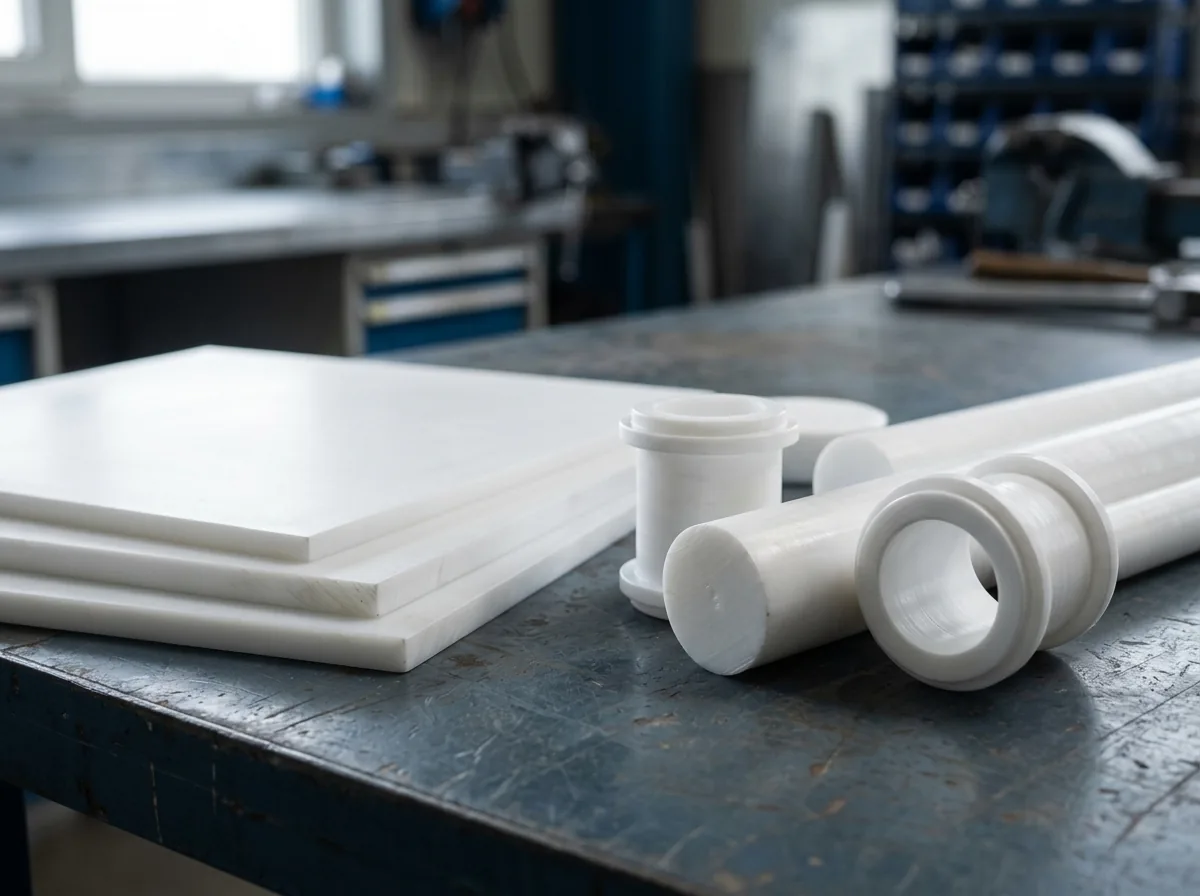
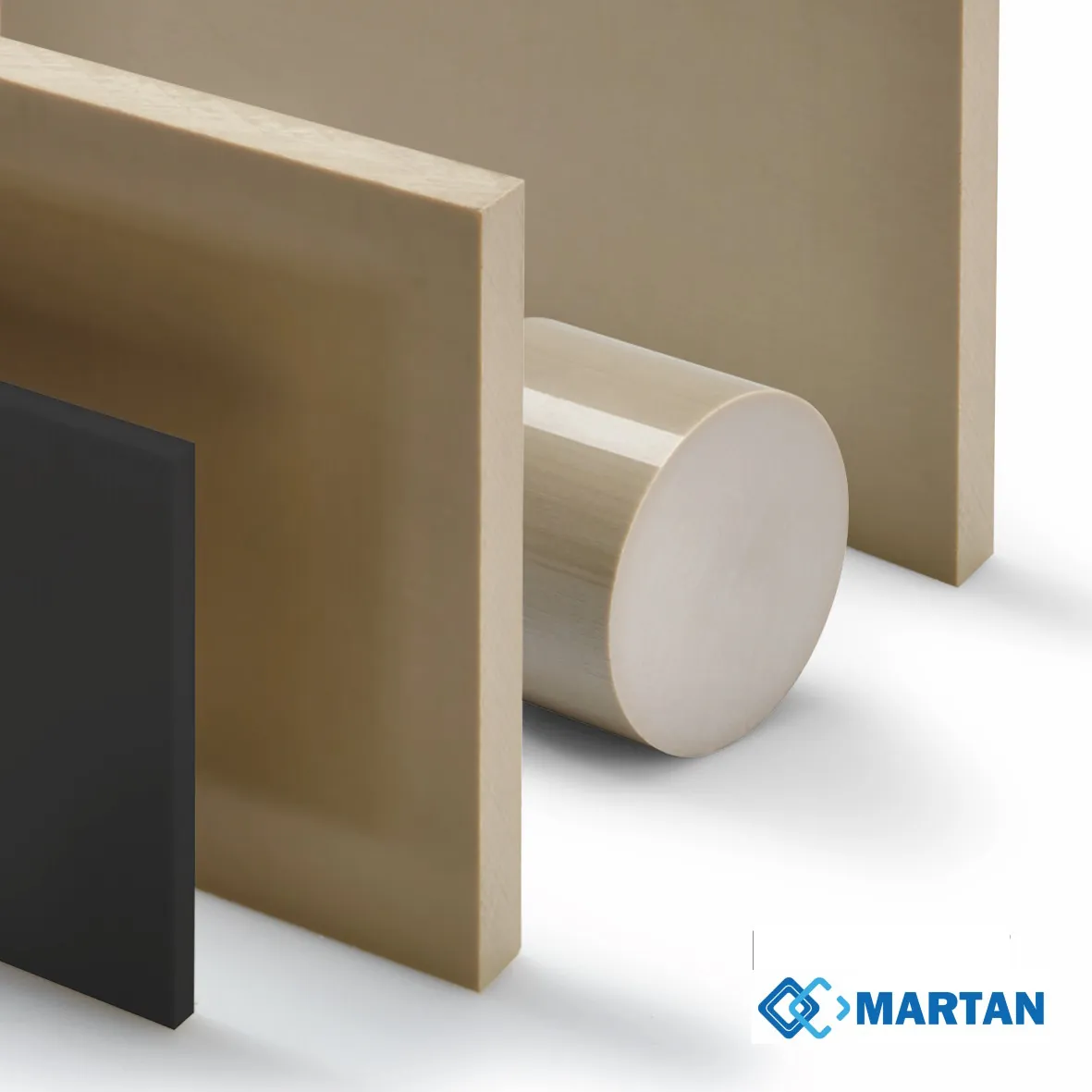
PEKK is offered among other things as granulate, powder, filament, composite material or semi-finished product. Which form is available and suitable for an application depends on the manufacturer, the material type and the intended manufacturing process.
Properties of PEKK plastic
High temperature resistance
PEKK has a high heat deflection temperature and can retain its mechanical properties even at elevated temperatures over a long period. However, the actually permissible continuous service temperature depends heavily on the specific PEKK type, the mechanical load, the component geometry and the ambient conditions.
For many high-temperature applications, service temperatures in the range of well above 200 °C are quoted depending on the grade. For short periods, certain PEKK grades can be exposed to even higher temperatures. However, a blanket service limit of 300 °C cannot be derived from this for every component.
For the structural design, the data sheet of the intended material grade as well as the actual load situation must therefore always be taken into account.
High mechanical strength and stiffness
PEKK exhibits high tensile, compressive and flexural strength. The material can absorb mechanical loads even at elevated temperatures and has a comparatively low tendency to creep.
As a result, PEKK is suitable among other things for load-bearing structural elements, brackets, fastening elements, housings, bearing components and other permanently loaded precision components.
Glass fibres, carbon fibres or other fillers can be used to specifically modify stiffness, strength, wear behaviour and thermal expansion. It should be noted that fibre-reinforced grades often have direction-dependent properties.
Very good dimensional stability
PEKK absorbs only small amounts of moisture. As a result, the dimensions of the material change comparatively little under changing ambient conditions.
This property is particularly advantageous for components with tight tolerances, repeatable positioning tasks and high requirements for dimensional stability. Nevertheless, dimensional stability depends on temperature, stress state, processing and material modification.
High chemical resistance
PEKK is resistant to numerous acids, alkalis, hydrocarbons, oils, fuels and organic solvents. With a suitable choice of material, chemical resistance is often retained even at elevated temperatures.
However, there is no universal resistance to all chemicals. Strongly oxidising media or certain highly concentrated acids, for example, can be critical. The following factors must therefore be checked before use:
- type of medium
- concentration
- temperature
- duration of exposure
- pressure and mechanical load
- stress state of the component
- PEKK grade used
Good hydrolysis and sterilisation resistance
Suitable PEKK grades have good resistance to hot water and steam. The material can therefore be of interest for components that are cleaned, disinfected or repeatedly sterilised.
Whether PEKK is suitable for a specific autoclaving, steam, radiation or chemical sterilisation process must be checked on the basis of the material type and the intended process cycles.
Wear and friction behaviour
PEKK has good wear behaviour and can be used for mechanically stressed components. Special fillers and modifications can further adjust the coefficient of friction, abrasion resistance and emergency running properties.
Typical applications are bearing bushes, guides, sealing rings, rollers, wear elements as well as components in pumps and valves.
Flame retardancy and low smoke development
PEKK exhibits favourable fire behaviour and, depending on the material grade, component thickness and test, can achieve self-extinguishing properties as well as low smoke and toxic gas development.
This makes the material interesting for applications in aviation, transport engineering and electrical engineering. However, compliance with specific fire protection standards must not be derived from the material designation PEKK alone. Corresponding test reports and approvals for the chosen grade are required.
Electrical insulation
Unfilled PEKK has good dielectric properties and can act as an electrical insulator even at elevated temperatures. Typical applications include insulating bodies, connectors, sensor components, coil formers and electrical housings.
For applications in which electrostatic charges must be avoided or specifically dissipated, electrically dissipative or conductive PEKK compounds can be used.
Radiation resistance
PEKK has high resistance to various forms of ionising radiation. As a result, the material is generally suitable for applications in medical technology, analytics, aerospace as well as other radiation-exposed environments.
The specific resistance depends on the type of radiation, dose, temperature, atmosphere and material grade.
Technical characteristics of PEKK
PEKK is not a single, fully uniform material grade. The technical values differ depending on the polymer structure, crystallinity, manufacturer, reinforcement, additives and processing method. The following overview therefore serves only as a general classification.
| Property | Typical classification |
|---|---|
| Material family | Polyaryletherketones, PAEK |
| Material type | thermoplastic high-performance plastic |
| Structure | amorphous to semi-crystalline depending on type |
| Density | depending on grade and reinforcement, often around 1.3 g/cm³ for unfilled types |
| Temperature resistance | very high, specific continuous service temperature depends on grade and load |
| Mechanical strength | high to very high |
| Chemical resistance | very high to numerous media |
| Moisture absorption | low |
| Electrical properties | good insulation when unfilled |
| Burning behaviour | favourable, depending on material type and component thickness |
| Processing | injection moulding, extrusion, pressing processes, 3D printing and machining |
For calculations, approvals and the structural design, only the technical data of the specific intended PEKK grade are authoritative.
PEKK variants and modifications
Unfilled PEKK
Unfilled PEKK offers a balanced ratio of strength, toughness, chemical resistance and electrical insulation. It is suitable among other things for precision components, electrical components and applications with high purity requirements.
Glass fibre-reinforced PEKK
Glass fibres primarily increase stiffness, dimensional accuracy and dimensional stability. At the same time, toughness, surface quality and machining behaviour can change.
Carbon fibre-reinforced PEKK
Carbon fibres enable very high specific stiffness and strength at comparatively low weight. Such PEKK composite materials are used in particular for lightweight and structural components.
Sliding-modified PEKK grades
Additives such as PTFE, graphite or carbon fibres can improve friction and wear properties. Such compounds are suitable, for example, for bearing, guide and sealing applications.
Electrically dissipative or conductive PEKK
Conductive fillers can specifically reduce the electrical resistance of PEKK. As a result, material variants are available for ESD areas, electronic manufacturing environments and other applications in which electrostatic charges must be controlled.
Medical PEKK grades
Specially tested and documented PEKK grades are offered for medical applications. Depending on the product, evidence of biocompatibility, sterilisation capability or traceability may be available.
However, the designation PEKK alone is not proof of biocompatibility or approval as an implant material. For medical applications, the specific material grade, the regulatory requirements and the intended application must always be checked.
Processing of PEKK
PEKK can be processed thermoplastically. Due to the high processing temperatures, however, the material places special demands on machines, tools, temperature control and material drying.
Injection moulding
In injection moulding, complex PEKK components can be manufactured economically in larger quantities. Systems designed for high melt and mould temperatures are required.
The process control influences among other things the crystallinity, shrinkage, dimensional accuracy, surface quality and mechanical properties of the finished component.
Extrusion and semi-finished product manufacturing
PEKK can be extruded into profiles, sheets, rods, films or other semi-finished product forms. The actual availability depends on the PEKK grade and the respective manufacturer.
Further information on corresponding manufacturing processes can be found in the section Extruding plastics and in our plastic semi-finished products.
Pressing processes
PEKK powder or prefabricated starting materials can, depending on the grade, also be processed in pressing and consolidation processes. These processes are used among other things for thick-walled components and fibre-reinforced composite materials.
3D printing with PEKK
PEKK is suitable for industrial high-temperature 3D printing. Compared to PEEK, the crystallisation behaviour of certain PEKK grades can be better controlled. As a result, warpage and internal stresses can be reduced with suitable process control.
Nevertheless, processing requires special high-temperature printers with controlled build chamber temperature, heated build plate, suitable nozzle and matched material drying. You can learn more about the process under industrial 3D printing.
Machining of PEKK
Precise finished parts can be produced from PEKK semi-finished products by machining. Suitable processes are in particular:
- CNC milling
- CNC turning
- drilling
- sawing
- grinding and finishing
During machining, heat generation, stresses in the semi-finished product, tool geometry, cutting values and cooling must be taken into account. Fibre-reinforced PEKK grades cause increased tool wear and require particularly wear-resistant cutting tools.
For tight tolerances or complex geometries, a low-stress machining strategy with several machining stages may be required. Martan Plastics manufactures precise components to your technical specifications in the area of plastic machining.
Joining and bonding of PEKK
Depending on the component geometry and material grade, PEKK can be joined by various processes. These include thermal welding processes, mechanical joints and adhesive bonds.
Bonding is demanding due to the comparatively low surface energy. Suitable pre-treatment can improve adhesion. Possible processes are:
- plasma treatment
- corona treatment
- chemical surface activation
- mechanical roughening
- matched primers and adhesion promoters
The suitability of a joint must be tested under the real thermal, chemical and mechanical loads.
Areas of application of PEKK plastic
Aerospace
In aerospace, PEKK is used because of its favourable ratio of weight, mechanical performance, temperature resistance and fire behaviour.
Typical applications are:
- structural and reinforcement elements
- brackets and fastening parts
- interior components
- cable holders and insulating components
- pipe, pump and valve components
- additively manufactured functional components
- fibre-reinforced lightweight components
For aviation applications, the respectively required fire protection, smoke gas, documentation and approval evidence is decisive.
Medical technology and healthcare
Suitable medical PEKK grades can be used for surgical instruments, sterilizable components, device components and selected implantological applications.
Particularly advantageous are the mechanical strength, X-ray transparency, sterilisation capability and chemical resistance of certain grades. The specific suitability must be demonstrated on the basis of the regulatory requirements and the intended application.
Further information can be found in our plastic solutions for medical technology and the section Healthcare.
Vehicle construction and mobility
In vehicle construction, PEKK is a candidate for thermally and mechanically highly stressed components. These include components in the environment of drive systems, fuels, lubricants, power electronics and high-voltage technology.
By specifically replacing metallic components, PEKK can contribute to weight reduction. However, whether a metal replacement is technically and economically sensible must be checked separately for each component.
Electrical industry and electronics
Due to its electrical insulation, temperature resistance and low moisture absorption, PEKK is suitable for demanding components in the electrical industry and electronics.
Possible applications are:
- connectors
- insulators and insulating sleeves
- coil formers
- sensor brackets
- high-temperature housings
- components for high-voltage systems
Mechanical and plant engineering
In mechanical and plant engineering, PEKK can be used for components in which high temperatures, aggressive media and mechanical loads occur simultaneously.
Typical components are guides, bearing bushes, sealing rings, valve seats, pump components, grippers, brackets and wear-stressed functional elements.
Oil and gas industry
In the oil and gas industry, suitable PEKK grades can be used for seals, backup rings, valve components, electrical insulations and media-contacted components.
Decisive factors here include pressure, temperature, media composition, duration of exposure and resistance to gases and chemicals under real operating conditions.
Semiconductor and cleanroom technology
Unfilled or specially formulated PEKK grades can be of interest for applications with high purity, temperature and chemical requirements. Possible areas of use are brackets, insulators, process components and precise functional parts.
For these applications, outgassing, particle behaviour, purity and chemical resistance of the specific material type must be checked. Further fields of application can be found in the sections Semiconductor and Cleanroom technology.
PEKK compared to PEEK, PTFE and PEI
PEKK is not fundamentally better than other high-performance plastics. The suitable material results from the specific requirement profile, the available semi-finished product form, the manufacturing process and the economic framework conditions.
| Criterion | PEKK | PEEK | PTFE | PEI |
|---|---|---|---|---|
| Temperature resistance | very high | very high | very high | high |
| Mechanical strength | high to very high | very high | comparatively low | high |
| Chemical resistance | very high | very high | almost universal | good to very good |
| Moisture absorption | low | low | very low | low |
| Electrical insulation | very good when unfilled | very good when unfilled | very good | very good |
| 3D printing | particularly interesting for suitable types | possible, but very demanding | only with special processes | readily possible |
| Availability as semi-finished product | comparatively limited | extensive | very extensive | good |
PEKK or PEEK?
PEEK is usually more widely available as a semi-finished product and material for machining. PEKK, on the other hand, offers advantages in certain additive manufacturing processes and composite material applications through its adjustable crystallisation rate.
Statements that PEKK is fundamentally more temperature-resistant, more chemically resistant or easier to process than PEEK fall short. The actual differences depend on the respective PEKK and PEEK grade as well as on the manufacturing process.
PEKK or PTFE?
PTFE offers an exceptionally broad chemical resistance and very low friction. PEKK, on the other hand, has significantly higher mechanical strength and stiffness.
PTFE is therefore particularly suitable for seals, sliding surfaces and highly chemical-resistant components. PEKK is often advantageous when high mechanical load capacity and dimensional stability are also required.
PEKK or PEI?
PEI is an amorphous high-performance thermoplastic with high dimensional stability, good electrical properties and more favourable processing behaviour. In many grades, PEKK offers higher chemical and thermal load capacity, but is usually more expensive and more demanding to process.
Advantages of PEKK
- very high thermal load capacity
- high mechanical strength and stiffness
- low tendency to creep
- low moisture absorption
- very good dimensional stability
- high resistance to numerous chemicals
- good hydrolysis and sterilisation resistance of suitable grades
- favourable fire, smoke and toxic gas behaviour
- good electrical insulation with unfilled types
- high radiation resistance
- suitable for lightweight applications
- thermoplastically processable
- suitable for high-temperature 3D printing
- available as fibre-reinforced composite material
Limits and disadvantages of PEKK
PEKK is a technically high-performance but demanding and comparatively expensive material. Its use is above all economical when several special properties are required simultaneously.
Possible limitations include:
- high price level
- more limited semi-finished product availability than PEEK
- high processing and mould temperatures
- necessary material drying before many processing methods
- demanding process control
- possible internal stresses and warpage
- increased tool wear with fibre-reinforced grades
- elaborate bonding preparation
- direction-dependent properties with fibre composite and 3D-printed components
- grade-specific approvals and evidence
When is PEKK the right plastic?
PEKK is a candidate in particular when a component is exposed to several high loads simultaneously. These include for example:
- high or changing temperatures
- strong mechanical loads
- aggressive chemicals or operating media
- tight dimensional and form tolerances
- electrical insulation requirements
- strict requirements for fire and smoke behaviour
- repeated cleaning or sterilisation cycles
- high radiation exposure
- lightweight requirements
- additive manufacturing of complex high-temperature components
At moderate temperatures and lower loads, more economical engineering plastics such as POM, PA, PET or PPS may be sufficient. The material selection should therefore always be made on the basis of the complete requirement profile.
PEKK components from Martan Plastics
Martan Plastics supports you in selecting suitable high-performance materials as well as in manufacturing plastic components to drawing, sample or CAD data. Depending on availability and requirement, PEKK semi-finished products, cut pieces or precisely machined finished parts can be realised.
For a reliable technical assessment, the following details are particularly helpful:
- component drawing or CAD data
- dimensions and tolerances
- service temperature and temperature profile
- mechanical load
- contact media and concentrations
- pressure and duration of exposure
- quantity
- desired manufacturing process
- required approvals and certificates
- special requirements for purity, fire behaviour or electrical properties
On this basis, it can be assessed whether PEKK is technically and economically suitable or whether another high-performance plastic represents the better solution.
Frequently asked questions about PEKK plastic
What does PEKK mean?
PEKK stands for polyetherketoneketone. The thermoplastic high-performance plastic belongs to the material family of polyaryletherketones, PAEK for short.
Is PEKK a thermoplastic?
Yes. PEKK is a thermoplastic plastic and can be melted at a sufficiently high temperature and processed by injection moulding, extrusion, pressing processes or additive manufacturing.
How temperature-resistant is PEKK?
PEKK has a very high temperature resistance. However, the permissible continuous service temperature depends on the material type, load, component geometry, ambient medium and required service life. For a specific design, the data sheet of the intended grade is required.
What is the difference between PEKK and PEEK?
Both materials belong to the PAEK family. They differ in their molecular structure and their crystallisation behaviour. PEEK is usually more widely available as a semi-finished product, while certain PEKK grades can offer advantages in additive manufacturing and in fibre-reinforced composite materials.
Is PEKK chemical-resistant?
PEKK is resistant to numerous acids, alkalis, oils, fuels and solvents. Nevertheless, suitability must be checked for the specific medium, its concentration, the temperature and the duration of exposure.
Is PEKK suitable for 3D printing?
Yes. Certain PEKK grades are very well suited for industrial high-temperature 3D printing. However, suitable machines, high nozzle and build chamber temperatures, careful material drying and matched process control are required.
Is PEKK biocompatible?
Some specially developed and tested PEKK grades can be biocompatible. However, biocompatibility or medical approval cannot be derived from the general material designation PEKK. The evidence for the specific material type is authoritative.
Can PEKK be machined?
Yes. PEKK can be milled, turned, drilled, sawn and ground. For tight tolerances, a plastic-appropriate machining strategy, sharp tools and controlled heat dissipation are required.
What disadvantages does PEKK have?
The most important disadvantages include the high price level, the demanding processing, the limited availability of certain semi-finished product forms and the increased tool wear with fibre-reinforced grades.