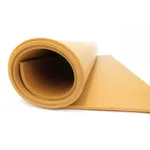
This image was created with artificial intelligence – marked under Art. 50 of the AI Act, Regulation (EU) 2024/1689. It is a placeholder until the company's photos arrive.
Machine components made of rubber
Machine mats made of rubber. Find out which machine mats are used in mechanical engineering and what you should look out for.
Machines generate forces, vibrations and noise during operation. These movements are transmitted directly via the machine foundation to the floor of a hall or a building. This creates loads for machines, foundations, building structures and adjacent systems.
Machine mounts made of rubber form an elastic intermediate layer between machine and substrate. The rubber mat absorbs part of the kinetic energy, distributes loads evenly and stabilises the installation of the machine. This results in smoother machine running, lower noise development and reduced loading of machine components.
In industrial mechanical engineering, machine mats, elastomer sheets and vibration dampers made of rubber are therefore part of the standard solution for vibration-damped machine mounting.
What are machine mounts made of rubber?
Machine mounts made of rubber are technical elastomer sheets or rubber mats that are used between machine and foundation. They serve to reduce vibrations, distribute machine loads evenly and stabilise the entire machine installation. The elastic properties of the material create a flexible intermediate layer that can absorb kinetic energy and partially dissipate it within the material itself.
While rigid materials such as metal or concrete transmit forces directly, rubber deforms slightly under load. This controlled deformation reduces the transmission of vibrations to the foundation as well as to adjacent machines or building structures. Machine mounts thereby contribute to smoother machine running, lower noise development and a longer service life of machine components.
In industrial applications, machine mounts are frequently used as rubber mats, elastomer sheets or individually cut rubber sheets. The specific design depends on the weight of the machine, vibration behaviour, speed as well as the design of the machine foundation.
How rubber mats damp vibrations and oscillations
Many machines generate periodic movements during operation. Rotating components, motors, compressors or presses generate vibrations that spread via the foundation.
A machine mount made of rubber acts as an elastic damping layer.
The material deforms minimally under load and thereby absorbs kinetic energy. Part of this energy is dissipated in the material. The transmission of vibrations is significantly reduced.
Typical effects of vibration damping:
- lower transmission of vibrations to the foundation
- reduced noise development
- more stable machine running
- lower loading of bolted connections
- protection of adjacent machines
For machines with high speeds or strong imbalances, a suitable machine mount significantly improves smoothness of running.
Typical areas of application for machine mats
Machine mounts made of rubber are used in many industrial applications. Particularly with machines with rotating components or high loads, the benefit is high.
Typical areas of application:
- machine tools
- milling machines
- lathes
- compressors
- pump systems
- generators
- presses
- conveyor systems
- industrial air conditioning systems
- technical assemblies
Even during the planning of a machine foundation, many plant manufacturers take vibration-damping machine mounts into account.
Advantages of machine mounts made of rubber
The use of machine mats brings several technical and economic advantages.
- Vibration damping Rubber mats reduce the transmission of vibrations to buildings and machine foundations.
- Noise reduction The elastic structure of the material reduces structure-borne noise and operating noise.
- Protection of machine components Bearings, bolted connections and housings experience lower dynamic loads.
- Load distribution The machine load is distributed evenly over the contact surface.
- Slip resistance Many machine mats have a structured surface for stable positioning.
- Flexible adaptation Rubber mats can be adapted as a cut piece precisely to machine feet or base plates.
Materials for machine mounts
Machine mounts are made from various elastomer materials. Each material has different properties.
| Material | Properties | Area of application |
|---|---|---|
| NR/SBR | high elasticity, good damping | general mechanical engineering |
| NBR | oil-resistant | machines with lubricants |
| EPDM | temperature- and weather-resistant | outdoor systems |
| Recycled rubber | high compressive load capacity | heavy machines |
Depending on the application, machine mounts are additionally produced with fabric inserts or reinforced structures.
What thickness a machine mount should have
The thickness of a machine mount depends primarily on the weight of the machine, the size of the contact surface as well as the vibration behaviour of the system. The higher the load and the stronger the vibrations generated, the greater the thickness of the rubber mat must be chosen so that effective damping occurs.
For smaller machines or light assemblies, relatively thin elastomer sheets are often sufficient. Heavier machines, on the other hand, require significantly thicker rubber mats so that the material can deform sufficiently elastically and the vibration isolation works. At the same time, the mount must remain stable enough to carry the weight of the machine permanently.
In many industrial applications, machine mounts are in a range of about 5 to 30 millimetres in thickness. For particularly heavy systems or for strongly vibrating machines, however, significantly thicker elastomer sheets can be used. The optimum thickness always results from the combination of machine weight, contact area and desired vibration damping.
Shore hardness of machine mats
In addition to thickness, the Shore hardness of the material also plays an important role.
| Shore hardness | Property | Application |
|---|---|---|
| 40–50 Shore A | high elasticity | strong vibration damping |
| 55–65 Shore A | balanced properties | universal machine mounts |
| 70–80 Shore A | high load capacity | heavy machines |
A softer rubber mat produces stronger damping. Harder materials carry higher loads.
Installation of machine mounts
The installation of machine mats generally takes place directly between machine and foundation.
The substrate should be level, clean and load-bearing. An even contact surface enables optimum load distribution.
For heavy machines, combinations of the following frequently occur:
- foundation plate
- metal plate
- rubber mat
- machine foot
This construction enables a stable installation and at the same time effective vibration damping.
Selection of the right machine mount
The selection of a suitable machine mount is always based on several technical factors. An important role is initially played by the total weight of the machine as well as the size of the contact surface over which the load is transmitted to the rubber mat. The higher the load per area, the higher the load capacity and material hardness of the machine mount must be.
In addition to the load, the vibration behaviour of the machine also plays a major role. Machines with rotating components or high speeds generate different vibration profiles than slow-running systems. The elasticity of the material as well as the thickness of the rubber mat must therefore be selected so that the vibrations are effectively damped.
In addition, environmental conditions influence the choice of material. In areas with oil, lubricants, chemicals or elevated temperatures, special elastomers that are resistant to these influences are frequently used. A technically suitably dimensioned machine mount ultimately ensures that machines stand stably, vibrations are reduced and the entire machine installation functions reliably in the long term.
Economic advantages of machine mounts
Machine mounts made of rubber also have economic advantages for industrial systems.
Vibration damping reduces mechanical loads within the machine. This extends the service life of many components. At the same time, the smoothness of running of the entire system improves.
Building structures also benefit from the elastic intermediate layer. Permanent vibrations lead to loads on foundations or hall floors in the long term. A machine mount made of rubber significantly reduces these forces.
Many companies therefore use machine mats specifically to reduce maintenance effort, noise exposure and wear.
Practical examples from mechanical engineering
Machine mounts made of rubber are used with very different machine types. The requirements differ depending on the weight, speed and vibration behaviour of the system.
Typical examples:
- CNC milling machines – high precision requires a smooth machine installation and reduced vibration transmission
- Compressors – strong periodic vibrations are significantly reduced by rubber mats
- Generators and motors – elastic machine mounts prevent the transmission of structure-borne noise into buildings
- Presses – high impact loads are absorbed by elastomer sheets
- Pump systems – vibration damping protects pipelines and fastenings
Particularly in production halls with many machines, a suitable machine mount prevents the transmission of vibrations to neighbouring systems.
Selection aid for machine mounts
The right machine mount results from the weight, contact surface and vibration behaviour of the machine.
| Machine weight | recommended thickness | typical Shore hardness |
|---|---|---|
| up to 200 kg | 5–10 mm | 55–65 Shore A |
| 200–1000 kg | 10–20 mm | 60–70 Shore A |
| 1–5 t | 15–25 mm | 65–75 Shore A |
| over 5 t | 20–40 mm | 70–80 Shore A |
These values serve as a guide for typical industrial applications. The exact design depends on the machine, foundation and operating conditions.
Why rubber works better than rigid mounts
In theory, rigid materials such as metal plates or solid plastic sheets could also be used for machine mounts. In practice, however, elastic materials show clear advantages, as they can absorb kinetic energy and dissipate it within the material itself.
Rubber has an elastic structure that deforms minimally under load. This deformation acts like a spring-damper combination. Part of the kinetic energy is stored, another part is dissipated in the material. This significantly reduces the transmission of vibrations.
Rigid materials, by contrast, transmit forces to the foundation almost unchanged. The vibrations thereby spread in the floor, in the machine foundation and partly also in the entire building. Elastic machine mounts made of rubber are therefore significantly more effective at decoupling machines and at protecting the machine environment and building structure.
Typical mistakes with machine mounts
Mistakes frequently occur in practice when selecting or installing machine mats.
- machine mounts that are too thin for heavy machines
- elastomers that are too hard with low vibration damping
- uneven or contaminated substrates
- contact surfaces that are too small under machine feet
- wrong choice of material with oil or chemicals
A technically suitable machine mount improves smoothness of running, service life of the machine and stability of the entire installation.
Technical principles of vibration isolation
The vibration isolation of machines is based on the interaction between machine mass, elasticity of the mount and the resulting operating frequency. A machine mount made of rubber acts as an elastic bearing between machine and foundation. This bearing has its own natural frequency, which is determined by material stiffness, thickness of the mat and machine weight.
For effective vibration isolation, the natural frequency of the bearing must be significantly below the operating frequency of the machine. In this range, the elastic material can absorb vibrations and greatly reduce their transmission. If both frequencies are too close together, the vibration can even be amplified.
Important technical parameters in the design of machine mounts are the dynamic stiffness of the material, the damping coefficient as well as the compression set. These properties determine how strongly the material behaves under load and how effectively vibrations are dissipated within the material itself.
A correctly dimensioned machine mount ensures that vibrations, structure-borne noise and dynamic forces are significantly reduced and machines run more smoothly.
Standards and guidelines for machine mounts
In mechanical engineering, various technical guidelines exist for the assessment of vibrations and for the design of vibration isolations.
Important standards in the field of machine mounts:
- DIN ISO 10816 – assessment of machine vibrations
- DIN EN ISO 10846 – measurement of the vibration isolation of elastic bearings
- DIN 7715 – storage of elastomer products
These standards provide technical principles for the assessment of vibrations, for the design of elastic bearings and for the long-term material resistance of elastomers.
Machine mounts as cut pieces
In industrial practice, machine mounts are frequently produced as custom-made cut pieces. Standard mats rarely fit exactly under machine feet, base plates or complete machine foundations. Individually cut rubber sheets allow the contact surface to be adapted exactly to the geometry of the machine.
Typical cut shapes are:
- rectangular machine mounts for base plates
- strips for machine feet
- large-area rubber sheets under complete systems
- segmented mats for several support points
A precise cut ensures even load distribution and improves the vibration damping of the entire machine installation.
Load capacity of rubber mats under machines
Machine mounts made of rubber must be able to absorb considerable compressive loads in industrial use. The actual load capacity depends on several factors, including material type, Shore hardness, mat thickness as well as the size of the area over which the machine load acts on the mount.
The larger the contact surface of the machine, the better the weight is distributed over the rubber mat. This reduces the surface pressure in the material. With small contact surfaces, for example under individual machine feet, significantly higher loads occur, which is why stronger or harder elastomers are frequently used.
In many industrial applications, typical compressive loads of machine mounts are in the range of about 0.5 to 5 N/mm². What is decisive here is that the material remains permanently load-bearing and deforms only elastically under the weight of the machine. A correctly designed rubber mat prevents permanent settlement, protects the foundation and ensures a long-term stable machine installation.
Machine mounts made of rubber as an economic solution
Machine mounts made of rubber offer a simple way to decouple machine foundations and reduce vibrations. Suitable rubber mats or elastomer sheets allow machines to be installed stably, vibrations to be reduced and machine components to be protected in the long term.
Many applications are produced with individually cut rubber sheets or machine mats. This allows the mount to be adapted exactly to the machine, foundation and load.
Summary
Machine mounts made of rubber play an important role in mechanical engineering in reducing vibrations, stabilising machine installations and protecting machine foundations. Due to their elastic properties, rubber mats act as an effective intermediate layer between machine and substrate. They absorb kinetic energy, reduce the transmission of vibrations and contribute to smoother and lower-wear machine operation.
The selection of a suitable machine mount depends on several technical factors. These include the weight of the machine, the size of the contact surface, the vibration behaviour of the system as well as the material properties of the elastomers used. Different Shore hardness grades, mat thicknesses and material types allow targeted adaptation to the respective application.
In addition to vibration damping, machine mounts also contribute to extending the service life of machine components. Bearings, bolted connections and foundation structures are spared by the reduced dynamic load. At the same time, noise development within production halls often also decreases.
Individually cut rubber sheets or machine mats allow mounts to be adapted exactly to machine feet, base plates or complete machine foundations. This creates a durable, economic and technically proven solution for vibration isolation in industrial applications.
Frequently asked questions about machine mounts made of rubber
What is a machine mount made of rubber?
A machine mount made of rubber is an elastic rubber mat or elastomer sheet under a machine. It serves for vibration damping, load distribution and stabilisation of the machine installation.
When are machine mats used?
Machine mats are used with machines with rotating components, motors, compressors, presses or technical assemblies. They reduce vibrations and stabilise machine foundations.
How thick should a machine mount be?
The thickness depends on the machine weight and on the vibration behaviour. Typical industrial machine mats have a thickness of between about 5 mm and 30 mm.
Are rubber mats suitable as vibration dampers?
Rubber mats have a high elasticity and absorb kinetic energy. They are therefore excellently suited for vibration damping of machines.
Can machine mounts be cut to size?
Many machine mounts are produced as cut pieces. This allows the rubber mat to fit exactly under machine feet, base plates or complete machine foundations.
Our rubber sheets
For industry and trade, we offer a wide variety of rubber sheets.
SBR rubber sheet
Our high-quality SBR rubber sheet (styrene-butadiene rubber) is the solution for numerous industrial and commercial applications. This rubber sheet is manufactured from first-class styrene-butadiene rubber and is distinguished by its outstanding physical properties.
EPDM rubber sheet
Discover the versatility and reliability of our EPDM rubber sheet, which is manufactured from ethylene propylene diene monomer (EPDM). This high-quality elastomer solution has been specially developed to meet the most demanding industrial and commercial applications.
NBR rubber sheet
The NBR rubber sheet is a high-quality industrial product that has been specially developed for applications where excellent resistance to oils, greases and various chemicals is required.
Viton rubber sheet
The Viton rubber sheet is a high-quality technical product that is used for a wide range of industrial applications. Manufactured from fluoro rubber (FKM), it offers outstanding properties that make it the ideal choice for extreme conditions.
FKM rubber sheet
The FKM rubber sheet is a high-quality technical product that is ideally suited for use in demanding industrial applications. Made from fluoro rubber (FKM), it is distinguished by a wide range of outstanding properties that make it the optimum choice for extreme operating conditions.
Silicone rubber sheet
The silicone rubber sheet is a first-class technical product that has been specially developed for applications that place high demands on temperature resistance and flexibility.
PUR rubber sheet
The PUR rubber sheet, made from high-quality polyurethane, is a technically advanced product that has been developed for applications that place the highest demands on abrasion resistance and mechanical load capacity.
Neoprene rubber sheet
The Neoprene rubber sheet, manufactured from high-quality chloroprene rubber (CR), is a versatile technical product that is ideally suited for a wide range of industrial and commercial applications.