Thin PEEK sheets – production, tolerances, applications
How are thin PEEK sheets made? Manufacturing, tolerances, material structure and applications in electronics, mechanical engineering and medical technology.
Thin PEEK sheets are among the most demanding semi-finished product formats in the field of high-performance plastics. Their production requires precise extrusion or pressing processes, precisely controlled cooling curves and an even material distribution to ensure dimensional accuracy and surface quality. This article explains how thin PEEK sheets are produced, which tolerances are realistic and in which applications they play to their strengths.
How thin PEEK sheets are produced
Production usually begins with high-purity PEEK granules, which are dried and then extruded. For particularly thin formats, modified tools and tightly controlled process parameters are used. The challenge: the material must be distributed evenly without creating local stresses or waviness.
A more in-depth look at the fundamental extrusion processes is provided by the article Extruding PEEK.
Process steps at a glance
- Drying: prevents surface defects
- Extrusion or pressing: depending on format and thickness
- Calibration: precise shape guidance immediately after discharge
- Cooling: controlled to avoid distortion and to regulate crystallinity
For very thin sheets (e.g. < 1 mm), special calenders or downstream grinding and planing processes are often used.
Typical thickness ranges and tolerances
Thin PEEK sheets are usually available in thicknesses between 0.3 mm and 5 mm. The tolerances depend heavily on the production process.
Guide values:
- Extruded sheets: ±0.05–0.15 mm
- Calender or film-like formats: ±0.02–0.05 mm
- Pressed sheets: somewhat higher tolerances, but high material homogeneity
For design tasks with tight dimensional requirements, it is worth taking a look at the material science details in the PEEK material science.
Properties of thin PEEK sheets
Thin formats retain the key advantages of the material:
- high temperature resistance
- very good chemical resistance
- excellent dimensional stability
- electrical insulation even at low wall thicknesses
- very good wear and sliding properties
The combination of flexibility and strength makes the thin sheets particularly attractive for technical applications.
Typical applications
Thin PEEK sheets are frequently used in:
- Electronics and sensor technology: insulation, carriers, shielding
- Medical technology: biocompatible covers, sterilisable components
- Mechanical engineering: wear layers, sliding segments
- Fluid technology: chemical-resistant membrane or sealing elements
- High-temperature environments: separating layers, precision interlayers
Technical background on the development of the material can be found in the PEEK history.
Quality characteristics of thin PEEK sheets
Thin PEEK sheets place high demands on production and material control. Typical quality characteristics are:
- homogeneous, streak-free surface
- high flatness without waviness
- minimal internal stresses to avoid distortion
- uniform crystallinity for reproducible mechanical properties
- clean cut edges on mechanically separated formats
Deviations such as matt areas, discolouration or uneven wall thicknesses indicate suboptimal process control.
Production limits and typical defect patterns
As the process is thermally and mechanically demanding, the following challenges occur with very thin sheets:
- waviness if cooling is too fast or uneven
- residual stresses that can lead to later distortion
- colour variations if the material overheats
- tolerance deviations with extremely thin formats below 0.5 mm
For high-precision applications, it can make sense to use film-like formats or variants ground flat on both sides.
Notes for design and engineering
For the development of components from thin PEEK sheets, the following should be taken into account:
- observe minimum bend radii to avoid stress cracks
- prefer mechanical fixings (screws, clamps)
- bonding only reliable with pre-treatment (e.g. plasma)
- weigh up cutting vs. punching – punching can easily tear out edges
- consider thicker sheets if components require high stiffness
Further fundamentals for selecting suitable formats are provided by the PEEK material science.
Connection to thicker semi-finished product formats
Thin sheets are often part of a larger material concept and are produced from the same base material as:
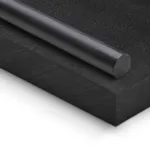
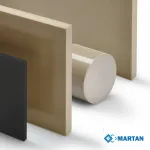
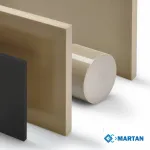
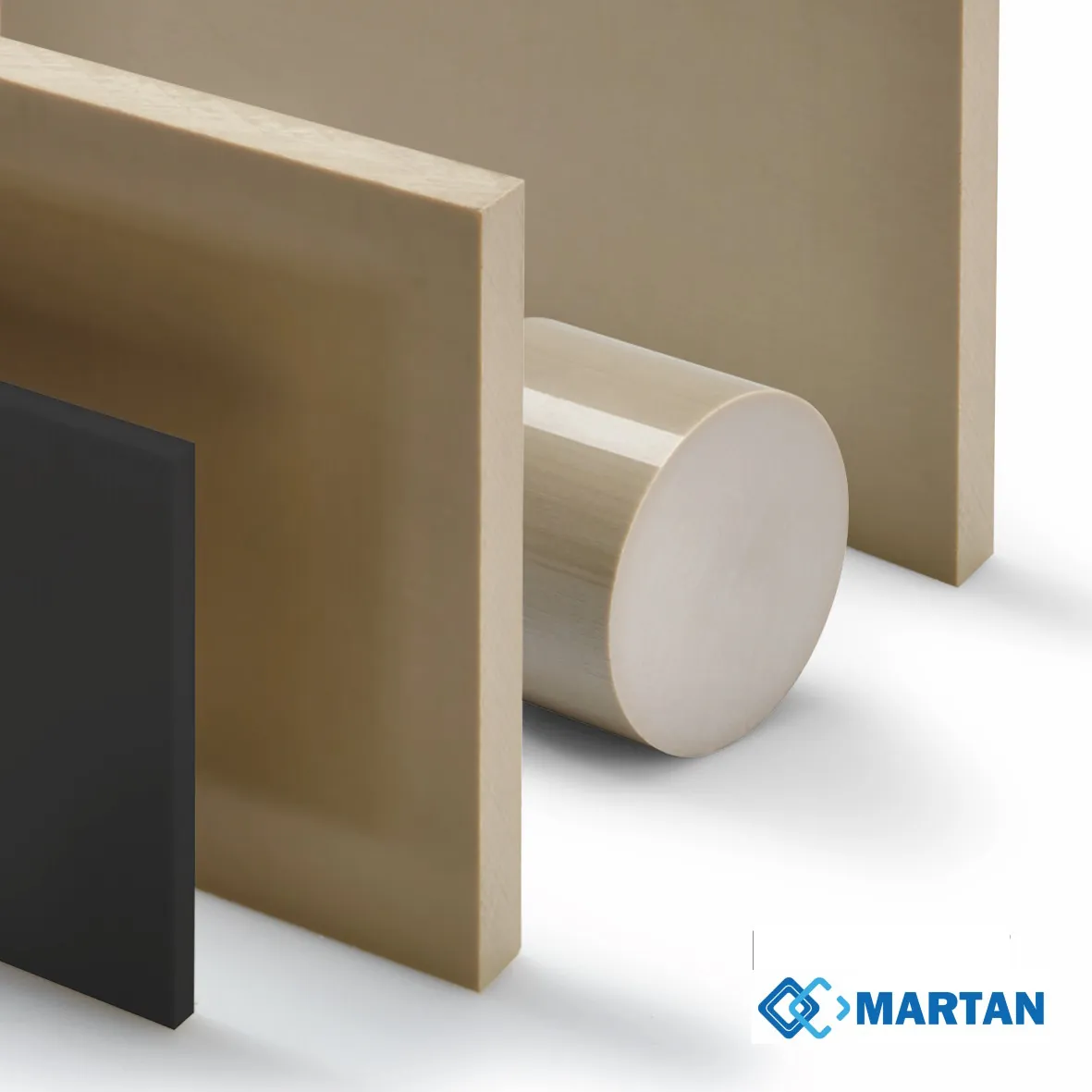
- PEEK sheets for milled parts
- PEEK rods for turned parts
- PEEK tubes for media and insulation applications
Product example for orientation: PEEK sheets natural – semi-finished product
FAQ
What counts as a "thin" PEEK sheet? Typically anything under 5 mm, particularly demanding: 0.3–2 mm.
How tight are the tolerances? Depending on the process, ±0.02 to ±0.15 mm.
Are thin sheets just as temperature-resistant as thick formats? Yes – the material properties are retained.
Can thin PEEK sheets be laser cut or milled? Milling is possible, laser cutting only to a limited extent due to heat input and possible material discolouration.