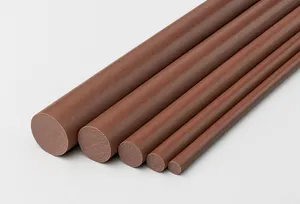
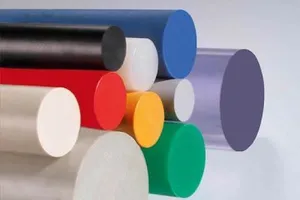
Plastic rods
POM-C rod – cut to size
POM-C rod: precise, versatile and robust POM-C (polyoxymethylene copolymer) is a high-performance plastic which, thanks to its high density of 1.39 - 1.42…
Colour
Description
POM-C rod: precise, versatile and robust
POM-C (polyoxymethylene copolymer) is a high-performance plastic which, thanks to its high density of 1.39 - 1.42 g/cm³, offers enormous strength, stiffness and excellent surface quality. These properties make POM-C a preferred material for technical applications that require tight tolerances and precise machining.
POM-C rods are also characterised by excellent sliding and wear properties, high heat resistance and outstanding dimensional stability. They are ideally suited for use in demanding technical and industrial applications.
In addition to its high strength, POM-C also exhibits low moisture absorption, which makes it particularly suitable for applications in the chemical industry and the automotive industry. The ease of machining and the excellent machinability make POM-C rods an ideal choice for a wide range of applications, from precision engineering to complex turned and milled parts such as gears and pump housings.
POM rod roundProcessing and advantages of POM-C rods
Machining POM-C rods
POM-C rods can be processed very well using common machining methods such as sawing, turning, milling and drilling. Due to the high density and strength of the material, sharp tools should always be used to achieve precise results. POM-C is characterised by excellent machinability, which enables economical production of precise components. Thermal forming is also possible, allowing complex components to be produced.
Thanks to the good chemical resistance of POM-C, the material can also be used in environments where it comes into contact with chemicals without losing stability. The low moisture absorption ensures that the mechanical properties remain constant even at high humidity or in contact with water.
POM-C rod or PA6 rod?
Both POM-C rods and PA6 rods are among the most frequently used engineering plastics in mechanical and plant engineering. The choice of the right material depends on the requirements for wear resistance, moisture absorption, dimensional accuracy and load capacity.
POM-C rods are characterised by very high dimensional accuracy, low water absorption and excellent sliding properties. As a result, POM-C is particularly suitable for precision parts, gears, guides, bearing bushes and components with tight tolerances. Even under changing ambient conditions, the dimensions remain largely constant.
PA6 rods, by contrast, offer high mechanical strength and impact resistance. The material can withstand high loads and is often used for heavily stressed machine parts. However, PA6 absorbs moisture from the environment, which can change its dimensions and properties over time.
For components requiring high precision, good sliding properties and low moisture absorption, a POM-C rod is often the better choice. If high load capacity and toughness are the main requirements, a PA6 rod can offer advantages.
| Property | POM-C rod | PA6 rod |
|---|---|---|
| Dimensional accuracy | Very high | Good |
| Water absorption | Very low | Relatively high |
| Sliding properties | Very good | Good |
| Wear resistance | Very high | High |
| Strength | High | Very high |
| Machinability | Very good | Very good |
| Precision parts | Very well suited | Well suited |
| Impact loads | Good | Very good |
For many applications in mechanical engineering, the food industry or conveyor technology, POM-C is preferred when permanently precise dimensions and low friction are required. PA6 is often used for highly loaded structural parts and robust machine elements.
Machining POM-C rods
POM-C rods can be machined very well mechanically and are among the preferred materials for the production of precise plastic components. Thanks to their high dimensional accuracy, good strength and low friction, they are ideally suited to machining processes.
POM-C can easily be turned, milled, drilled, sawn and threaded. This produces clean cut edges and precise surfaces, which is why the material is often used for technical components with tight tolerances. The low water absorption also helps to ensure that finished components retain their shape and dimensions permanently.
Particularly in mechanical engineering, in conveyor technology and in the food and packaging industry, POM-C rods are further processed into custom finished parts. The material is used, for example, to produce gears, bearing bushes, guide rollers, spacers, sliding elements and precision components.
Possible machining processes for POM-C rods:
-
CNC turning
-
CNC milling
-
Drilling
-
Thread cutting
-
Sawing
-
Waterjet cutting
-
Cylindrical grinding
-
Engraving
Thanks to the excellent machining properties, POM-C is suitable both for individual parts and for series production with high demands on precision and repeatability.
Properties
POM-C rods have numerous advantageous properties that make them a preferred material in various industries:
- High strength and stiffness: POM-C offers high mechanical stability, making it ideal for the production of components that must withstand high loads.
- High impact resistance: Even at low temperatures, POM-C remains impact-resistant and resistant to mechanical stress.
- Excellent sliding and wear properties: Thanks to its low friction and high wear resistance, POM-C is perfectly suited to sliding and bearing applications.
- High dimensional stability: POM-C exhibits excellent dimensional stability, which makes it ideal for precision parts with tight tolerances.
- Low moisture absorption: The material is insensitive to moisture, so it retains its mechanical properties even in humid environments.
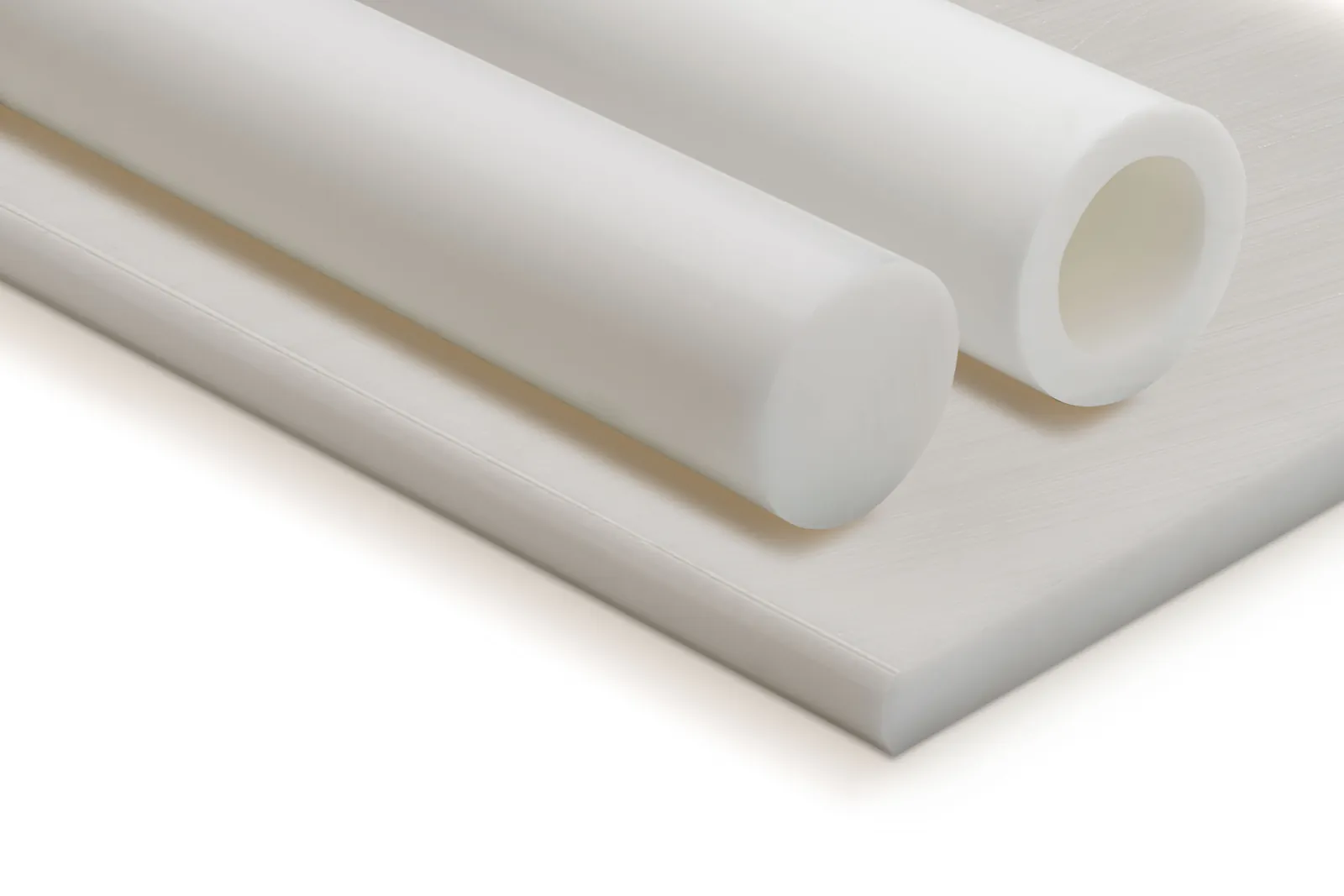
POM rod and sheets
Applications
Typical applications for POM-C rods
POM-C rods are used in numerous industrial sectors for the production of precise and wear-resistant components. Thanks to their high dimensional accuracy, low moisture absorption and very good sliding properties, they are particularly suitable for applications with high demands on precision and continuous load.
In mechanical and plant engineering, POM-C rods are frequently used to manufacture gears, bearing bushes, guide rollers, sliding elements and spacers. The material offers high wear resistance and enables smooth, low-friction operation of moving components.
POM-C is also regularly used in the food industry. The material is used, for example, to produce conveyor technology components, rollers, guides and machine parts that must be permanently load-bearing and easy to clean.
Further typical applications are valve components, precision parts for automation technology, pump parts, insulating components and turned and milled parts for special-purpose machines. Thanks to the very good machinability, POM-C rods can be economically processed into complex finished parts.
Typical components made from POM-C rods are:
-
Gears
-
Bearing bushes
-
Guide rollers
-
Slide rails
-
Spacers
-
Valve parts
-
Pump components
-
Conveyor technology components
-
Turned parts
-
Milled parts
-
Precision parts for mechanical engineering
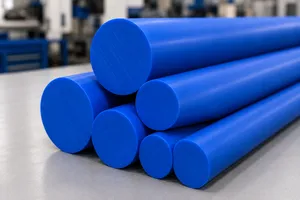
POM rod blue at technischekunststoffe24.de
FAQ on POM-C rods
Are POM-C rods weather-resistant?
POM-C rods are conditionally weather-resistant, but they are not intended for permanent outdoor use, as UV rays can cause changes in the material properties. For outdoor use, suitable measures should be taken to protect against direct sunlight.
How can POM-C rods be machined?
POM-C rods can easily be machined by sawing, turning, milling and drilling. It is recommended to use sharp tools to ensure clean cuts and precision. The material is also ideally suited to machining work, which facilitates the production of precise components.
For which applications are POM-C rods particularly suitable?
POM-C rods are particularly suitable for applications that require high strength, low moisture absorption and good sliding and wear properties. These include plain bearings, guide rails, pump housings, gear components and components in food and medical technology.
Are POM-C rods food-safe?
Yes, POM-C is suitable for food contact in accordance with the requirements of BfR, EU and FDA. It is frequently used in food and medical technology, as it is physiologically harmless and meets high hygiene requirements.
Which colours are available for POM-C rods?
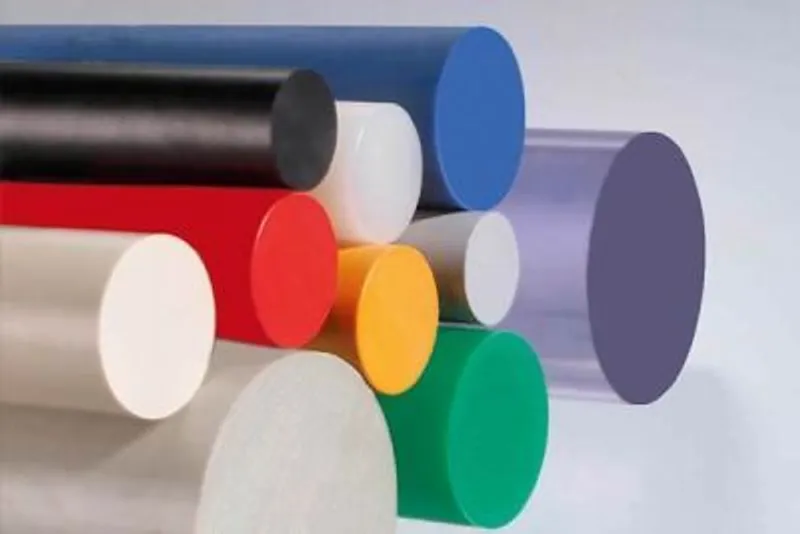
Our POM-C rods are available in the colours black and natural (white). Both variants offer the same outstanding properties and are suitable for various technical and industrial applications.
Use the versatility and robustness of our POM-C rods for your demanding technical projects and benefit from a material that impresses with its high performance, durability and excellent machining properties.
Technical data
- Material: polyoxymethylene copolymer (POM-C)
- Density: 1.39 - 1.42 g/cm³
- Temperature resistance: service temperatures between -40 °C and +100 °C
- Impact resistance: high impact resistance, even at low temperatures
- Moisture absorption: low moisture absorption (0.8 % at saturation)
- Chemical resistance: good resistance to many chemicals, greases and diluted acids
- Heat resistance: high heat resistance at temperatures up to 100 °C
- Machinability: excellent machinability for precise turning and milling work
POM-C rods are available in various diameters and colours, which makes them suitable for diverse technical and industrial requirements. Our rods are available in the colours black and natural and offer a large selection of standard sizes from 10 mm to 500 mm diameter.