How plastic semi-finished products are turned into precision components
How precise components are made from plastic semi-finished products – from material selection through CNC milling & turning to quality inspection.
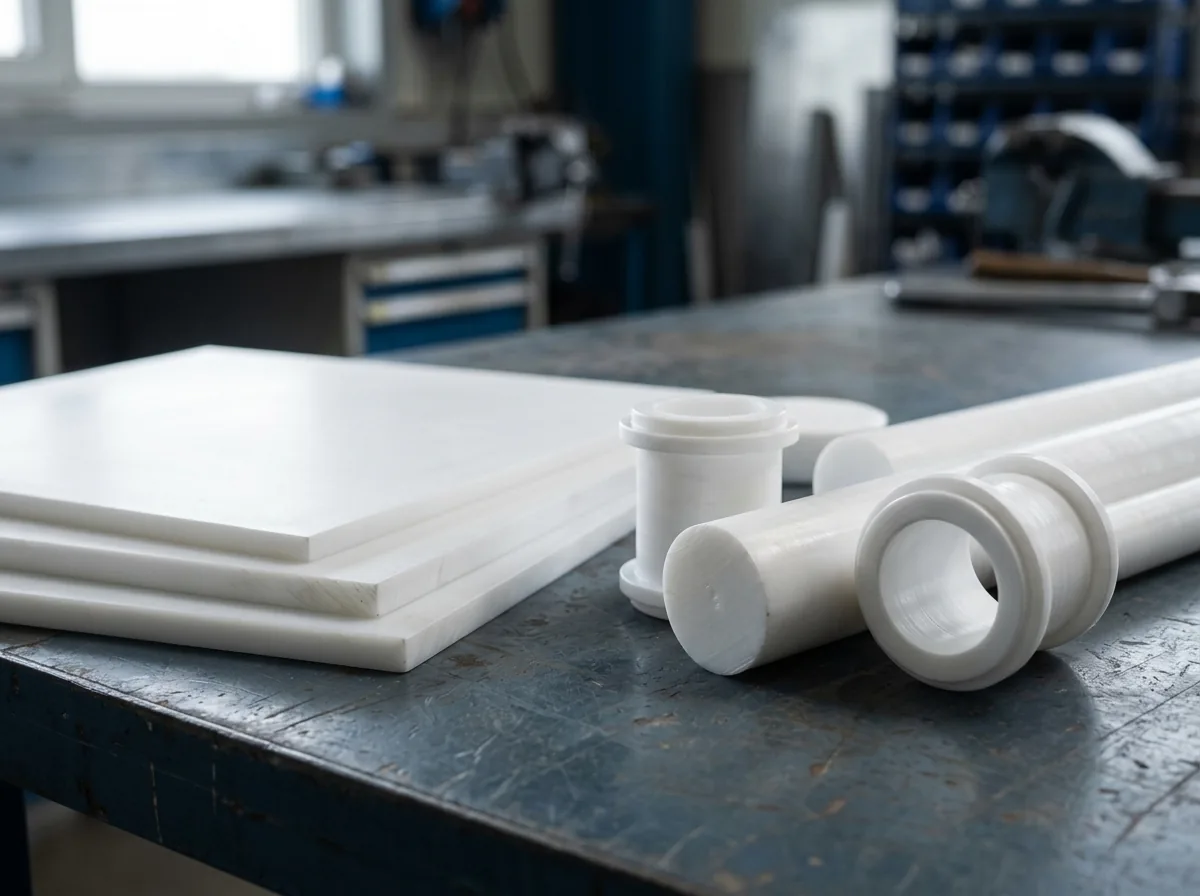
Precise machining turns sheets, rods and other plastic semi-finished products into custom components for demanding industrial applications. It is not enough simply to mill or turn the desired contour out of the material. Material selection, semi-finished product quality, component geometry, clamping technology, machining parameters and tolerances must all be coordinated with one another.
Particularly with engineering plastics and high-performance plastics, material properties such as thermal expansion, stiffness, moisture absorption or toughness directly influence machining and the subsequent dimensional accuracy.
So how does a plastic semi-finished product become a precise, fit-for-purpose component?
1. Determine the requirements for the component
At the beginning comes not the machine, but the later application of the component.
Before production, the following requirements should be known, among others:
- mechanical load
- service temperature
- contact with chemicals or other media
- required dimensional accuracy and tolerances
- friction and wear
- electrical requirements
- desired surface quality
- dimensions and geometry
- required quantity
This information forms the basis for selecting a suitable material and the appropriate machining process.
Particularly with closely toleranced components, it should already be taken into account during design that plastics behave differently from metallic materials.
2. Select the right plastic
The choice of material has a direct influence on the function, service life and machinability of the subsequent precision component.
Numerous plastic materials with different properties are available for technical components.
Typical examples are:
- POM for dimensionally stable and precise mechanical components
- PEEK for demanding applications with high thermal and chemical loads
- PTFE for applications where, for example, chemical resistance and sliding properties are required
- PVDF for chemically stressed components and applications with high purity requirements
Which plastic is suitable therefore always depends on the specific operating conditions.
Subsequent machining must also already be taken into account when selecting the material. A very dimensionally stable plastic places different demands on production than a soft or highly elastic material.
3. Determine the suitable plastic semi-finished product
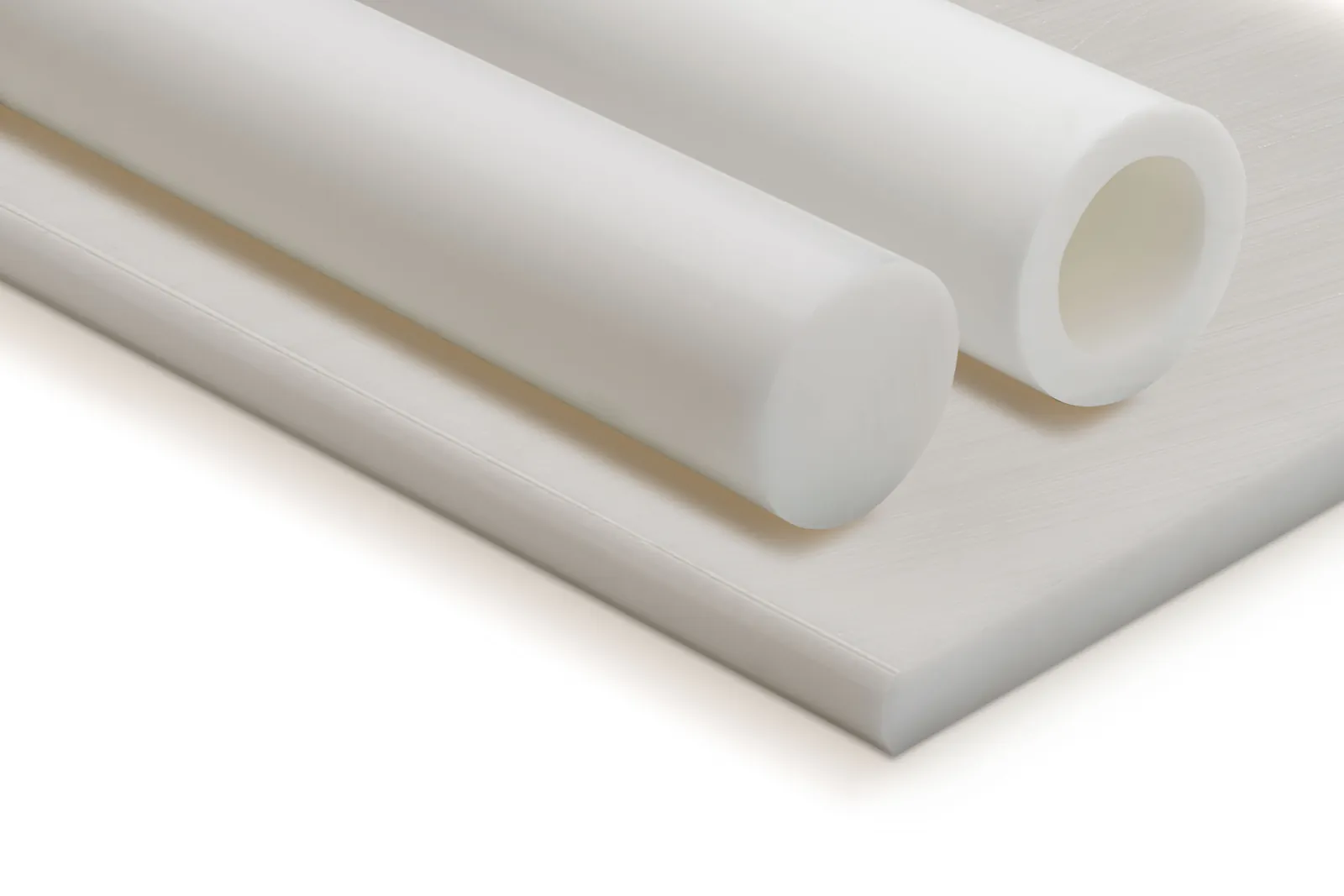
Once the material has been determined, the appropriate semi-finished product form is selected.
Depending on the component geometry, the following may be considered, for example:
- plastic sheets
- rods
- tubes
- profiles
- custom semi-finished products
Choosing the most suitable starting format can reduce material usage and machining effort.
For a rotationally symmetrical component, for example, a rod is often a suitable starting material. Flat or complex contoured components, on the other hand, can often be produced economically from sheets.
In addition to the dimensions, the quality of the semi-finished product also plays an important role. Material condition, internal stresses and manufacturing processes can influence behaviour during subsequent machining.
4. Prepare the semi-finished product to the blank size
Before the actual precision machining, the semi-finished product is brought to a suitable blank size.
Sufficient material remains for the subsequent machining. How large this machining allowance must be depends, among other things, on the material, component geometry and required accuracy.
Already at this stage, care should be taken to machine the material as stress-free and material-appropriately as possible.
The prepared semi-finished product can then be set up for the actual plastic machining.
5. Precision machining by CNC milling or CNC turning
CNC-controlled machining processes are often used to produce complex precision components.
CNC milling for complex geometries
CNC milling of plastic can be used to produce contours, pockets, grooves, holes and complex three-dimensional geometries, among other things.
The process is particularly suitable for components such as:
- guide elements
- holders
- housings
- sheet components
- machine elements
- complex technical moulded parts
Tool geometry, cutting speed, feed rate and clamping technology must be matched to the respective plastic.
CNC turning for rotationally symmetrical components
CNC turning of plastic is suitable for rotationally symmetrical components.
Typical turned parts are, for example:
- bushes
- rollers
- rings
- sleeves
- spacers
- technical functional parts
In turning too, the material properties influence the choice of tools and machining parameters.
Why plastic machining requires special experience
Plastic cannot simply be machined with the same settings as metal.
Several typical material properties must be taken into account.
Heat generation
Plastics have different thermal properties from metallic materials. If too much heat is generated during cutting, this can affect the surface, the geometry or the dimensional accuracy.
Cutting speed, feed rate, tool and chip removal must therefore be matched to the respective material.
Lower stiffness
Many plastics are significantly less stiff than metal. With unfavourable clamping or high machining forces, the workpiece can deform during machining.
Material-appropriate clamping technology is therefore particularly important.
Material stresses
Semi-finished products may exhibit internal stresses due to manufacturing. If a larger proportion of material is removed during machining, these stresses can be released and lead to distortion.
For particularly demanding components, several coordinated machining steps can therefore be sensible.
Different material properties
POM, PA, PEEK, PTFE or PVDF do not react identically during cutting. Tool selection and process parameters must therefore always be matched to the specific plastic.
From roughing to precise finishing
For complex precision components, machining can be carried out in several steps.
First, a larger part of the excess material is removed during roughing. This is followed by the more precise finishing of the functionally relevant surfaces and dimensions.
This approach allows better control over:
- component geometry
- dimensional accuracy
- surface quality
- machining forces
- possible deformation
Which process sequence is sensible depends on the material, geometry and tolerance requirements.
Deburring and post-processing
After milling, turning or drilling, post-processing may be required.
This includes in particular the removal of burrs on edges, holes or threads.
Depending on the component and application, further machining steps may also be necessary to produce the desired surface or function.
The goal is a component that not only meets the specified dimensions but can be directly further processed or assembled for its intended use.
Quality inspection of precise plastic components
After machining, the relevant characteristics of the component are inspected in accordance with the technical requirements.
These may include, for example:
- external and internal dimensions
- hole diameters
- distances
- flatness
- parallelism
- geometrical characteristics
- surfaces
- functionally relevant tolerances
Which inspection methods are required depends on the drawing, the component geometry and the later intended use.
Particularly for recurring series, a reproducible process control is important so that the required properties can be maintained across several production runs.
Which plastics are suitable for precision components?
There is no blanket answer. Different materials offer different advantages.
| Plastic | Typical properties | Examples of applications |
|---|---|---|
| POM | high stiffness, good dimensional stability, good machinability | gears, guides, technical functional parts |
| PA | good mechanical properties and wear resistance | rollers, guides, bearing components |
| PEEK | high thermal and chemical resistance | demanding technical components |
| PTFE | very good sliding properties and high chemical resistance | sealing and sliding elements |
| PVDF | good chemical resistance | plant and process engineering |
For applications with particularly high thermal, mechanical or chemical requirements, it is also worth taking a look at high-performance plastics.
Typical precision components made of plastic
Machined plastic parts are used in numerous branches of industry.
Typical components are, for example:
- bearing bushes
- guides
- rollers
- gears
- insulating parts
- spacers
- sealing components
- housing components
- holders
- custom functional parts
Thanks to the large selection of engineering plastics, mechanical, electrical, thermal and chemical requirements can be specifically taken into account.
From the technical drawing to the finished plastic component
The more precisely the requirements for a component are described, the more specifically the material and production process can be selected.
The following information is particularly helpful for a technical assessment:
- technical drawing or component geometry
- desired material or requirements for the material
- dimensions
- functionally relevant tolerances
- service temperature
- mechanical loads
- media or chemical contact
- required quantity
- special requirements for surface or documentation
On this basis, it can be assessed which semi-finished product and which machining process are suitable for the respective precision component.
Coordinate plastic semi-finished product and machining
A precise plastic component is created through the interaction of a suitable material, high-quality semi-finished product, well-considered design and material-appropriate machining.
Even the choice of starting material influences the subsequent production process. At the same time, CNC milling, CNC turning, clamping technology and machining parameters must be adapted to the respective plastic.
Martan Plastics supports you from the selection of suitable plastic semi-finished products through to precise plastic machining.
Do you need a plastic component to drawing, or would you like to check which material is suitable for your application? Send us your technical requirements and component data for an individual assessment.