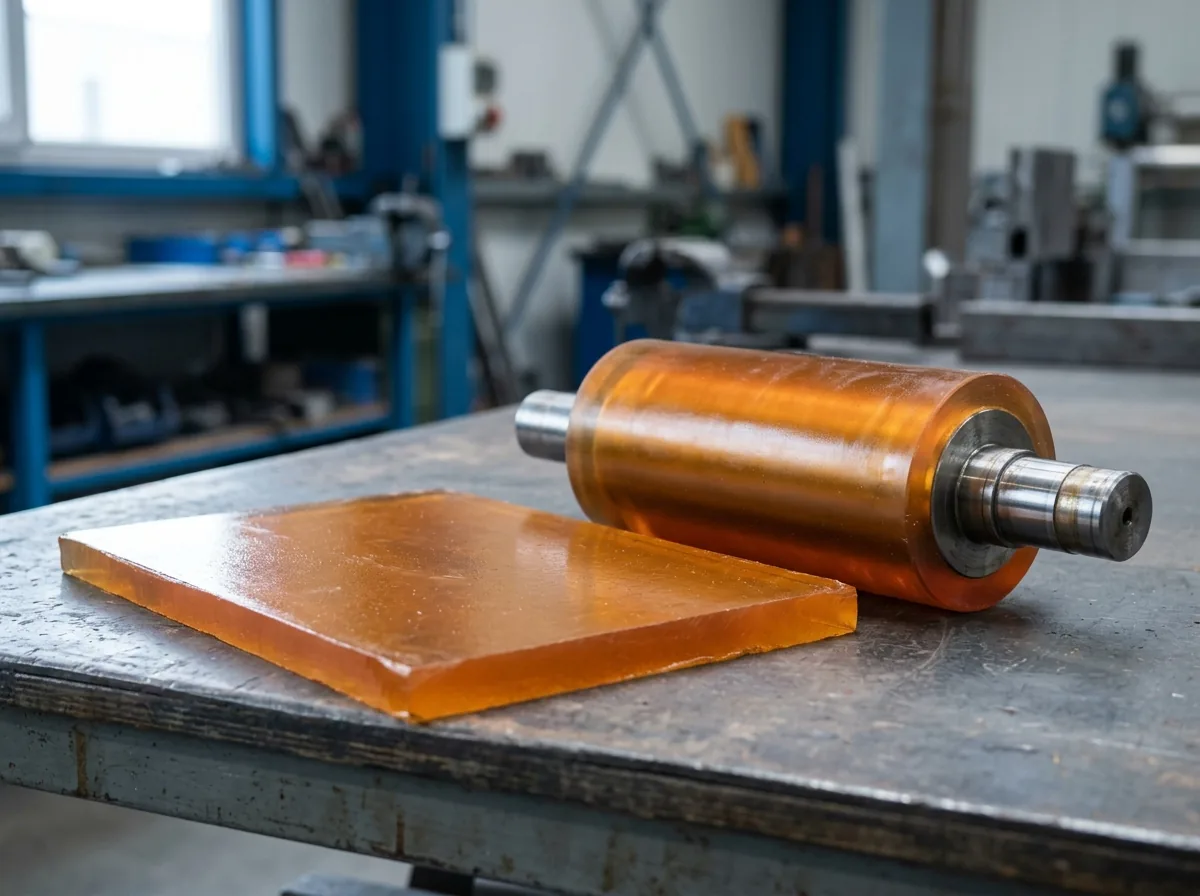
 This image was created with artificial intelligence – marked under Art. 50 of the AI Act, Regulation (EU) 2024/1689. It is a placeholder until the company's photos arrive.
Polyurethane - PUR
Polyurethane elastomers are a family of elastic polymers formed from the reaction of polyols and isocyanates.
Polyurethane - PUR
PU/PUR elastomer
Polyurethane elastomers are elastic materials from the polyurethane material group. In technical usage they frequently appear as PU elastomer or PUR elastomer. The page Elastomers serves as an overview of related materials.
Abbreviation: PU, PUR, polyurethane elastomer
PU and PUR are the abbreviations for polyurethane. In many applications, "PU/PUR elastomer" describes an elastic polyurethane variant that combines resilience with high mechanical load capacity.
Classification: polyurethane vs. elastomer
Polyurethane denotes a material class that, depending on the formulation, ranges from elastic to hard. Elastomers describe the property class "elastically deformable with recovery". Polyurethane elastomers lie at the interface of both terms and are chosen as a material when abrasion, force transmission and dimensional stability play a major role in operation.
Details on the material class can be found under Polyurethane (PU).
Your partner for elastomers
Contact us
Properties of polyurethane elastomers
Polyurethane elastomers combine elastic recovery behaviour with high mechanical load capacity. They are used when conventional rubbers reach their limits or when additional requirements are placed on abrasion, load-bearing capacity or service life.
Mechanical properties
- High abrasion resistance under dynamic load
- Very good tensile and tear strength
- High load-bearing capacity combined with elastic behaviour
- Low permanent deformation under continuous load
Elasticity and hardness ranges
PU elastomers cover a broad hardness range – from rubber-like soft to almost plastic-like hard. This allows properties to be tailored specifically, for example for damping, guiding or force transmission.
Resistances
Compared with many conventional elastomers, polyurethane elastomers show increased resistance to oils, greases and mechanical wear. Temperature and media resistance depend on the respective formulation. For a direct comparison with other rubber materials, the overview of
provides a structured classification.
Production and processing methods for polyurethane elastomers
Polyurethane elastomers are produced using different methods depending on component geometry, quantity and requirement profile. The choice of method influences dimensional accuracy, surface quality and mechanical properties.
Casting (cast polyurethane)
In the casting process, the liquid polyurethane is introduced into open or closed moulds and cured there. This process is particularly suitable for medium quantities, large components and high mechanical requirements.
- Very high abrasion and tear resistance
- Flexible tooling costs
- Suitable for thick-walled or complex components
Injection moulding
In the injection moulding process, the material is injected under pressure into temperature-controlled tools. This process is designed for high quantities and precise geometries.
- High dimensional accuracy and reproducibility
- Short cycle times in series production
- Economical for large batch sizes
Reaction injection moulding (RIM)
In reaction injection moulding, the starting components react directly in the mould. This process lies between classic casting and injection moulding and is used for large or structurally loaded components. Further information on individually manufactured components can be found under
.
Areas of application for polyurethane elastomers
Polyurethane elastomers are used when components are permanently subjected to mechanical load and elastic properties are required at the same time. They are used above all where abrasion, impact load and dynamic forces play a central role.
Mechanical and plant engineering
In mechanical engineering, PU elastomers are used for rollers, guides, damping elements and protective components. The combination of elasticity and wear resistance supports stable continuous operation.
Conveying and transport technology
In conveying technology, polyurethane elastomers are used in drive and deflection rollers, coatings and buffer elements. The high abrasion resistance contributes to long service lives.
Vehicle and commercial vehicle technology
PU elastomers are used for bearings, stops, dampers and protective elements where alternating loads occur.
Industrial components and special parts
For application-specific requirements, polyurethane elastomers are frequently manufactured as customised components. Details on individual manufacturing are described on the page custom rubber moulded parts.
Polyurethane elastomers compared with classic rubber elastomers
Polyurethane elastomers are frequently used as an alternative to classic rubber elastomers when higher mechanical requirements exist. The differences are evident above all in abrasion behaviour, load-bearing capacity and service life.
PU elastomers vs. NBR
NBR is used above all for its oil and fuel resistance. By comparison, polyurethane elastomers offer higher abrasion and tear resistance and are preferred for dynamic stress.
PU elastomers vs. EPDM
EPDM is characterised by good weather and ozone resistance. Polyurethane elastomers are chosen when mechanical load capacity and wear resistance are the priority.
PU elastomers vs. NR
Natural rubber has very good recovery behaviour. Polyurethane elastomers complement this material range with higher load-bearing capacity and better abrasion values.
A detailed overview of common elastomer materials is available under elastomer materials.
Selection criteria for polyurethane elastomers
A suitable polyurethane elastomer is selected on the basis of mechanical, thermal and operational requirements. A structured assessment supports a reliable material decision.
Mechanical load
Polyurethane elastomers are suitable for applications with high compressive, tensile or abrasion load. Hardness, tear strength and recovery behaviour are adapted to the respective load.
Temperature range
The permissible service temperature range depends on the polyurethane formulation. For applications with elevated temperatures or changing climatic conditions, a material-specific adjustment is required.
Media contact
In contact with oils, greases or other media, chemical resistance should be specifically tested. Polyurethane elastomers can be formulated for different media requirements.
Geometry and quantity
Component geometry and planned quantities influence the choice of manufacturing method. For individual components, production as rubber moulded parts is a suitable option.
Frequently asked questions about polyurethane elastomers
What is a polyurethane elastomer?
A polyurethane elastomer is an elastic material from the polyurethane material group that combines high mechanical load capacity with elastic recovery behaviour.
What are PU elastomers used for?
PU elastomers are used for rollers, damping elements, bearings, protective components and moulded parts in mechanical engineering, plant engineering and vehicle construction.
What advantages do polyurethane elastomers offer over rubber?
Polyurethane elastomers offer high abrasion resistance, high load-bearing capacity and long service lives under dynamic load.
In which hardness grades are PU elastomers available?
PU elastomers are available in a broad hardness range – from soft-elastic to almost plastic-like.
Are polyurethane elastomers suitable for custom-made parts?
Polyurethane elastomers are very well suited to individual geometries and application-specific components. Further information can be found under custom rubber moulded parts.
Advantages you can expect from Martan Gummi
Large selection of rubber mats, rubber sheets, O-rings
Individual solutions on site
Rubber processing and sealing technology
Designing, drafting and drawing your parts
The highest degree of precision
XXL - machine park, plotting, punching, bonding
Contact us
REQUEST YOUR NON-BINDING QUOTE NOW
Submit individual enquiry
Our industries
Mechanical & plant engineering
Conveying technology
Food industry
Automotive industry
Packaging industry
Medical / laboratory technology
Vehicle technology
Water technology
Aerospace industry
Rail technology
Shopfitting
Aviation industry
Mechanical & plant engineering
Conveying technology
Food industry
Automotive industry
Packaging industry
Medical / laboratory technology
Vehicle technology
Water technology
Aerospace industry
Rail technology
Shopfitting
Aviation industry
Contact us



