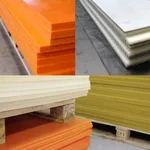
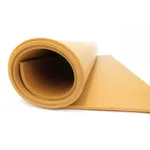
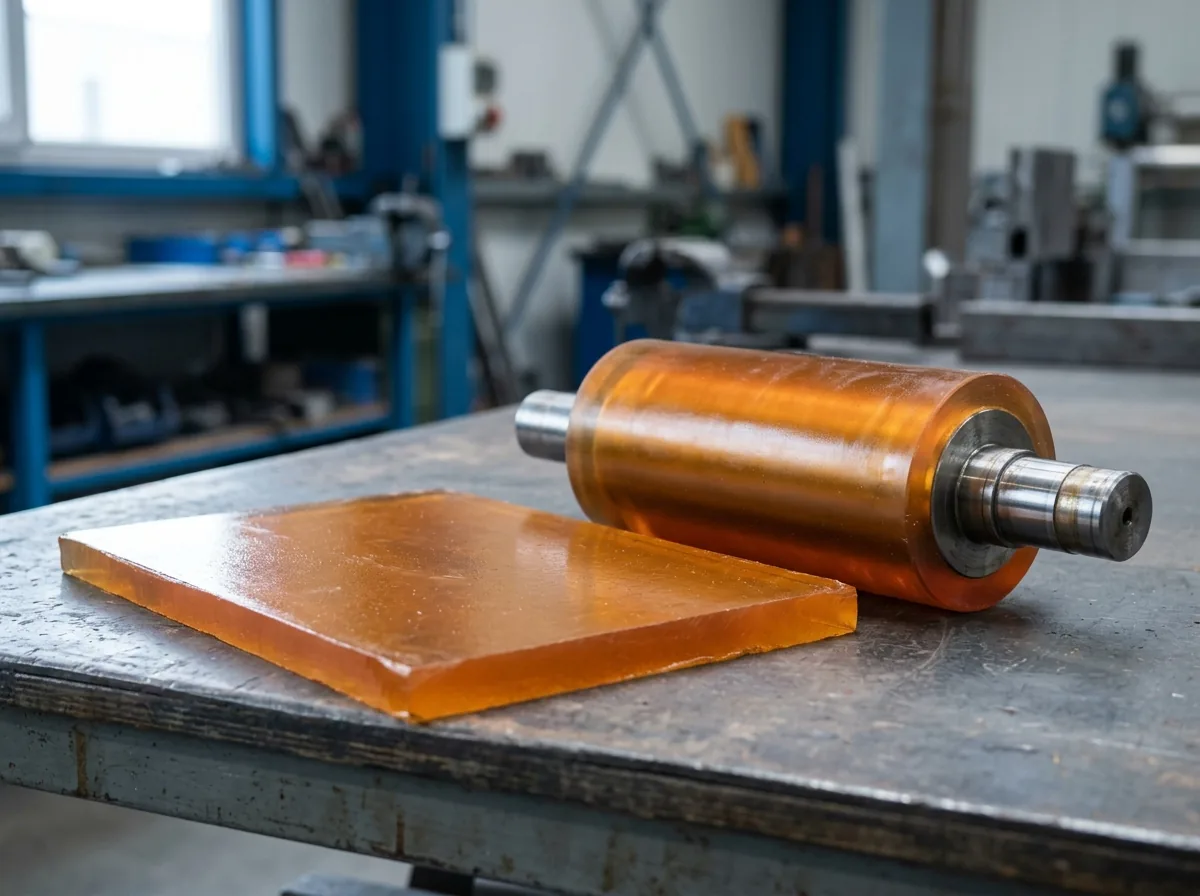
 This image was created with artificial intelligence – marked under Art. 50 of the AI Act, Regulation (EU) 2024/1689. It is a placeholder until the company's photos arrive.
Polyurethane (PU)
What is polyurethane? Everything about properties, strength, flexibility and typical applications – explained concisely.
Polyurethane belongs to the group of thermosets
Polyurethane, PU for short, is a versatile engineering elastomer material with a broad spectrum of properties. It combines the elasticity of classic rubbers with the mechanical load-bearing capacity of engineering plastics. This makes polyurethane suitable for applications with high demands on abrasion resistance, load-bearing capacity and service life.
In industrial use, PU is primarily used where permanent mechanical stress occurs. Typical characteristics are high tear strength, good recovery properties and very good resistance to wear. Depending on the formulation, polyurethane can be set to be soft-elastic or hard-elastic.
Polyurethane belongs to the group of elastomers and is often used as an alternative to natural rubber, NBR or EPDM when longer service lives or better mechanical load-bearing capacity are required. An overview of related materials can be found in the Elastomers and rubber materials section.
Properties of polyurethane
Polyurethane is characterised by a combination of elastic and highly load-bearing properties. The material can be specifically adapted to technical requirements and covers a broad spectrum of mechanical loads.
Mechanical properties
PU has a very high abrasion resistance and tear strength. Compared with many classic rubber materials, polyurethane achieves significantly longer service lives under dynamic stress. The high recovery capacity ensures dimensionally stable components even under permanent load.
Hardness range and elasticity
The hardness range of polyurethane extends from soft-elastic to hard-elastic. This makes the material suitable for both damping and load-bearing applications. The elastic properties remain stable across a large load range.
Wear and ageing resistance
Polyurethane shows very good resistance to mechanical wear. In addition, the material is ageing-resistant and retains its properties over long periods of use. This makes PU particularly suitable for continuous industrial applications.
Compared with other elastomers and rubber materials, polyurethane is preferred when high mechanical load-bearing capacity and low wear are required.
Areas of application for polyurethane
Polyurethane is used in numerous industrial applications where high mechanical load-bearing capacity, wear resistance and elasticity are required. The material is particularly suitable for components subject to dynamic stress and long service lives.
Mechanical and plant engineering
In mechanical engineering, polyurethane is used for rollers, damping elements, strippers and guides. The high abrasion resistance and good recovery capacity ensure reliable continuous operation even under varying loads.
Conveying and transport technology
In conveying technology, PU is used among other things for conveyor rollers, coatings and buffer elements. Polyurethane reduces wear and noise generation and helps to protect adjacent components.
Seals and elastic components
Polyurethane is suitable for technical seals, moulded parts and elastic connecting elements where mechanical load-bearing capacity is the priority. For classic sealing tasks, PU is often used in addition to other elastomers.
Depending on the area of application, polyurethane can be specifically chosen as an alternative to NBR, EPDM or natural rubber when longer service lives or better mechanical performance are required.
Polyurethane compared with other elastomers
Polyurethane differs significantly from classic elastomers such as NBR or EPDM in several technical respects. The choice of the suitable material depends on the respective area of application and the mechanical requirements.
Polyurethane vs. NBR
Compared with NBR, polyurethane offers higher abrasion resistance and tear strength. NBR is particularly suitable for oil- and fuel-resistant applications, while PU is preferably used under heavy mechanical stress.
Polyurethane vs. EPDM
EPDM is characterised by high weather and ageing resistance. Polyurethane, by contrast, is chosen when mechanical load-bearing capacity, dimensional stability and wear resistance are the priority.
Classification within the elastomers
Polyurethane closes the gap between classic rubber materials and engineering plastics. A systematic overview of related materials is provided by the Elastomers and rubber materials section.
The selection of the suitable elastomer is always based on the specific loads, media resistance and the desired service life.
Forms and processing methods of polyurethane
Polyurethane can be processed by different methods. The choice of processing method has a decisive influence on the mechanical properties, dimensional accuracy and possible applications of the components.
Cast polyurethane
Cast polyurethane is often used for technically demanding moulded parts. The casting process allows the production of complex geometries with high density and very good mechanical properties. This process is particularly common for individual parts and small series.
Injection-moulded polyurethane
Injection-moulded PU is suitable for series components with high dimensional accuracy. The process enables reproducible quality and is used primarily for standardised components.
Polyurethane coatings
Polyurethane is also used as a coating material to protect surfaces from wear. Typical applications are rollers, rolls or heavily stressed contact surfaces.
The choice of the suitable processing method depends on the quantity, geometry and the required properties of the component. A classification of related materials is possible in the Elastomers and rubber materials section.
Resistances of polyurethane
Polyurethane offers a balanced resistance to mechanical, chemical and thermal influences. The actual resistance depends on the respective PU formulation and the operating conditions.
Media resistance
PU shows good resistance to many oils, greases and lubricants. The material generally remains stable against water and aqueous solutions. Resistance to solvents and aggressive chemicals depends on the type of polyurethane used.
Temperature resistance
Polyurethane is designed for a medium temperature range. Higher temperatures are possible for short periods, but continuous loading should be designed to suit the material in order to avoid changes in properties.
Environmental and ageing resistance
PU has good ageing stability under continuous mechanical stress. Under permanent UV or weather exposure, additional design measures or a suitable material comparison may be advisable.
For applications with special requirements on media or environmental resistance, a comparison with other elastomers is recommended.
Selection criteria for polyurethane
Polyurethane is suitable for applications where mechanical load-bearing capacity, wear resistance and elastic behaviour are required in combination. The material selection is always based on the real operating conditions.
Mechanical stress
PU is preferably used when components are permanently exposed to high compressive, tensile or frictional forces. The high abrasion resistance ensures long service lives even under dynamic load.
Service life and maintenance effort
Due to the high mechanical stability, maintenance intervals can be extended with polyurethane. This is particularly advantageous in continuously operated plants.
Distinction from other elastomers
Polyurethane is chosen when classic rubber materials such as NBR or EPDM are subjected to heavier mechanical loads. A cross-material comparison is possible in the Elastomers and rubber materials section.
The final material decision should always be made taking into account temperature, media contact and mechanical stress.
Polyurethane at Martan Gummi
Martan Gummi offers polyurethane solutions for industrial applications with high demands on wear resistance, load-bearing capacity and service life. The material is selected on a project-specific basis and adapted to the respective application.
Depending on the area of application, different polyurethane grades and processing methods are used. This enables the realisation of both standardised components and individual moulded parts for special requirements.
The selection of the suitable polyurethane is based on the mechanical load, the ambient conditions and the desired service life. In addition, it is checked whether alternative elastomers and rubber materials are technically advisable.
For a material-appropriate design and technical clarification, expert advice is available. An enquiry can be made directly via the contact page.
Frequently asked questions about polyurethane
What is polyurethane?
Polyurethane is an engineering elastomer material that combines elastic properties with high mechanical load-bearing capacity. It is used for heavily stressed industrial components.
Is polyurethane a rubber?
Polyurethane belongs to the group of elastomers. Compared with classic rubber materials, PU offers higher abrasion resistance and load-bearing capacity.
What is polyurethane used for?
Polyurethane is used in mechanical and plant engineering, in conveying technology and for rollers, damping elements and technical moulded parts.
How abrasion-resistant is polyurethane?
PU has a very high abrasion resistance and is suitable for applications with continuous friction or sliding stress.
Is polyurethane temperature-resistant?
Polyurethane is designed for a medium temperature range. The exact temperature resistance depends on the respective formulation.
When is polyurethane the right choice?
Polyurethane is suitable when mechanical load-bearing capacity, wear resistance and long service lives are required. A comparison with other elastomers and rubber materials supports the selection.