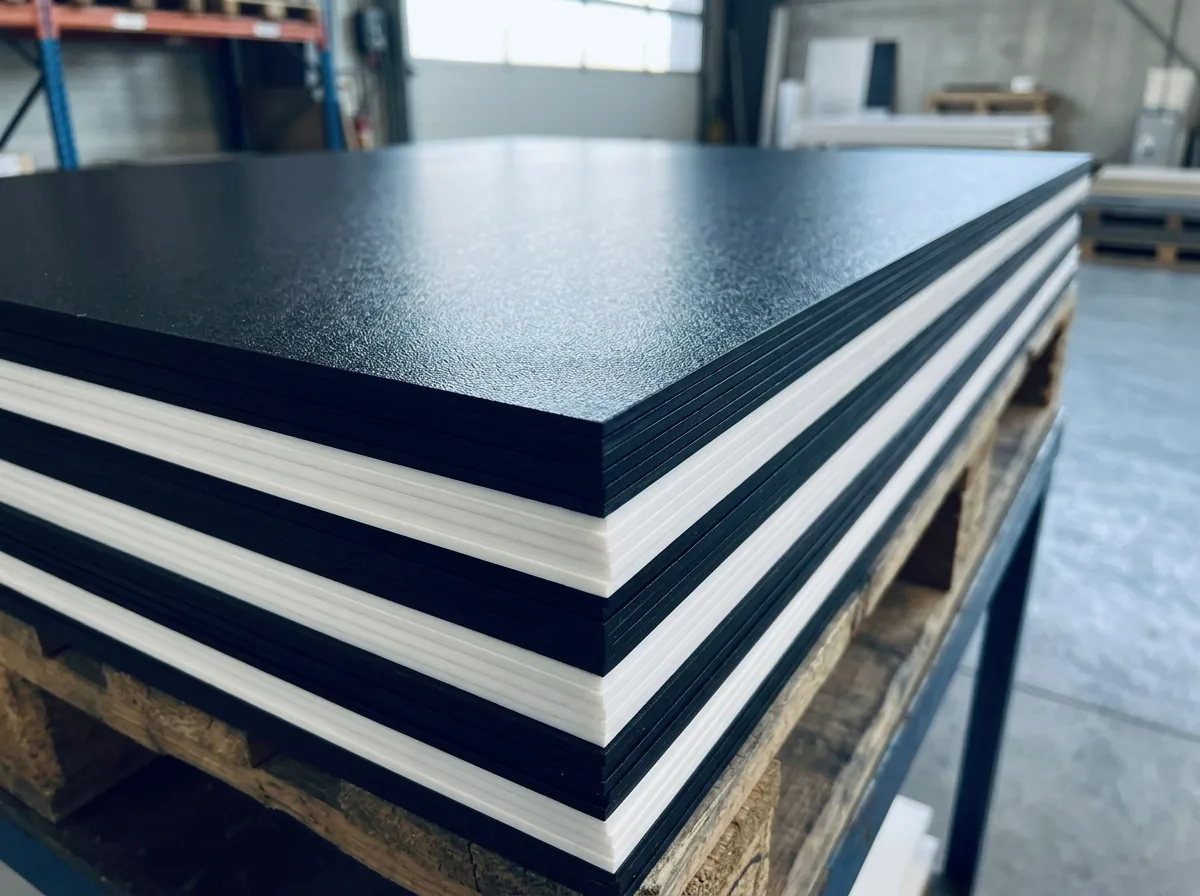
 This image was created with artificial intelligence – marked under Art. 50 of the AI Act, Regulation (EU) 2024/1689. It is a placeholder until the company's photos arrive.
Laser marking of plastics – what matters?
Laser marking of plastic explained: suitable plastics, laser types, laser labelling and the difference from laser engraving.
Why plastics are laser-marked
Laser marking of plastic enables permanent, precise and non-contact identification of plastic parts. In numerous industries, components are marked by laser with serial numbers, data matrix codes, barcodes, technical information or logos. Laser marking of plastic therefore supports both unambiguous identification and traceability as well as automated production and quality assurance processes.
In contrast to labels, inks or other applied markings, laser marking requires no additional consumables. Depending on the plastic, colour, additives and the laser used, permanently legible and high-contrast markings are produced.
Requirements for successful laser marking of plastic
The effectiveness of laser marking depends largely on the plastic used and its composition. Not all plastics react equally to laser radiation. Pigmentation, additives, fillers and the surface structure therefore influence the marking result.
Materials such as ABS, polyamide (PA), polycarbonate (PC), POM, PET, polypropylene as well as high-performance plastics such as PEEK can be suitable for laser marking. The specific markability, however, always depends on the particular material grade, colouring and additive formulation.
Dark-coloured plastics often allow high-contrast markings, depending on their composition. With light or transparent plastics, on the other hand, an adapted wavelength or special laser-active additives may be required. Fillers such as glass fibres or carbon black also influence the interaction between laser radiation and material.
For reproducible laser marking on plastic, the material, wavelength and process parameters such as power, pulse duration and frequency must therefore be matched to one another.
Which laser types are used for plastic laser marking?
Depending on the type of plastic and the desired marking result, different laser systems are used.
Fibre lasers
Fibre lasers can be used in particular for correspondingly absorbing or laser-additivated plastics. Depending on the material composition, high-contrast and rapidly produced markings can be achieved with them.
CO₂ lasers
CO₂ lasers are used for various organic materials and plastics. Depending on the material, surface changes or targeted material removal can occur.
UV lasers
UV lasers are particularly interesting for temperature-sensitive, light or transparent plastics. The short wavelength can reduce the thermal load on the component and enable a very fine marking.
Typical processes in laser marking of plastic
In laser marking of plastic, the laser can trigger different material reactions. Which process is suitable depends on the material and the desired appearance.
- Colour change: The material structure or contained pigments react to the laser energy and produce a visible colour contrast.
- Foaming: Local gas formation creates a slightly foamed surface, which can produce a light marking, particularly on dark plastics.
- Material removal or laser engraving: Material is removed in a targeted manner and a tactile recess is created.
- Surface modification: The laser specifically changes the structure or reflection behaviour of the surface.
Application examples from industry
Medical technology
In medical technology, permanent identification of instruments, housings and technical components is particularly important. Laser marking enables identification with serial numbers, data matrix codes and other identification features, among other things.
Further information on typical fields of application for engineering plastics can be found in the Medical technology section.
Automotive industry
The automotive industry uses laser markings for the traceability of components and for quality control. Plastic parts such as connectors, housings or control elements can be permanently marked with codes, symbols or serial numbers.
Electronics
In the electronics industry, laser markings are used, among other things, on plastic housings, connectors and other components. Particularly with small components, high resolution and permanently machine-readable markings are advantageous.
Consumer goods
Logos, type designations and decorative markings can also be produced permanently on plastic surfaces with suitable laser processes.
Which plastics are suitable for laser marking?
Not every plastic can be marked equally well with a laser. The actual suitability depends on the polymer base, the colouring, contained additives and the laser system used.
| Plastic | Suitability for laser marking | Typical applications |
|---|---|---|
| ABS | often very good | Housings, electronics, consumer goods |
| PA – polyamide | good to very good | Mechanical engineering, vehicle construction |
| PBT | often very good | Connectors, electronics |
| PC – polycarbonate | good to very good | Electronics, displays, technical housings |
| PEEK | depending on grade and additive formulation | High-performance components, medical technology |
| PPS | good to very good | Electronics, high-temperature applications |
| POM | depending on grade and additive formulation | Precision parts, gears, bearings |
| PET | depending on grade and colouring | Technical components |
| PMMA | depending on process and desired marking | Displays, signs, advertising technology |
Particularly for planned series production, therefore, not only the type of plastic but the specific material grade should be checked. If a standard plastic does not show a sufficient laser reaction, targeted plastic modification or additive formulation can improve markability.
Laser marking or laser engraving of plastic – what is the difference?
Laser marking and laser engraving of plastic are not identical. With laser marking, the focus is on a permanently visible identification. For this purpose, the laser can, for example, produce a colour change, foaming or another local material change without creating a pronounced recess.
In laser engraving of plastic, on the other hand, material is removed in a targeted manner. This creates a tactile recess in the surface.
Laser marking is particularly suitable for serial numbers, data matrix codes, barcodes, QR codes, symbols or logos. Laser engraving can be useful if a clearly pronounced surface structure is additionally desired.
Which method is better suited depends on the plastic, the component geometry, the desired identification and the requirements for the surface.
Advantages of laser marking of plastic parts
Laser marking of plastic parts offers several advantages over labels, inks or printing processes:
- permanently legible and abrasion-resistant markings
- high precision even with small fonts and codes
- non-contact processing
- no inks or labels required
- rapid adaptation of changing marking content
- good integration into automated production processes
- unambiguous identification and traceability
- even complex or small plastic parts can be marked
Laser marking of black plastics
With black plastics, the focus is in particular on sufficient light-dark contrast. Depending on the polymer, pigmentation and laser, a light identification on dark material can be produced, for example, by foaming or a targeted colour change.
For laser marking of black plastic parts, suitable variants of PA, PBT, ABS, PC, PEEK or PPS, among others, are an option. With some materials, laser-active additives improve absorption and thus the achievable contrast.
Before series production, the material grade, colouring, laser source and process parameters should therefore be tested together.
Challenges in laser marking of plastics
A typical challenge is insufficient contrast on light or transparent plastics. Here, a different laser wavelength, adapted process parameters or suitable additives can help.
Excessive energy input should also be avoided. Depending on the plastic and component geometry, thermal changes, distortion or unwanted damage to the surface can otherwise occur.
For applications with high requirements for traceability or machine readability, contrast, code quality and repeatability should additionally be tested under realistic operating conditions.
Frequently asked questions about laser marking of plastic
Which plastics can be marked with a laser?
Many engineering plastics can be laser-marked. Depending on the specific material grade, these include, for example, ABS, PA, PBT, PC, POM, PET, PEEK and PPS. The actual suitability depends on colour, additives, fillers and the laser wavelength used.
Can plastic be laser-engraved?
Yes. In laser engraving of plastic, material is removed from the surface in a targeted manner. In contrast to many laser marking processes, this creates a tactile recess.
What is the difference between laser marking and laser engraving with plastic?
With laser marking, above all a visible marking is produced, for example by colour change or foaming. With laser engraving, the laser removes material and creates a recess.
Which laser is suitable for marking plastic?
That depends on the plastic and the desired result. Depending on the application, fibre lasers, CO₂ lasers and UV lasers are used, among others. Particularly with sensitive or transparent plastics, a UV laser can offer advantages.
Can black plastic parts be marked with a laser?
Yes. With a suitable material composition, high-contrast light markings can be produced on black plastics. Laser-active additives can further improve the markability of certain materials.
Can plastic parts be laser-marked with serial numbers or data matrix codes?
Yes. Laser marking is particularly suitable for variable content such as serial numbers, data matrix codes, QR codes and barcodes and is therefore frequently used for industrial traceability.
Suitable material selection for laser-marked plastic parts
For permanently legible laser marking, the material, colouring and subsequent marking process should already be taken into account during material selection. Martan Plastics supports you in selecting suitable engineering plastics and supplies semi-finished products, cut pieces as well as machined plastic parts for industrial applications.
If you have questions about the suitable material grade, you can submit your requirements directly via the Enquiry.






