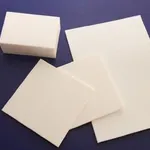
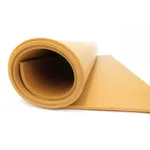
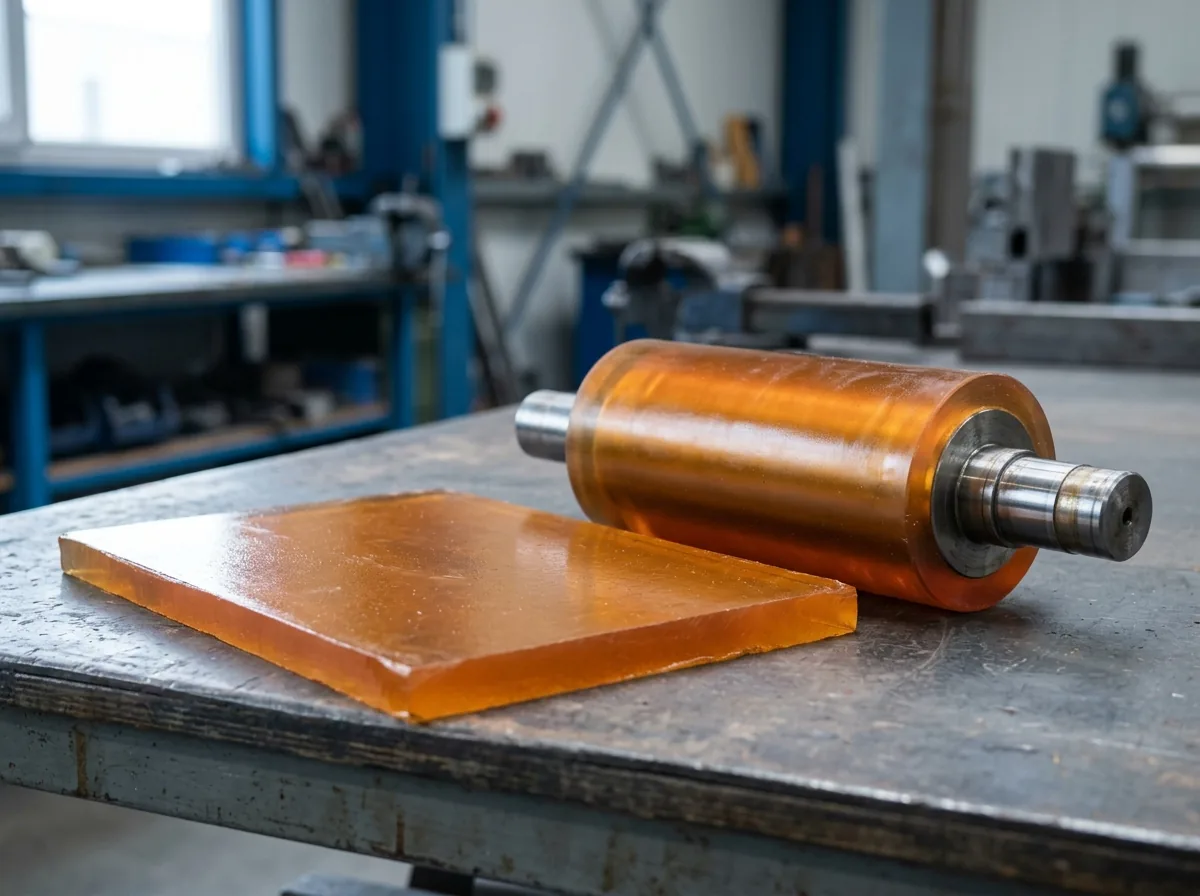
 This image was created with artificial intelligence – marked under Art. 50 of the AI Act, Regulation (EU) 2024/1689. It is a placeholder until the company's photos arrive.
Sealing materials for special requirements
Sealing materials for special requirements: heat-resistant, chemically resistant, pressure-resistant, approved. Overview for industry.
Industry & Technology
Your partner for elastomers
Polyurethane elastomers are a family of elastic polymers formed from the reaction of polyols and isocyanates. They are characterised by a wide range of properties that make them suitable for a broad spectrum of applications in various industries.
Contact us
Benefits you can expect from Martan Gummi
Large selection of rubber mats, rubber sheets, O-rings
Custom solutions on site
Rubber machining and sealing technology
Designing, drafting and drawing your parts
The highest level of precision
XXL machine park, plotting, punching, bonding
Contact us
Seals perform a central function in technical applications. They reliably separate media from one another, compensate for manufacturing and assembly tolerances and safeguard processes over long periods. In many industrial applications they act as inconspicuous yet safety-relevant components whose failure can have considerable consequences.
Standard materials fulfil these tasks reliably under normal conditions. However, as soon as extreme temperatures, aggressive media, high pressure, dynamic load cycles or industry-specific approvals come into play, conventional solutions quickly reach their limits. Sealing materials for special requirements are developed precisely for these application scenarios and form the basis for stable, predictable and economical processes in demanding environments.
What characterises special requirements for sealing materials
Special requirements often arise from the combination of several load factors. In practice, temperature, medium, pressure and mechanical influences rarely act in isolation but simultaneously. This considerably increases the demands on the material, construction and processing of the seal. Even small deviations in material selection can lead to leaks, increased wear or unplanned downtime.
Another aspect is the increasing technisation of industrial processes. Higher process speeds, more compact designs and stricter environmental regulations further increase the importance of specialised sealing materials.
Special requirements arise from the area of application. Typical drivers are chemical exposure, thermal extremes, regulatory requirements or mechanical stress. In these cases, the right material choice determines service life, maintenance intervals and operational safety.
High-temperature-resistant sealing materials
High-temperature-resistant seals are used wherever continuous thermal loads exceed the properties of classic elastomers. Typical fields of application are exhaust systems, heat exchangers, industrial furnaces and energy-intensive production plants.
Alongside pure temperature resistance, factors such as thermal expansion, creep behaviour and oxidation resistance also play a role. Materials must reliably maintain their sealing effect even under repeated temperature changes.
Typical materials are:
In high-temperature applications, for example in plant engineering, in energy technology or in thermal processes, materials are required that retain their properties even under continuously high heat.
Typical materials are:
- Graphite seals for high temperatures and pressures
- Metallically reinforced seals for extreme thermal load
- High-temperature fibre materials for flexible applications
These materials are characterised by dimensional stability, low relaxation and high media resistance.
Chemically resistant sealing materials
Chemical resistance is one of the most common special requirements for seals. Even minor incompatibilities between medium and material can cause swelling, embrittlement or material degradation.
In practice, a detailed media analysis is required. Concentration, temperature, flow rate and possible cleaning media significantly influence material suitability. Particularly in the process industry, long-lasting seals are an important factor for plant availability.
Proven solutions are:
In the chemical, pharmaceutical and process industries, seals are permanently in contact with aggressive media. Acids, alkalis, solvents or gases require materials with high chemical resistance.
Proven solutions are:
- PTFE-based sealing materials
- Modified fibre material seals
- Elastomers with a special formulation for media contact
The selection is always made depending on the medium and temperature and should be based on tested resistance lists.
Seals for high pressures and dynamic load
High system pressures and dynamic loads frequently occur in mechanical engineering, in hydraulic applications and in energy technology. Alongside static pressure, vibrations, pulsations or changing load conditions often act here.
Under these conditions, sealing materials must build up uniform surface pressure and permanently compensate for setting phenomena. The design of the seal therefore always takes place in interaction with flange geometry, bolt force and surface quality.
Used among others are:
High pressure, pressure changes or vibrations place special demands on mechanical stability. In such applications, seals are required that minimise setting phenomena and seal permanently.
Used among others are:
- Metallic seals
- Spiral-wound gaskets
- Highly compressed fibre material seals
The combination of material, seal geometry and flange system is decisive here.
Hygienic and regulated applications
In hygienically sensitive areas, alongside the technical sealing function, product safety is above all the focus. Sealing materials must not release any substances, must be easy to clean and must exhibit high resistance to cleaning processes.
In addition, documentation, traceability and conformity certificates play a central role. Manufacturers and operators must ensure that the materials used comply with the respective industry-specific requirements.
Typical requirements are:
In the food, pharmaceutical and medical technology sectors, strict specifications apply. Sealing materials must be tasteless, low-migration and compliant with applicable standards.
Typical requirements are:
- FDA or EU conformity
- Smooth, easy-to-clean surfaces
- Resistance to cleaning and disinfecting agents
Specially approved elastomers and PTFE variants are used here.
Comparison of selected sealing materials
| Requirement | Suitable materials | Typical areas of application |
|---|---|---|
| High temperatures | Graphite, metal | Energy, plant engineering |
| Chemical media | PTFE, special fibre materials | Chemicals, process industry |
| High pressure | Spiral-wound, metal | Mechanical engineering |
| Hygiene | FDA elastomers, PTFE | Food, pharmaceuticals |
Selecting the right sealing material
Selecting the right sealing material begins with a clear definition of the operating conditions. Alongside medium, temperature and pressure, the installation situation, maintenance cycles and possible downtime costs should also be taken into account.
In many cases, a cross-material consideration is advisable. Modern sealing solutions combine different materials or use coatings to cover several requirements at once. A systematic assessment reduces risks already in the design phase.
Typical test criteria in material selection are:
- Long-term behaviour under operating conditions
- Compatibility with adjacent components
- Ease of assembly and reproducibility
- Availability and cost-effectiveness
The choice of the right material should always be application-related. Alongside the technical data, assembly conditions, maintenance intervals and economic aspects also play a role. Sound advice reduces failures and increases the service life of the entire assembly.
In conclusion
Sealing materials for special requirements make a central contribution to the operational safety and process stability of industrial plants. Temperature, medium, pressure and regulatory requirements determine the material choice and have a direct effect on service life and maintenance effort. An application-related selection of high-quality materials ensures predictable service lives, reduced failure risks and economically stable processes. Anyone who takes special operating conditions into account at an early stage creates a reliable basis for permanently dependable sealing solutions.
Frequently asked questions about sealing materials for special requirements
Which seal is suitable for extreme temperatures?
For very high temperatures, graphite or metallic seals are preferably used, as they retain their properties even under continuous load.
Which materials are particularly chemically resistant?
PTFE-based sealing materials offer very high resistance to a wide range of chemical media.
Are special approvals important for seals?
In regulated industries, tested and approved materials ensure compliance with legal requirements and support stable production processes.
Can one material fulfil several requirements at once?
High-performance seals often combine temperature, pressure and media resistance; the specific suitability results from the respective application profile.
What role does assembly play with demanding seals?
Professional assembly significantly influences the sealing effect and contributes to uniform surface pressure as well as long-term functional reliability.
How does the material choice affect maintenance and service life?
Suitably selected sealing materials extend service lives, reduce maintenance effort and support economically stable plant operation.
REQUEST YOUR NON-BINDING QUOTE NOW
Submit an individual enquiry
Our industries
Mechanical & plant engineering
Conveyor technology
Food industry
Automotive industry
Packaging industry
Medical / laboratory technology
Vehicle technology
Water technology
Aerospace industry
Rail technology
Shopfitting
Aviation industry
Mechanical & plant engineering
Conveyor technology
Food industry
Automotive industry
Packaging industry
Medical / laboratory technology
Vehicle technology
Water technology
Aerospace industry
Rail technology
Shopfitting
Aviation industry
Contact us