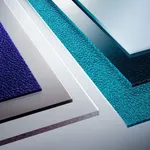
Custom plastic bent parts
Plastic bent parts to drawing: hot bending, cold folding, forming. Thermoplastics up to 20 mm, length up to 2,000 mm. Enquiry with sketch possible.
Plastic bent parts are made from sheet material that is specifically heated, folded or formed over a surface. This gives you components such as protective hoods, covers, enclosures, machine doors or hygiene protection elements with clean geometry and repeatable dimensional accuracy.
We bend and form plastic sheets to drawing, sketch or sample. Typical production limits: thicknesses up to 20 mm and lengths up to 2,000 mm (depending on material and geometry).
Commonly processed thermoplastics: polystyrene (PS), acrylic glass (PMMA), polyvinyl chloride (PVC), PETG, polycarbonate (PC), polyethylene (PE) and polypropylene (PP).
Processes: bending, folding, surface forming
Hot bending
In hot bending, the bend area is specifically brought into the material's forming range and then bent to a defined angle or radius. The process is suitable for clean edges, defined radii and dimensionally stable components.
Cold folding
Cold folding uses controlled pressure on a folding machine. Depending on the material and geometry, a clean edge is produced without thermal influence. The process is particularly suitable for series geometries with constant angles.
Surface forming
In surface forming, a plastic sheet is brought into a three-dimensional contour over forming elements. This allows domes, free forms and hollow-body geometries to be realised for cladding, visual protection or design components.
Tooling in the project
For recurring geometries, we support you in the design of forming elements and auxiliary fixtures. This increases repeat accuracy, reduces set-up times and simplifies series runs.
Materials: which plastic sheet is suitable for bending?
Thermoplastics can be formed well within the appropriate temperature range. The choice of material depends on impact strength, appearance, chemical contact, temperature and UV requirements. For transparent components, PMMA and PC are often used; for chemically robust components, often PE, PP or PVC.
- PMMA (acrylic glass): very good appearance, clean edges, suitable for covers and visible parts
- PC (polycarbonate): high impact strength, suitable for protective hoods and safety applications
- PVC: robust, often used for industrial and advertising applications
- PETG: good thermoformability, suitable for cladding and surface forming
- PE / PP: chemical-resistant, suitable for technical components and covers
- PS: easy to process, suitable for simple moulded parts
For material selection, it is worth looking at your operating conditions. If required, we supplement the bent part with cut-to-size pieces, holes, grooves or contour milling via our other machining services such as milled parts, laser cutting or waterjet cutting.
Typical applications: from machine protection to hygiene
Bent parts are used as soon as a sheet can do more than "just flat": protection, guidance, covering, cladding or visible part. Common applications:
- Protective hoods, enclosures and machine doors
- Machine cladding, protective housings and covers
- Hygiene protection and splash protection in production and food environments
- Platforms, stands, brackets, presentation components
- Technical components with defined edges, radii or domes
Design notes for clean results
Drawing details
For fast quotations, details on material, sheet thickness, dimensions, quantity, angles/radii and the desired visible quality help. For visible parts, photos or a sample part support the coordination.
Radii, angles, tolerances
Bend radius and springback depend on the material. The more precise the specifications for geometry and functionally relevant dimensions, the more predictable the result. For functionally critical areas, reference edges and clearly defined measuring points in the drawing are recommended.
Combined machining
Many projects benefit from a coordinated sequence: first cutting and contour, then forming, then holes, countersinks or edge finishing. This produces assembly-ready assemblies from a single source.
Process: how to get your bent part
- 1. Enquiry: drawing/sketch, material request, quantity, operating environment
- 2. Review: feasibility, process, radii/angles, production limits
- 3. Quotation: price, delivery time, optional sample/first part
- 4. Production: cutting + forming + optional finishing
- 5. Shipping: transport-safe packaging
For your enquiry, please use the contact route via Contact. For recurring components, a brief standardisation of the drawing details is worthwhile so that follow-up orders run faster.
FAQ on plastic bent parts
Thermoplastics such as PMMA, PC, PETG, PVC, PE and PP can be bent or formed well depending on the temperature range and geometry. The choice depends on operating conditions and the desired appearance.
Material, thickness, dimensions, quantity, drawing/sketch as well as details on angles, radii and functionally relevant dimensions. Photos or a sample part help with visible parts.
Protective hoods, enclosures, machine doors, cladding, covers, hygiene protection and technical bracket or guide parts.
Many projects use a combined sequence of cutting, contour machining and forming. This produces assembly-ready components from a single production process.