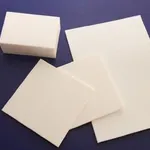
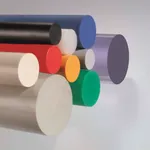
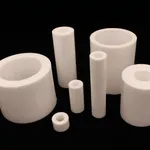
This image was created with artificial intelligence – marked under Art. 50 of the AI Act, Regulation (EU) 2024/1689. It is a placeholder until the company's photos arrive.
Phenolic resins (PF)
What are phenolic resins (PF)? Everything about properties, heat resistance, typical applications and technical advantages. Find out more now.
Phenolic resins belong to the group of thermosets
Phenolic resins are thermosetting plastics that are formed by the polycondensation of phenols and aldehydes. After curing, they form a permanently cross-linked structure and are suitable for applications with high demands on temperature resistance, dimensional stability and electrical insulation.
In industrial use, phenolic resins are among the established materials when components must remain dimensionally stable in the long term and function reliably under thermal or mechanical load. Typical fields of application are found in mechanical engineering, in electrical engineering and in heat-exposed design areas.
As a material group, phenolic resins belong to the thermosets. Within this group, they are distinguished by a particularly high heat deflection temperature and a low tendency to creep.
Chemical structure and curing of phenolic resins
Phenolic resins are formed by a chemical reaction of phenols with aldehydes, usually formaldehyde. This produces a three-dimensionally cross-linked polymer framework that is irreversibly fixed during curing. This process fundamentally distinguishes phenolic resins from meltable plastics.
Curing takes place under the influence of heat and leads to a permanently solid structure. Once cross-linking is complete, phenolic resins can neither be reshaped nor re-melted. The chemical bonds remain stable even at elevated temperature.
Compared with thermoplastics, phenolic resins retain their shape and strength even under continuous thermal load. This property forms the basis for their use in heat-exposed, mechanically stressed or electrically insulating applications.
Mechanical and thermal properties of phenolic resins
Phenolic resins are distinguished by high compressive strength and very good dimensional stability. Under continuous mechanical load, they retain their shape and show a low tendency to creep. These properties predestine the material for load-bearing or structurally relevant components.
Thermally, phenolic resins achieve a high heat deflection temperature. Even at elevated service temperatures, the material structure remains stable, without softening or plastic deformation. The low thermal expansion supports use in components with tight tolerances.
Compared with epoxy resins, phenolic resins offer very good temperature stability combined with high surface hardness. This combination is relevant for applications with simultaneous thermal and mechanical stress.
Electrical properties and insulation behaviour of phenolic resins
Phenolic resins possess very good electrical insulating properties and have been used in electrotechnical applications for decades. The high dielectric strength and the stable specific resistance ensure reliable electrical separation even under thermal load.
The insulation behaviour remains constant over a wide temperature range. Moisture and temperature fluctuations influence the electrical characteristics only slightly. As a result, phenolic resins are suitable for components in which electrical safety must be permanently guaranteed.
In practice, phenolic resins are often used in combination with laminated materials. Combining them with carrier materials produces electrically resilient, mechanically stable semi-finished products for industrial applications.
Chemical resistance and environmental behaviour of phenolic resins
Phenolic resins exhibit good resistance to many oils, greases, fuels and weak acids. This property supports use in industrial environments in which materials regularly come into contact with media or process substances.
Chemical resistance to strong acids and alkalis is limited. For applications with permanently aggressive chemicals, specialised plastics are better suited. Phenolic resins play to their strengths above all where mechanical load, temperature and electrical insulation act together.
Compared with highly chemical-resistant materials such as PTFE, the focus of phenolic resins is on structural stability and heat deflection temperature. The choice of material is therefore always application-related.
Typical areas of application of phenolic resins
Phenolic resins are used wherever components are permanently exposed to high thermal, mechanical or electrical loads. The combination of dimensional stability, temperature resistance and insulating capability enables use in demanding industrial environments.
In mechanical and plant engineering, phenolic resins are used for structural components, bearing supports or guide elements where dimensional accuracy under load is required. In electrical engineering, they serve as carrier material for insulating components, switching parts or dimensionally stable structural elements.
Further applications are found in the automotive industry, for example in heat-exposed components in the engine compartment, as well as in industrial electronics. Processing is often carried out as semi-finished products, which are then machined and adapted to the specific application.
Frequently asked questions about phenolic resins
Are phenolic resins heat-resistant?
Phenolic resins possess a high heat deflection temperature and remain dimensionally stable even at permanently elevated temperatures. They are suitable for applications in which thermal load plays a central role.
Can phenolic resins be reshaped afterwards?
After curing, phenolic resins are permanently cross-linked. Reshaping by heating is technically impossible. Shaping takes place before or during curing.
What is the difference between phenolic resins and thermoplastics?
Phenolic resins belong to the thermosets and retain their shape even under the influence of heat. Thermoplastics soften at temperature and can be reshaped multiple times.
Are phenolic resins electrically insulating?
Phenolic resins have very good electrical insulating properties and are frequently used in electrotechnical components in which reliable electrical separation is required.
For which applications are phenolic resins particularly suitable?
Typical areas of application are found in mechanical engineering, in electrical engineering and in thermally loaded industrial applications in which dimensional stability, insulation and temperature resistance act together.