PEEK
PEEK (polyetheretherketone) stands out for its high temperature resistance, chemical resistance and mechanical strength. Find out more.
PEEK, the short name for polyetheretherketone, is a semi-crystalline thermoplastic high-performance plastic from the polyaryletherketone (PAEK) material family. The material combines very high temperature resistance with excellent mechanical strength, low moisture absorption and high resistance to numerous chemicals.
This makes PEEK suitable for components where classic engineering plastics reach their limits due to high temperatures, aggressive media or continuous mechanical loads. Typical applications are found in mechanical and plant engineering, semiconductor technology, medical technology, aerospace, electrical engineering and the chemical industry.
Martan Plastics supplies PEEK as a semi-finished product and, on request, manufactures precise components, cut pieces and contours from it to drawing or CAD data.
What is PEEK?
PEEK is a thermoplastic high-performance plastic whose molecular structure consists of ether and ketone groups. This structure provides exceptional thermal and chemical stability.
As a semi-crystalline plastic, PEEK has both crystalline and amorphous regions. The crystalline regions contribute to high stiffness, strength and temperature resistance. The amorphous regions support the toughness of the material.
Despite its demanding property profile, PEEK can be processed thermoplastically. Depending on component geometry, quantity and material quality, extrusion, injection moulding, pressing processes and machining are among the options. You can find further materials science background in our detailed PEEK materials science.
Properties of PEEK plastic
PEEK combines properties that are present in many other plastics only individually or to a significantly lesser degree.
High temperature resistance
Depending on load, component geometry and material type, unreinforced PEEK can be used at high continuous temperatures. Values of around 250 to 260 °C are often given as the typical maximum continuous service temperature. The melting point is approximately 343 °C.
However, the ambient temperature alone is not decisive. When selecting the material, the mechanical load, duration of exposure, media present and the required service life must also be taken into account.
For a comparison across materials, you can find further information under High-performance plastics for extreme temperatures.
High mechanical strength and stiffness
PEEK has high tensile, compressive and flexural strength. The material remains comparatively dimensionally stable even under thermal load and exhibits a low tendency to creep.
As a result, PEEK is suitable for precision components that are subjected to mechanical stress over long periods. These include, for example, bearing components, gears, guides, valve components and highly loaded structural elements.
Very good dimensional stability
The low moisture absorption and high dimensional stability enable tight tolerances and reproducible dimensions. Compared with moisture-absorbing plastics, PEEK changes its dimensions only slightly under changing ambient conditions.
This property is particularly important for precision components, measuring devices, holders and mechanical functional parts.
High chemical resistance
PEEK is resistant to numerous acids, alkalis, hydrocarbons, oils, greases, fuels and organic solvents. In many cases, the media resistance is retained even at higher temperatures.
Limits exist in particular with certain strongly oxidising media and concentrated acids. The actual suitability should therefore be checked on the basis of the specific chemical, concentration, temperature, duration of exposure and mechanical load.
A detailed comparison with a particularly chemical-resistant fluoroplastic is provided by the article PEEK or PTFE – chemical resistance compared.
Hydrolysis and hot water resistance
PEEK has very good resistance to hot water and steam. The material can therefore be used for components that are repeatedly sterilised or exposed to hot water.
The actual suitability for autoclaves, cleaning processes or sterilisation procedures depends on the respective material type, temperature, number of cycles and mechanical load.
Good wear and sliding properties
PEEK has high abrasion resistance and friction and wear behaviour that is favourable for a high-strength engineering plastic. Special sliding-modified grades can further improve these properties.
As a result, PEEK is suitable for:
- plain bearings
- bearing bushes
- sealing rings
- guides
- rollers
- wear elements
- pump and valve components
Good electrical insulation properties
PEEK has good dielectric properties and can also be used as an electrically insulating material at elevated temperatures. This makes the plastic interesting for insulators, connectors, coil formers, sensor components and components in semiconductor technology.
For applications in which electrical charges must be deliberately dissipated, modified, antistatic or electrically conductive PEEK grades are available.
Radiation resistance
PEEK has high resistance to ionising radiation. The material is therefore used, among other things, in medical technology, analytical and laboratory technology and, with suitable material design, in industrial applications exposed to radiation.
Typical technical characteristics of unreinforced PEEK
The following data serve as a guide. The actual values differ depending on manufacturer, material type, processing method, test standard and conditioning.
| Property | Typical guide value |
|---|---|
| Density | approx. 1.30 to 1.32 g/cm³ |
| Tensile strength | approx. 90 to 100 MPa |
| Modulus of elasticity | approx. 3,600 to 4,000 MPa |
| Melting temperature | approx. 343 °C |
| Maximum continuous service temperature | often up to approx. 250–260 °C |
| Water absorption | very low |
| Chemical resistance | very high |
| Electrical properties | good insulating |
| Burning behaviour | self-extinguishing depending on material type |
For structural design, the data sheets of the specific PEEK grade intended should always be used. Guide values for a general material group do not replace component-specific testing.
PEEK variants and modifications
In addition to unreinforced PEEK, various modified material types are available. Reinforcing materials or functional additives can be used to deliberately change certain properties.
Unreinforced PEEK
Unreinforced PEEK offers a balanced ratio of strength, toughness, chemical resistance and electrical insulation. It is suitable for numerous mechanical and electrical components as well as for applications with high purity requirements.
Natural-coloured PEEK is typically beige to light brown. Black grades are also available for optical, technical or UV-related requirements.
Glass fibre reinforced PEEK
Glass fibres increase in particular stiffness, strength and dimensional stability. At the same time, the wear behaviour against a metallic counterface can change.
Glass fibre reinforced PEEK is frequently used for highly loaded structural and precision components where low deformation is more important than maximum toughness.
Carbon fibre reinforced PEEK
Carbon fibres increase stiffness and strength and can at the same time reduce thermal expansion. Depending on the composition, thermal conductivity and electrical conductivity can also increase.
Carbon fibre reinforced PEEK is suitable, for example, for highly loaded components, precision components and applications with high requirements for dimensional accuracy and wear resistance.
Sliding-modified PEEK
Additives such as PTFE, carbon fibres or graphite can improve sliding and wear behaviour. Such PEEK compounds are preferably used for bearings, bushes, guides and dynamically stressed machine elements.
Electrically dissipative and conductive PEEK
Antistatic, electrostatic dissipative and electrically conductive PEEK grades are available for the electronics and semiconductor industry. The respective material selection depends on the required electrical resistance range and the specific application.
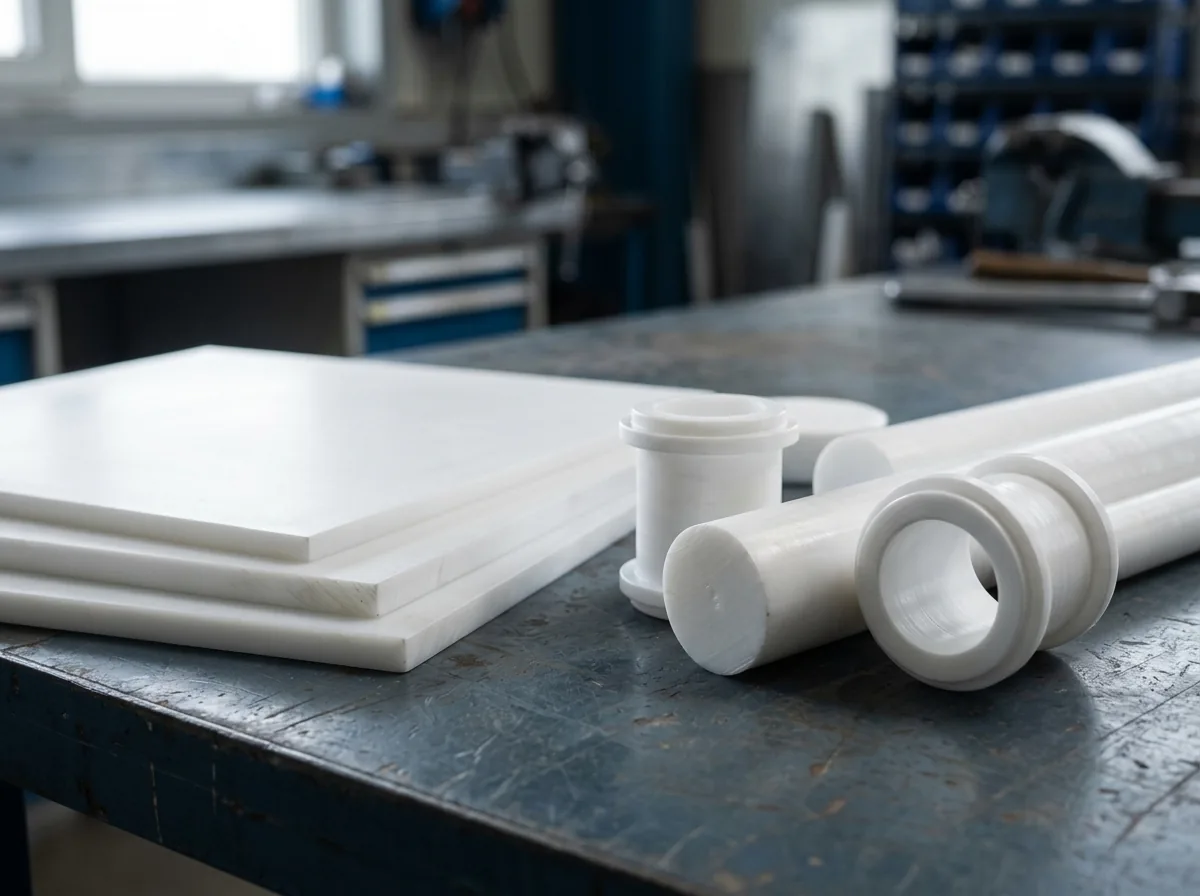
PEEK semi-finished products and cut pieces
PEEK is available in various semi-finished product forms. These include in particular:
- sheets
- rods
- tubes
- rings
- blocks
- films
- profiles
- custom cut pieces
For flat components and milled components, PEEK sheets and individual cut pieces are available. Turned parts, bushes, rings and rotationally symmetrical components can be manufactured from PEEK rods.
In addition to natural-coloured grades, Martan Plastics offers, among other things, black PEEK sheets and black PEEK rods.
The selection of the suitable semi-finished product depends on the component geometry, the required tolerances, the fibre orientation, the quantity and the intended machining.
Machining of PEEK
PEEK can be milled, turned, drilled, sawn and ground. Due to the high material value, the heat generated during machining and possible internal stresses, material-appropriate machining is particularly important.
During machining, the following points should be taken into account, among others:
- sharp and suitable tools
- controlled heat generation
- adapted cutting speeds and feeds
- stable workpiece clamping
- low deformation due to clamping forces
- suitable cooling
- coordinated machining steps
- possible intermediate stress relief for complex precision components
With fibre-reinforced PEEK grades, tool wear increases. Depending on the material and component, carbide or PCD tools may be advisable.
Martan Plastics carries out precise plastic machining and manufactures PEEK components to drawing, sample or CAD data.
Typical applications of PEEK
PEEK is used above all where several high requirements must be met at the same time.
Mechanical and plant engineering
In mechanical and plant engineering, PEEK is used, among other things, for bearing bushes, guides, gears, seals, valve seats, rollers and thermally loaded structural parts.
The material can replace metallic components where weight, corrosion resistance, electrical insulation or reduced lubrication requirements are decisive.
Medical technology
Suitable medical PEEK grades can be used for surgical instruments, sterilisation containers, device components and other medical technology applications. Special requirements apply to implants with regard to material purity, biocompatibility, documentation and approval.
Not every commercially available PEEK grade is automatically suitable for medical applications or direct body contact. The specific material type, the intended application and the required evidence are decisive.
Further information can be found under Plastics for medical technology.
Aerospace
PEEK enables lightweight yet mechanically loadable components. Typical applications are holders, insulating parts, cable components, bearing components and structural elements in thermally or chemically demanding environments.
For aerospace-specific applications, the material type, burning behaviour, smoke gas development, traceability and industry-specific approvals must be checked. An overview is provided by our page on Plastics for aerospace.
Semiconductor and electronics industry
In semiconductor manufacturing, PEEK is used for high-precision carriers, insulators, handling components, test adapters and components in cleanroom processes.
Depending on the application, low outgassing, high purity, defined electrical properties and high dimensional accuracy may be required.
Chemical, pump and valve technology
The combination of chemical resistance, mechanical strength and temperature stability makes PEEK suitable for pump parts, valve seats, seals, backing rings, impellers and media-contacted structural elements.
Before use, resistance to the specific medium must be tested under real operating conditions.
Automotive and vehicle technology
PEEK can be used for thermally highly loaded components, sealing systems, bearing points, electrical insulations and components in the vicinity of fuels, lubricants or aggressive operating media.
Food and packaging technology
Suitable and appropriately tested PEEK grades can be used for components in food production plants. These include, for example, guides, bearings, seals, scrapers and mechanical functional parts.
General food conformity cannot be derived from the material designation PEEK alone. The appropriate manufacturer declarations and evidence for the specific material type are required.
PEEK compared with other high-performance plastics
PEEK is not automatically the most economical or technically best choice for every application. Depending on the requirement profile, materials such as PTFE, PPS, PSU, PPSU, PEI or PAI may be more suitable.
| Criterion | PEEK | PTFE | POM |
|---|---|---|---|
| Temperature resistance | very high | very high | medium |
| Mechanical strength | very high | low | high |
| Chemical resistance | very high | almost universal | good |
| Wear resistance | high | depending on modification | good |
| Dimensional stability | very high | lower | high |
| Machinability | demanding | good | very good |
| Price level | high | medium to high | lower |
PEEK is particularly suitable for applications in which high temperatures, mechanical load, wear and media contact occur simultaneously. PTFE is preferred when the most comprehensive possible chemical resistance and very low friction are the priority. POM is often the more economical solution for mechanically stressed components at moderate temperatures.
A detailed comparison within the high-performance plastics can be found under PEEK, PPS and PSU compared. For applications in mechanical engineering, the comparison POM, PA or PEEK additionally supports material selection.
Advantages of PEEK
PEEK offers in particular the following advantages:
- very high thermal load capacity
- high mechanical strength and stiffness
- low tendency to creep
- very good dimensional stability
- low moisture absorption
- high chemical resistance
- good hydrolysis resistance
- high wear resistance
- good electrical insulation
- high radiation resistance
- thermoplastic processability
- numerous reinforced and modified variants
Limits and disadvantages of PEEK
Despite its comprehensive property profile, PEEK also has limits.
The material is significantly more expensive than classic engineering plastics such as PA, POM or PET. Its use is therefore economical above all when its special properties are actually required.
Further limitations are:
- demanding processing at high temperatures
- high tool wear with fibre-reinforced grades
- possible stress problems with improper machining
- limited resistance to individual strongly oxidising media
- complex bonding due to the low surface energy
- quality-dependent approvals and conformities
- anisotropy in fibre-reinforced or additively manufactured components
A technical and economic material selection should therefore always take the entire requirement profile into account.
When is PEEK the right material?
PEEK is particularly suitable when a component simultaneously:
- is exposed to high temperatures,
- is subjected to high mechanical load,
- must meet tight tolerances,
- comes into contact with chemicals or steam,
- is to function with low wear,
- must insulate electrically, or
- is to have a lower weight than a metal component.
At moderate temperatures or lower loads, more economical engineering plastics may be sufficient. For a systematic pre-selection, our Guide to material selection for high-performance plastics will assist you.
PEEK from Martan Plastics
Martan Plastics supports you from the selection of the suitable PEEK grade through to the finished machined component. Depending on the requirement, you receive natural-coloured, black, reinforced or functionally modified PEEK as a semi-finished product, cut piece or ready-to-install precision part.
For a reliable material recommendation, the following information is particularly helpful:
- service temperature and temperature profile
- mechanical load
- contact media and concentrations
- component dimensions
- tolerances
- quantity
- desired PEEK grade
- required standards and certificates
- drawing, sample or CAD data
On this basis, it is possible to assess which PEEK variant, semi-finished product form and machining method is technically and economically suitable for your application.