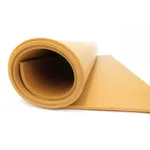
This image was created with artificial intelligence – marked under Art. 50 of the AI Act, Regulation (EU) 2024/1689. It is a placeholder until the company's photos arrive.
Rubber sheets: sustainability and recycling
Learn how recycling works, what advantages it offers and why environmentally friendly solutions are becoming increasingly important.
Rubber sheets have been established in numerous application areas for decades – from industrial production and construction to sports and leisure. However, with growing awareness of environmental and climate protection, the topics of sustainability and recycling are becoming increasingly important.
More and more companies and end consumers value the fact that the materials used can be produced and used in an environmentally friendly way. Legal requirements and international climate targets are also increasing the pressure on industry to develop sustainable solutions.
This is not only about the production of rubber sheets from environmentally friendly raw materials, but equally about the question of how these products can be designed in an ecologically responsible way throughout their entire life cycle – from production and use to recycling.
Sustainability is therefore no longer a niche aspect, but a central factor in the selection and development of rubber products.
Production and material selection
The ecological assessment of rubber sheets begins with the choice of raw materials. While mainly synthetic rubbers were used in the past, manufacturers today increasingly rely on sustainable alternatives:
- Recycled rubber from old tyres or production remnants is processed and further processed as granulate.
- Natural rubber from renewable raw materials can serve as an alternative in certain application areas.
- Hybrid materials that combine recycled content and bio-rubber are gaining in importance.
These materials are processed into stable sheets by pressing or vulcanisation processes. Modern mixing processes make it possible to tailor the properties individually to the respective application area – for example increased heat resistance or improved slip resistance.
Advantages of recycled rubber sheets
Recycled rubber sheets combine ecological and economic benefits:
- Conservation of resources by reducing the need for new raw materials
- Climate protection by reducing CO₂ emissions in production
- Waste avoidance by recycling old tyres and rubber waste
- Cost efficiency due to a cheaper raw material base
- Durability: recycled rubber sheets are also robust and resistant
- Versatile application areas, ranging from industry to private gardening
Energy and resource efficiency
The energy and resource efficiency of production is a decisive sustainability aspect, as it largely determines how high the ecological footprint of a rubber sheet is. In the production of recycled rubber sheets, the energy input is significantly lower than in the production of new material, as many complex chemical processes are eliminated.
In addition, transport routes can be shortened if recycling plants are located regionally and can therefore draw on materials already available in the surrounding area. This not only reduces CO₂ emissions, but also strengthens local economic cycles.
Furthermore, modern production facilities increasingly rely on energy-efficient machines and partly use renewable energies to further reduce the ecological impact. The combination of lower primary raw material requirements, regional value creation and optimised production processes leads to a noticeable relief for the environment and climate.
Recycling after use
Rubber sheets generally have a long service life, but they too eventually reach the end of their use. A sustainable approach provides that used sheets do not end up in landfills, but are returned to the cycle.
First, the old sheets are collected and sorted according to their material composition, as the different mixtures can only be sensibly further processed separately. The next step is mechanical processing, in which the sheets are shredded and processed into fine granulate.
This granulate forms the starting material for a variety of new applications: it can be used in the production of new rubber sheets, serves as a shock-absorbing base in sports facilities or is used as elastic filling material in playgrounds. In this way, the cycle is closed, because the products are given a second life instead of being disposed of.
The process not only saves raw materials and energy, but also reduces the amounts of waste that would otherwise arise in disposal. This shows that a functioning circular economy for rubber is not only possible, but already a reality in many industries.
Challenges in rubber recycling
Despite great progress, there are still some hurdles in the recycling of rubber sheets. A major challenge is the variety of materials, as different mixtures and additives make uniform processing more difficult.
The binders or additives contained in the sheets are also often difficult to recycle or cannot be fully reused at all. There are also logistical difficulties, as the collection and transport of used sheets are complex and cost-intensive.
Nevertheless, research institutions and companies are continuously working on new processes to simplify recycling processes and to secure material quality at a consistently high level.
Application areas of sustainable rubber sheets
Sustainable rubber sheets are not only an ecological gain, but also versatile:
- Playgrounds and sports facilities: fall protection mats made of recycled rubber increase safety and are at the same time resource-saving.
- Construction and industry: rubber sheets serve as vibration dampers, insulation material or bases for machines.
- Agriculture: rubber mats in stables increase animal comfort and are easy to clean.
- Gardening and landscaping: recycled rubber sheets are slip-resistant, weather-resistant and durable – ideal for paths, terraces or green areas.
Future trends and innovations
The rubber industry is working intensively to make its products and processes increasingly sustainable. An important future topic is bio-based rubber mixtures obtained from renewable raw materials such as natural rubber or vegetable oils. There are also continuous improvements in recycling processes, which are intended to enable even more efficient separation and reprocessing of materials.
Increasingly, circular value creation is also being relied upon, in which rubber remains in the cycle for as long as possible and is used multiple times. In addition, sustainability certificates are playing an ever greater role, as they create transparency and make it easier for customers to choose consciously sustainable products.
In conclusion
Sustainability and recycling have long been central factors in the rubber industry. Recycled rubber sheets make a decisive contribution to waste avoidance, resource conservation and CO₂ reduction.
With innovative processes, rising demand and new material developments, the future of rubber sheets will clearly be shaped in the direction of environmental friendliness. For users, this means: they can rely on durable and high-performance products – and at the same time make a contribution to environmental protection.
Frequently asked questions
Are recycled rubber sheets just as durable as new rubber sheets? Yes, modern recycled rubber sheets have a robustness and service life comparable to products made from new material.
How do I dispose of old rubber sheets properly? Old sheets should be handed in at specialised recycling plants or disposal companies that further process the material.
What advantages do bio-based rubber sheets have? They consist of renewable raw materials and reduce dependence on fossil materials. At the same time, they are recyclable and have lower CO₂ emissions in production.
Are sustainable rubber sheets more expensive than conventional products? Not necessarily. Thanks to more efficient recycling processes and falling production costs, prices are usually at a comparable level.
Where are sustainable rubber sheets particularly often used? Especially in sports and leisure areas, but sustainable sheets are also gaining increasing importance in industry, construction and agriculture.
Our rubber sheets
For industry and trade, we offer a wide variety of rubber sheets.
SBR rubber sheet
Our high-quality SBR rubber sheet (styrene-butadiene rubber) is the solution for numerous industrial and commercial applications. This rubber sheet is made from first-class styrene-butadiene rubber and is characterised by its outstanding physical properties.
EPDM rubber sheet
Discover the versatility and reliability of our EPDM rubber sheet, which is made from ethylene propylene diene monomer (EPDM). This high-quality elastomer solution has been specially developed to meet the most demanding industrial and commercial applications.
NBR rubber sheet
The NBR rubber sheet is a high-quality industrial product that has been specially developed for applications requiring excellent resistance to oils, greases and various chemicals.
Viton rubber sheet
The Viton rubber sheet is a high-quality technical product that is used for a wide range of industrial applications. Made from fluoro rubber (FKM), it offers outstanding properties that make it the ideal choice for extreme conditions.
FKM rubber sheet
The FKM rubber sheet is a high-quality technical product that is ideal for use in demanding industrial applications. Made from fluoro rubber (FKM), it is characterised by a variety of outstanding properties that make it the optimal choice for extreme operating conditions.
Silicone rubber sheet
The silicone rubber sheet is a first-class technical product that has been specially developed for applications placing high demands on temperature resistance and flexibility.
PUR rubber sheet
The PUR rubber sheet, made from high-quality polyurethane, is a technically advanced product that has been developed for applications placing the highest demands on abrasion resistance and mechanical load capacity.
Neoprene rubber sheet
The neoprene rubber sheet, made from high-quality chloroprene rubber (CR), is a versatile technical product that is ideal for a wide range of industrial and commercial applications.