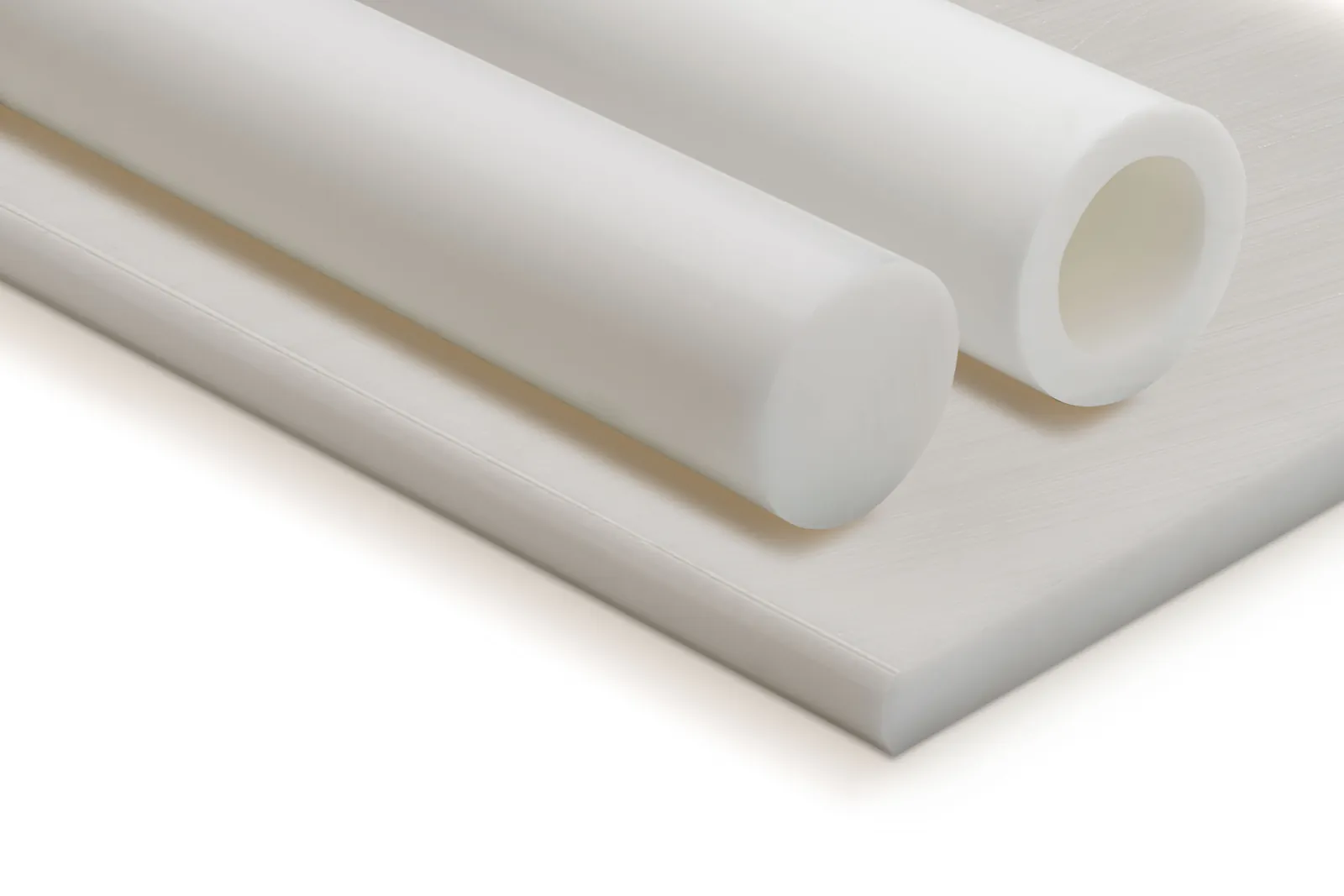
Plastics for the food industry: requirements & certifications
Which plastics are suitable for the food industry? PE, POM, PP, PTFE and PEEK compared – including EU 10/2011, FDA.
Food-safe plastics are used wherever components, semi-finished products or surfaces come into direct or indirect contact with food. In the food industry, the materials used must therefore not only withstand mechanical and chemical loads, but also meet the applicable requirements for food contact.
Typical applications range from cutting boards and work surfaces to slide rails, guides and rollers, through to seals, conveyor screws and precision-manufactured machine parts.
Which type of plastic is suitable depends on the specific application. Temperature, contact time, type of food, cleaning media, mechanical stress and the required conformity must all be considered together.
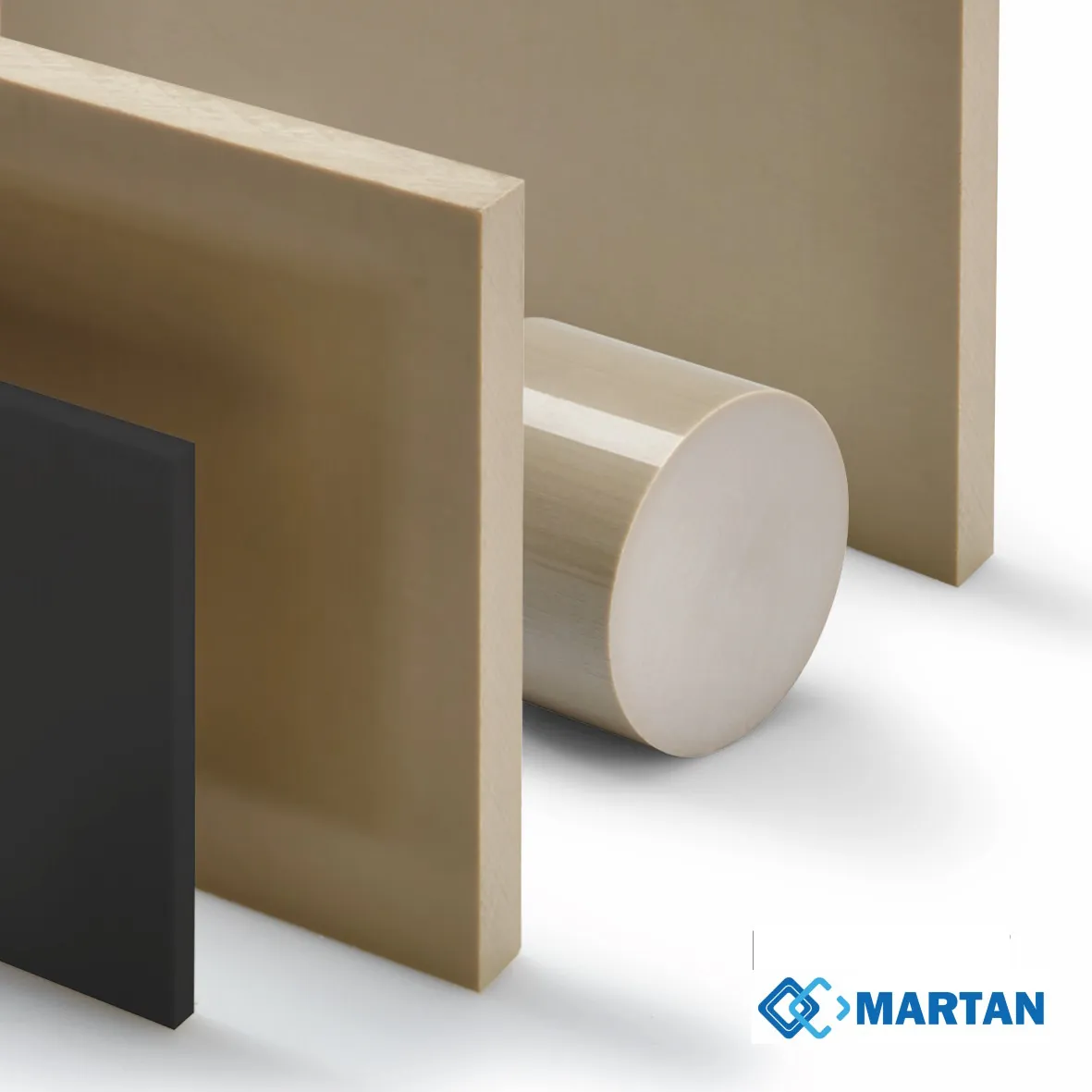
For industrial applications, Martan Plastics offers both suitable plastic materials and the manufacture of custom plastic parts for the food industry.
Which plastics are suitable for food?
Not every version of a plastic is automatically food-safe. Even with material groups that are generally suitable, the formulation, additives, colourants and processing can affect conformity.
The following plastics, among others, are suitable for applications in the food industry:
| Plastic | Typical properties | Examples in the food industry |
|---|---|---|
| PE | low water absorption, good chemical resistance, good sliding and wear properties | cutting boards, slide rails, guides, conveyor elements |
| POM | high rigidity, dimensional stability and wear resistance | gears, rollers, bearings, guides and precision parts |
| PP | good chemical resistance and higher temperature resistance than many PE types | containers, covers and structural components |
| PTFE | very high chemical resistance, very low friction and high temperature resistance | seals, plain bearings and components at high temperatures |
| PEEK | high mechanical, chemical and thermal load capacity | highly stressed precision components and plant components |
| PA | high strength and wear resistance | rollers, bearings and mechanically loaded components |
| PET | high dimensional stability and rigidity | precision components and applications with increased requirements for dimensional stability |
Whether a specific semi-finished product or component can be used for food contact should always be checked on the basis of the respective material quality and the associated conformity documentation.
PE: versatile for food processing and conveyor technology
Polyethylene (PE) is one of the most frequently used engineering plastics in food processing.
The properties differ significantly depending on the PE type. PE 300 or PE-HD offers, among other things, good chemical resistance and is suitable for containers, covers and structural elements. PE 500 is often used for robust machine parts and cutting boards.
PE 1000 or PE-UHMW is characterised by very good sliding and wear properties. This makes the material suitable, for example, for:
- slide rails
- chain guides
- conveyor elements
- wear strips
- linings
- cutting boards
- guide elements
For food contact, a correspondingly compliant PE quality must be selected.
POM: for precision plastic parts in food machinery
POM is used where higher rigidity and dimensional stability are required.
The engineering plastic is suitable, for example, for:
- gears
- rollers
- bushes
- guides
- bearings
- valve components
- precision machine parts
Particularly for moving components, POM can be of interest due to its good mechanical properties and its favourable sliding properties.
Here too, the same applies: not every POM quality is automatically approved for food contact. The specific type and its documentation must match the intended application.
PP: chemical-resistant and versatile
Polypropylene (PP) combines low density with good chemical resistance and higher temperature resistance compared with many PE versions.
Possible applications include, for example:
- containers
- covers
- cladding
- sheets
- structural components
- chemically loaded components
Food-safe PP qualities can be used both in processing and in areas where regular cleaning processes take place.
PTFE: for high temperatures and aggressive media
PTFE offers very high chemical resistance, a very low coefficient of friction and high temperature resistance.
This makes the high-performance plastic suitable, among other things, for:
- seals
- plain bearings
- guides
- valve components
- non-stick applications
- components in thermally demanding processes
For applications involving aggressive cleaning media or elevated temperatures, PTFE can therefore be a suitable alternative to standard plastics.
PEEK: high-performance plastic for particularly demanding applications
Where high temperatures, mechanical loads and chemical stress occur simultaneously, suitable PEEK plastics can be used.
PEEK is suitable, for example, for highly loaded:
- bearings
- guides
- sealing elements
- valve components
- precision parts
- machine components
Due to its property profile, PEEK is primarily an option where standard plastics reach their technical limits.
Plastic parts for the food industry
In addition to semi-finished products, custom-manufactured plastic parts play an important role in the food industry. They are used, among other things, in conveyor systems, packaging machines, filling plants and processing machines.
Typical plastic parts for the food industry are:
- slide rails and chain guides
- rollers and drums
- bearing bushes
- gears
- conveyor screws
- guide strips
- seals
- cutting boards
- covers and cladding
- spacers
- valve components
- moulded and precision parts
Through application-appropriate material selection, properties such as wear resistance, friction behaviour, chemical resistance or cleanability can be matched to the respective production process.
Further information on specific applications and solutions can be found in the Plastics for the food industry section.
What requirements apply to plastics in the food sector?
Materials and articles made of plastic that are intended for food contact are subject to special legal requirements in Europe.
A central basis is Regulation (EU) No. 10/2011 for materials and articles made of plastic intended to come into contact with food.
When assessing a material, the following points must be taken into account, among others:
- type of food contact
- contact time
- temperature
- type of food
- composition of the plastic
- additives and colourants
- possible substance migration
- intended cleaning and disinfection
The mere name of a plastic – for example PE, POM or PTFE – is therefore not sufficient to determine its suitability for food contact.
What does migration mean in food-safe plastics?
Migration is understood as the transfer of constituents of a food contact material to the food.
How pronounced a possible migration is depends, among other things, on temperature, contact time, type of food and material composition.
For practical material selection, this means: a material does not have to be abstractly "food-safe", but must be suitable for the intended contact conditions and documented accordingly.
EU 10/2011 and declaration of conformity
For plastic materials and articles with food contact, Regulation (EU) No. 10/2011 is particularly relevant in the European Union.
It contains, among other things, requirements for authorised substances as well as migration limits and test conditions.
For many applications, a declaration of conformity is also required. It serves to document compliance with the relevant requirements for the specific material or product in a traceable manner.
When procuring food-safe plastic parts, therefore, it is not enough to ask about the plastic type. The specific material quality, the intended application and the available evidence are equally important.
What does FDA-compliant mean?
For plants or components intended for the US market, the requirements of the US Food and Drug Administration may also be relevant.
In connection with plastics, people often speak of "FDA approval". Technically more precise is to speak of FDA-compliant materials or of the conformity of a defined material formulation with the relevant requirements of Title 21 CFR.
The specific material quality and the intended conditions of use must be taken into account.
A detailed classification can be found in the article FDA-compliant materials for the food industry.
What matters when selecting food-safe plastics?
For material selection, you should not consider food conformity alone. The technical conditions of use also determine which plastic is suitable.
Temperature
The actual operating and cleaning temperature limits the possible materials. Particularly in thermally loaded applications, high-performance plastics such as PTFE or PEEK may be required.
Chemical resistance
Cleaning and disinfecting agents can place considerable stress on plastics. Concentration, temperature and exposure time should therefore be taken into account during selection.
Mechanical load
For gears, bearings or guides, rigidity, strength and wear behaviour are the main priorities. For such applications, POM, for example, may be more suitable than a softer PE material.
Friction and wear
For slide rails, chain guides and conveyor systems, low friction and high wear resistance are particularly important. PE 1000 is therefore of interest for numerous conveyor applications.
Moisture
In wet areas, materials with low water absorption are advantageous. Here, for example, PE has advantages over plastics that absorb a great deal of moisture.
Cleanability
Design, surface and material should be selected so that the components can be reliably cleaned. The cleaning chemicals used must also be taken into account.
Which food-safe plastic suits which application?
The following assignment provides initial guidance:
| Requirement | Frequently suitable material |
|---|---|
| Cutting boards | PE 500 |
| Slide rails and chain guides | PE 1000 |
| Precision guides and rollers | POM |
| Gears and mechanical precision parts | POM |
| Containers and covers | PE or PP |
| High chemical load | PTFE |
| High temperatures | PTFE or PEEK |
| High mechanical and thermal load | PEEK |
| Wear-stressed conveyor elements | PE 1000 or POM |
| Sealing and valve components | PTFE, POM or PEEK depending on the application |
This assignment serves as guidance. The final material selection should always be made on the basis of the specific operating conditions and the required conformity.
Machining food-safe plastics
Custom plastic parts for food machinery and production plants can be manufactured from suitable semi-finished products.
Depending on the material and component geometry, different processes are suitable. Martan Plastics handles plastic machining from cut to size to precision-manufactured component.
For complex contours, holes, pockets and custom geometries, CNC milling of plastic is suitable, among other things.
This allows, for example, guides, slide strips, sheets, holders or other custom components to be manufactured to suit the respective food or packaging machine.
Selecting food-safe plastics correctly
For safe material selection, you should first define the specific application:
- Does the component come into direct or indirect contact with food?
- What type of food is it in contact with?
- What temperatures occur during operation and cleaning?
- How long does the contact last?
- Which cleaning and disinfecting agents are used?
- What mechanical loads act on the component?
- What wear and sliding properties are required?
- Which European or international conformity requirements must be met?
- What documentation is required for quality assurance and audit?
Only then should the specific material quality be selected.
If you need semi-finished products or custom-manufactured plastic parts for your application, you can find further information under Plastics for the food industry or in the overview of our plastic materials.
Frequently asked questions about food-safe plastics
Which plastics are food-safe?
The material groups frequently used include PE, PP, POM, PTFE, PET, PA and PEEK. However, the material group alone does not guarantee food conformity. The specific material type, formulation and documentation must be suitable for the intended application.
Is PE suitable for food?
Certain PE qualities are suitable for food contact. In the food industry, for example, PE 500 and PE 1000 are used for cutting boards, guides, slide rails and conveyor elements. The specific quality must have the required evidence.
Is POM food-safe?
Certain POM qualities can be used for food contact. Due to its rigidity, dimensional stability and wear resistance, POM is often used for rollers, bearings, guides, gears and other machine parts.
What does food-safe or food-suitable plastic mean?
This means a plastic whose specific material quality meets the applicable requirements for the intended food contact. Material composition, migration, temperature, contact time and type of food all play a role, among other things.
Which plastics are suitable for plastic parts in the food industry?
PE is often used for slide rails and conveyor elements, and POM for precise mechanical parts. PTFE offers advantages under high chemical or thermal load, while PEEK is an option for particularly demanding mechanical and thermal applications.
What is the difference between EU-compliant and FDA-compliant?
For the European market, the European regulations for food contact materials apply in particular, including Regulation (EU) No. 10/2011 for plastics. FDA compliance, by contrast, refers to the relevant US requirements. Which requirements are relevant depends on the respective market and the specific application.
Can food-safe plastics be machined individually?
Yes. From suitable semi-finished products, it is possible to manufacture, among other things, cut sheets, guides, rollers, bushes, slide strips and complex CNC-finished parts. In addition to material selection, the requirements of the respective application must also be taken into account.