FDA-approved plastics for the food industry
Suitable plastics for food and what FDA approval means – requirements, benefits & applications for maximum safety.
FDA approval for plastics involves far more than a formal material release. In the food industry, it is about product safety, auditability, liability relevance and international supply capability. A blanket statement of "FDA-compliant" is not sufficient for industrial applications. What matters is the precise assessment of the material under real service conditions.
This page combines regulatory classification, an extended material matrix with FDA status, technical assessment, documentation logic and practical industrial applications. The aim is a reliable decision-making basis for design, quality assurance and purchasing.
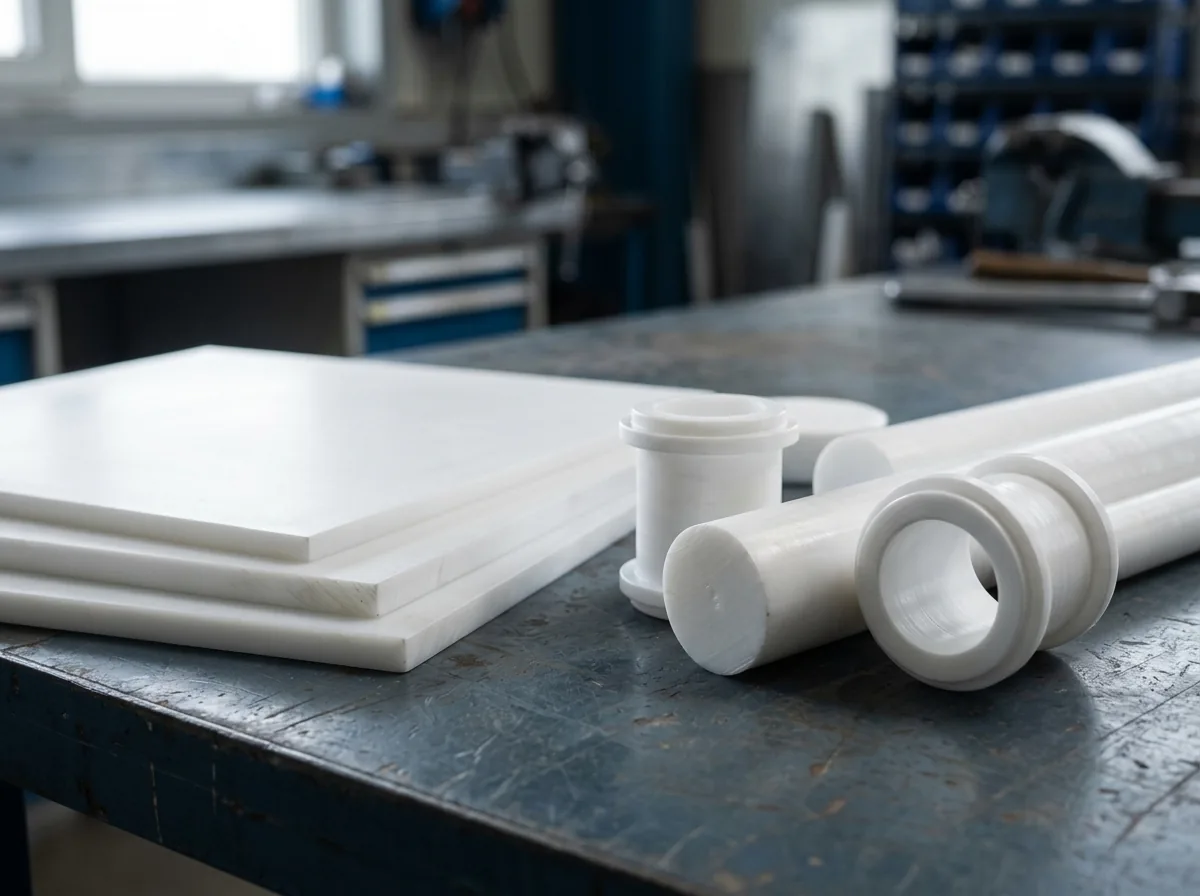
Sheets, rods and dimensionally accurate cut pieces made from FDA-compliant materials are provided for conveyor technology, filling systems, processing machinery and high-performance processes.
FDA approval for plastics – definition for practice
An FDA approval describes the conformity of a defined material formulation with the requirements of the US Food and Drug Administration in accordance with Title 21 CFR. The material is assessed in the context of specific service conditions.
Relevant sections include:
- 21 CFR 174 – General requirements
- 21 CFR 177 – Polymeric materials
- 21 CFR 178 – Additives and processing aids
The assessment is based on:
- Type of food contact (direct / indirect)
- Temperature profile
- Contact time
- Food type (fatty, aqueous, dry, acidic)
FDA-compliant means conformity with a defined CFR section under clearly described service parameters.
FDA approval vs. food-compliant – regulatory classification
In the industrial environment, a distinction is frequently made between "FDA-compliant" and "food-compliant".
FDA approval
- Reference to US law (21 CFR)
- Material- and formulation-related assessment
- Service parameters as the basis
Food compliance in Europe
- EU Regulation 10/2011
- Specific migration limits
- Test conditions according to European requirements
Many materials fulfil both systems. However, the regulatory assessment is carried out on a project-specific basis and in relation to the legal jurisdiction.
Material matrix: FDA-compliant plastics for the food industry
The following extended material matrix shows typical FDA-compliant materials including technical and regulatory classification.
| Material | CFR basis | FDA-compliant | Direct food contact | Suitable for EU 10/2011 | Typical industries | Continuous service temperature |
|---|---|---|---|---|---|---|
| POM | 21 CFR 177.2470 | Yes (depending on type) | Yes | Depending on type | Filling technology, mechanical engineering | up to approx. 100°C |
| PE-HD | 21 CFR 177.1520 | Yes | Yes | Yes | Meat processing, food production | up to approx. 80°C |
| PE 1000 (UHMW-PE) | 21 CFR 177.1520 | Yes | Yes | Yes | Conveyor technology, packaging | up to approx. 80°C |
| PTFE | 21 CFR 177.1550 | Yes | Yes | Depending on type | Baking industry, sealing technology | up to approx. 260°C |
| PP | 21 CFR 177.1520 | Yes | Yes | Yes | Container construction, covers | up to approx. 100°C |
| PA | 21 CFR 177.1500 | Depending on type | Indirect / conditional | Depending on type | Rollers, bearing technology | up to approx. 120°C |
| PEEK | 21 CFR 177.2415 | Yes | Yes | Yes | High-performance systems | up to approx. 250°C |
This matrix addresses search queries such as "kunststoffe mit fda zulassung", "fda konforme werkstoffe lebensmittel" and "21 cfr kunststoffe".
Technical assessment: migration, type of contact and colour
A well-founded FDA assessment takes additional technical aspects into account:
Migration A distinction is made between overall migration and specific migration of individual substances. Temperature, contact time and medium influence the assessment.
Primary and secondary contact Direct contact with unpackaged food requires a stricter assessment than indirect contact via packaging.
Colour variants Natural materials frequently have a clearly documented FDA basis. Coloured variants require a separate formulation review.
Cleaning chemistry CIP and SIP processes with alkaline or acidic media influence material stability and the regulatory assessment.
Decision-making guide for FDA-compliant materials
The following procedure is recommended for a structured material selection:
- Definition of the food type
- Determination of the maximum process and cleaning temperature
- Assessment of mechanical load
- Analysis of cleaning and disinfection cycles
- Comparison with the CFR section and manufacturer's declaration
- Documentation of project-related service parameters
The result is a technically suitable and regulatory-backed material recommendation.
Documentation logic: proof of FDA conformity
Reliable documentation forms the basis for regulatory certainty and auditability. It ensures that the FDA conformity of a material can be traced, verified and assigned on a project-specific basis.
1. Manufacturer's declaration
The manufacturer's declaration documents the reference of the material used to the relevant CFR section. It describes the material composition and defines the permissible areas of application with regard to temperature, contact time and food type. This creates the formal basis for assessment as FDA-compliant.
2. Project-related declaration of conformity
In addition to the general manufacturer's declaration, a project-related declaration of conformity is issued. This describes the specific application in the respective industrial project, specifies temperature profiles and contact times and assigns the material to the specific food type. As a result, the regulatory assessment is directly linked to the actual use.
3. Batch traceability
Batch traceability ensures that semi-finished products used can be clearly assigned to a production lot. Batch number, production date and associated delivery documents enable seamless documentation along the supply chain and create transparency in the event of an audit.
4. Migration assessment
The migration assessment analyses possible substance transfer under defined load scenarios. Temperature, medium and contact time are taken into account and compared with the regulatory limits. The documented assessment forms an essential component of technical and regulatory safeguarding.
This structured documentation logic supports auditability, product safety and international supply chains.
Specific industrial applications of FDA-compliant materials
- Conveyor technology: PE 1000 with FDA approval enables low-wear transport in high-performance packaging lines. Further details on FDA-compliant PE 1000 support project-specific design.
- Filling systems: POM components ensure precise guidance in the wet area. Information on POM with FDA approval provides technical foundations for design and quality assurance.
- Meat and food processing: PE-HD sheets serve as hygienic work surfaces with high resistance to cleaning chemicals. More on PE-HD for food contact can be found in the materials section.
- Baking industry and high-temperature processes: PTFE components ensure temperature stability in direct food contact. Technical data on FDA-compliant PTFE deepen the assessment.
- Chemically demanding high-performance processes: PEEK is used at high temperatures and with aggressive media. Details on PEEK with FDA approval complement the regulatory classification.
Why FDA-compliant materials from Martan Plastics?
The selection of FDA-compliant materials is based on specific service parameters and industrial practice. Martan Plastics combines technical material expertise with regulatory understanding and supports companies in the structured assessment of temperature profiles, types of contact and load scenarios. In addition to providing suitable semi-finished products, the focus is on documentation-relevant information, batch traceability and project-related conformity support. Dimensionally accurate cut pieces and application-specific advice enable an economical and regulatory-backed implementation in the food industry.
Summary and classification
FDA approval and FDA-compliant materials form a central basis for safe and auditable processes in the food industry. A reliable assessment takes into account regulatory requirements according to 21 CFR, technical influencing factors such as migration, type of contact and temperature as well as a structured documentation logic. Only the interaction of material matrix, project-specific assessment and clear traceability creates transparency along the entire supply chain.
Companies benefit from an early, technically sound material selection that takes into account both US FDA requirements and European specifications. This results in stable, long-term safeguarded solutions for conveyor technology, filling systems, processing machinery and high-performance processes in direct or indirect food contact.
FAQ – FDA approval and FDA-compliant materials
What does FDA-compliant mean for plastics? FDA-compliant describes the conformity of a defined material formulation with the requirements of the Food and Drug Administration in accordance with 21 CFR under specifically defined service conditions.
Which plastics have FDA approval? Typical FDA-compliant materials are PE-HD, PE 1000, POM, PTFE, PP and PEEK, in each case depending on type and formulation.
Does FDA approval automatically apply to Europe? The requirements of EU Regulation 10/2011 additionally apply for the European market.
What role does migration play for FDA-compliant materials? Migration describes the possible transfer of substances into food and is assessed on the basis of defined test conditions.
Which documents are required for audits? Manufacturer's declaration with CFR reference, project-related declaration of conformity, batch verification and description of the service parameters.