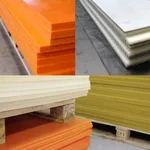
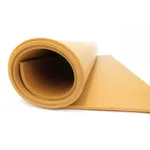
This image was created with artificial intelligence – marked under Art. 50 of the AI Act, Regulation (EU) 2024/1689. It is a placeholder until the company's photos arrive.
Rubber sheets for construction & industry
Find out which rubber sheets are available and where they are used: from NR, SBR and EPDM to NBR, CR and silicone.
Rubber sheets have long become indispensable in construction and industry. They perform numerous tasks: as robust sealing materials, as effective vibration dampers, as durable floor coverings or as protective layers for machines, tools and entire work areas.
The variety of material variants makes it possible to provide the right solution for almost every technical or structural requirement. The correct choice of rubber material decides functionality, service life and ultimately also the economic efficiency of a project.
Whether in large-scale construction projects, civil engineering, machine construction or the chemical industry – rubber sheets are a firm part of everyday practice.
Material variants at a glance
| Material | Properties | Temperature range | Resistance | Typical applications |
|---|---|---|---|---|
| NR (natural rubber) | very elastic, abrasion-resistant | -40 °C to +80 °C | limited chemical resistance | conveyor belts, floor coverings, mechanically stressed applications |
| SBR | cost-effective, good mechanical properties | -30 °C to +100 °C | moderately weather-resistant | seals, floor mats, covers |
| EPDM | UV- and ozone-resistant, weatherproof | -40 °C to +120 °C | very weather-resistant | roof waterproofing, façades, swimming pools |
| NBR | oil- and fuel-resistant | -30 °C to +100 °C | resistant to oils, greases | automotive industry, workshops, fuel lines |
| CR (neoprene) | versatile, ageing-resistant, flame-retardant | -35 °C to +100 °C | resistant to oils, chemicals | construction waterproofing, façade connections, protective mats |
| Silicone | highly temperature-resistant, hygienic | -60 °C to +250 °C | very hygienic, weather-resistant | food and pharmaceutical industry, medical technology |
| FKM (Viton) | extremely chemical- and temperature-resistant | -20 °C to +250 °C | resistant to aggressive chemicals | chemical plants, seals in the high-temperature range |
| PU | extremely abrasion-resistant, tough | -20 °C to +80 °C | moderately chemical-resistant | heavily stressed floor areas, machine components |
Basics of rubber sheets
Rubber sheets consist of various elastomers which, depending on their composition, have specific properties. Hardness levels, temperature resistance, resistance to chemicals or oils and abrasion resistance distinguish the individual variants.
The surface structure – smooth, grooved or studded – can also influence the function, for example slip resistance or damping. In addition to standard formats, manufacturers also offer cut-to-size pieces, which means rubber sheets can be fitted precisely into buildings, machines or plants.
This flexibility makes them a universal material that can be used in almost every industry.
Areas of application in construction & industry
- Construction: sealing of foundations, roof waterproofing, impact sound insulation, protective layers for formwork
- Mechanical engineering: vibration damping, machine bases, seals, protective layers for tools
- Chemical industry: resistant coverings against aggressive media, protective mats in production areas
- Transport & logistics: anti-slip floor coverings, loading area covers, protective mats for loading ramps
- Electrical engineering: insulation mats, protective mats for control cabinets and workplaces
Practical examples
- In production halls, SBR sheets are laid as robust floor mats to protect employees from slipping and machines from vibrations.
- In roof construction, EPDM sheets serve as long-lasting waterproofing against rain, snow and UV rays.
- In chemical plants, FKM sheets are used because they reliably withstand even aggressive media.
Advantages of rubber sheets
The advantages of rubber sheets are varied and can be used across industries:
- They are flexible and adapt to different substrates.
- They damp vibrations and reduce noise.
- They offer protection against moisture and chemicals.
- They increase occupational safety through anti-slip surfaces.
- They extend the service life of machines, as they serve as a protective and damping layer.
Processing & cutting to size
Rubber sheets can be processed in different ways. In addition to classic cutting to size with knives or scissors, more precise processes such as punching, waterjet cutting or laser cutting are often used in industry.
This also allows complex contours, holes or recesses to be produced without impairing the material properties. For large-area applications, rubber sheets are cut into strips and then laid. Depending on the substrate, they can be laid loose, bonded over the full surface with special adhesives or mechanically screwed.
For highly stressed surfaces, such as machine foundations or loading ramps, a fixed connection makes sense, while for temporary applications a loose laying is often sufficient. Multi-layer constructions are also possible in order to achieve specific damping or insulation values.
The choice of the right fastening method is important: in damp areas, bonding with water-resistant adhesives is recommended, while in industrial environments with high mechanical stress, screwing ensures lasting stability. For custom-made seals or vibration absorbers, a cut to the nearest millimetre is also decisive.
Care & service life
The durability of rubber sheets depends not only on the material but also on care, storage and the type of stress. Regular visual inspection is advisable in order to detect cracks, wear or hardening at an early stage.
Light soiling can be removed with water and a mild cleaning agent; aggressive chemicals should be avoided, as they can attack the surface.
Storage tips:
- Store dry and dark to avoid ozone and UV influences.
- Temperatures between 10 and 25 °C are ideal.
- Direct sunlight and extreme cold should be avoided.
With oil-resistant materials such as NBR, it is important that they do not come into permanent contact with incompatible media. For outdoor areas: EPDM and silicone are particularly weather-resistant, while natural rubber or SBR age more quickly under prolonged UV or ozone influence.
If the sheets are used, stored and maintained properly, they can be used reliably for many years. Professional installation also helps to significantly extend the service life, as stresses or incorrect loads are avoided.
Standards & specifications
Various standards and specifications apply in industry, ensuring the quality and usability of rubber sheets.
These include, for example, DIN ISO 3302 (tolerances for rubber products) or DIN ISO 7620 (determination of physical properties). Compliance with such standards is important above all in safety-critical areas in order to ensure reliable results.
Sustainability & trends
Sustainable materials are increasingly coming into focus. Recycled rubber or innovative blends with reduced use of raw materials are gaining in importance. Manufacturers are working on producing rubber sheets in a more resource-efficient way and improving recyclability at the end of their service life. Bio-based elastomers are also a growing trend.
In addition, there are efforts to make production processes more energy-efficient and to reduce the CO₂ footprint. Some companies already rely on circular economy concepts in which used rubber sheets are collected, reprocessed and reintegrated into the production process. The use of fillers from renewable raw materials or the development of rubber blends without harmful plasticisers are also topics that are gaining in relevance.
For construction and industrial companies, this opens up the possibility of using not only functional but also environmentally friendly solutions. In the long term, it is to be expected that sustainability aspects will be incorporated more strongly into standards and tenders, so that the choice of environmentally compatible rubber sheets can also bring economic advantages.
In summary
The choice of the right rubber sheet decides the success of a construction or industrial project. While natural rubber convinces with elasticity, EPDM and NBR score with resistance to weather or chemicals.
Silicone, on the other hand, offers advantages at high temperatures and in hygienically sensitive applications. Special materials such as FKM or PU complete the spectrum for highly specialised fields of application.
With the right choice of material, reliability, service life and functionality can be decisively increased – and that with optimum economic efficiency. In addition, the choice of material should always be made taking into account standards, environmental aspects and long-term operating costs.
Explanations of the material variants
The table shows the most important differences at a glance. It thus becomes clear that every material has its specific advantages and disadvantages. While EPDM scores with its weather resistance, NBR convinces in contact with oils. Silicone offers a broad temperature spectrum, while FKM (Viton) is predestined for highly specialised applications in the chemical industry.
FAQ
Which rubber sheet is suitable for outdoor areas? EPDM is the first choice for outdoor use due to its high weather and UV resistance.
Which rubber sheets are suitable for contact with oils and greases? NBR offers the best properties, as it is particularly oil- and fuel-resistant.
Can I have rubber sheets cut individually? Yes, manufacturers offer cut-to-size pieces – from small seals to large-area coverings.
Are silicone sheets also suitable for the food industry? Yes, silicone is hygienic, temperature-resistant and therefore ideal for the food and pharmaceutical industry.
How long do rubber sheets last? The service life depends on the material and the load. EPDM and silicone are particularly durable, while NR and SBR are more suitable for indoor areas.
How are rubber sheets installed? Depending on the requirement, they can be laid loose, bonded or mechanically fastened, for example by screwing or clips.
Our rubber sheets
For industry and trade, we offer a wide variety of rubber sheets.
SBR rubber sheet
Our high-quality SBR rubber sheet (styrene-butadiene rubber) is the solution for numerous industrial and commercial applications. This rubber sheet is made from first-class styrene-butadiene rubber and is characterised by its outstanding physical properties.
EPDM rubber sheet
Discover the versatility and reliability of our EPDM rubber sheet, which is made from ethylene propylene diene monomer (EPDM). This high-quality elastomer solution has been specially developed to meet the most demanding industrial and commercial applications.
NBR rubber sheet
The NBR rubber sheet is a high-quality industrial product that has been specially developed for applications requiring excellent resistance to oils, greases and various chemicals.
Viton rubber sheet
The Viton rubber sheet is a high-quality technical product that is used for a wide range of industrial applications. Made from fluoro rubber (FKM), it offers outstanding properties that make it the ideal choice for extreme conditions.
FKM rubber sheet
The FKM rubber sheet is a high-quality technical product that is ideal for use in demanding industrial applications. Made from fluoro rubber (FKM), it is characterised by a variety of outstanding properties that make it the optimum choice for extreme operating conditions.
Silicone rubber sheet
The silicone rubber sheet is a first-class technical product that has been specially developed for applications placing high demands on temperature resistance and flexibility.
PUR rubber sheet
The PUR rubber sheet, made from high-quality polyurethane, is a technically advanced product that has been developed for applications placing the highest demands on abrasion resistance and mechanical load capacity.
Neoprene rubber sheet
The neoprene rubber sheet, made from high-quality chloroprene rubber (CR), is a versatile technical product that is ideal for a wide range of industrial and commercial applications.