CNC milling, sawing, turning, drilling: machining processes for engineering plastics
CNC milling, sawing, turning and drilling of engineering plastics such as POM, PE or PA6 – machined precisely, dimensionally accurate and material-specific. Find out more now and request custom-fit plastic parts!
Engineering plastics such as POM, PE, PA6 or PTFE are often not used in their raw format in industrial applications, but are machined precisely to drawing. Processes such as CNC milling, sawing, turning and drilling enable accurately fitting components – precise, reproducible and matched to the specific material. This is not just about visual quality, but about functional properties such as tightness, load capacity or thermal stability.
Here you can order your CNC parts online
What does CNC machining mean for plastics?
CNC stands for "Computerized Numerical Control". Machining is carried out by computer-controlled machines that shape workpieces exactly to a digital drawing. CNC machines are fed with CAD or CAM data and can also realise complex geometries with high repeat accuracy. Plastic machining differs significantly from metalworking: plastics behave differently in thermal, mechanical and chip-formation terms and therefore require specific machining strategies.
Highest dimensional accuracy
CNC machining enables tolerances in the tenth or even hundredth range. This is particularly important for seals, sliding guides or technical geometries where any oversize or undersize can lead to functional problems.
Repeat-accurate series production
Once set up, CNC programs can be reproduced at any time. This guarantees consistent quality across many batches and is particularly crucial for OEM supplier parts or serial assemblies.
Machining of complex geometries
CNC machining centres allow freeform surfaces, 3D pockets or angled holes that would be difficult or only possible with great effort on conventional machines. Internal machining or hidden contours are also possible.
Material-friendly cutting
Through the precise control of feed, cutting speed and tool selection, materials can be machined without stress cracks, scorching or thermal deformation. This reduces rejects and increases the service life of the components.
Variety of formats and contours
Whether individual component, series or complex contour: CNC machining can be used flexibly. Milling, drilling, turning and even engraving or internal machining can be combined efficiently. This reduces lead times and simplifies production logistics.
Sawing: The first step to shape
During sawing, the plastic semi-finished product blank (sheet, block or rod) is brought into the desired format. Modern panel saws and band saws ensure:
- Low-burr, smooth cut edges
- Material-appropriate cutting (e.g. for brittle PMMA or tough PE500)
- High repeat accuracy for series cuts
Particularly with large formats or cut pieces for further machining in the milling centre, the quality of the saw cut is decisive for dimensional accuracy and downstream processes.
CNC milling: For complex geometries and pockets
Milling is the most versatile process in plastic machining. With CNC milling machines, the following can be produced:
- 3D contours
- grooves, openings, pockets
- freeform surfaces and precise cut edges
Depending on the plastic, parameters such as cutting speed, feed or cooling must be adjusted exactly. Professional CNC machining takes into account:
- heat generation and material distortion
- tool selection for tough or brittle plastics
- clamping technology for vibration-free machining
Typical applications: machine covers, housing parts, guides, viewing windows, structural components.
Turning: Rotationally symmetrical components
Turning produces rotationally symmetrical components such as:
- rollers
- bushes
- seals
- round bodies with internal and external threads
CNC-controlled lathes enable high dimensional accuracy – even with demanding materials such as PEEK or PVDF. The challenge lies in chip formation and heat dissipation: plastic splits differently from metal and can smear or tear if parameters are wrong.
Drilling: Exact openings and mounting holes
Drill holes are often the last step in machining – whether for assembly, fastening or passage. When drilling plastics:
- High cutting performance, low feed
- Step drilling or pilot drilling for deep holes
- Deburring of edges for assembly-ready quality
For transparent plastics such as acrylic glass, particular care is necessary to avoid stress cracks or clouding.
Delivery forms and processing of engineering plastics
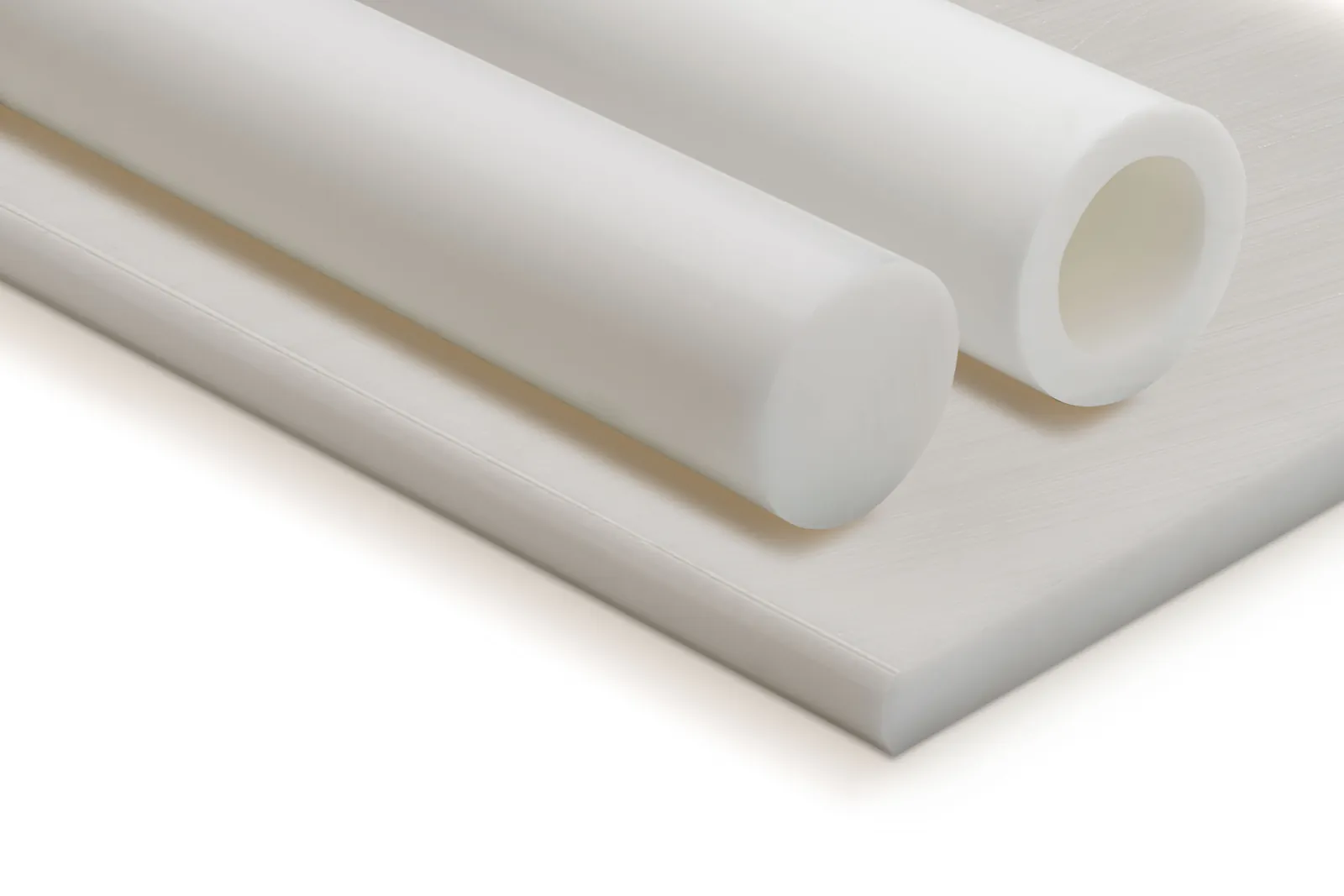
Engineering plastics are available in various semi-finished product formats:
| Delivery form | Description |
|---|---|
| Sheets | cut to size as required |
| Rods | For turned parts and milled bodies |
| Square bars | For milled parts and milled profiles |
| Blocks | For large milled parts with depth |
Further processing usually takes place in specialised companies with experience in plastic machining – because every material group (e.g. thermoplastics vs. thermosets) brings different requirements with it.
Conclusion: CNC machining of plastics requires know-how
Whether CNC milling, sawing, turning or drilling: the machining of engineering plastics differs significantly from metal or wood. Material knowledge, suitable machines and experience are decisive for a high-quality result.
If you need individual parts or series made of plastic, our team supports you with competent advice, a modern machine park and material-appropriate implementation.
Frequently asked questions (FAQ)
Which plastics can be milled well? PA6, POM, PE, PTFE, PVC and PEEK are among the most frequently milled plastics. Each material requires its own parameters.
Is cooling necessary when milling plastic? In many cases yes – e.g. by air or minimum quantity lubrication. Particularly with heat-sensitive plastics such as PVC or PC.
Can transparent plastics such as acrylic glass be drilled? Yes – but with special drill bits, low feed rate and particular care to avoid stress cracks.
Is CNC machining worthwhile for small series too? Yes, particularly for precise or complex geometries. Once set up, programs can also be used for later repeat orders.






