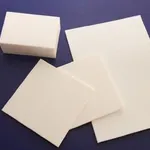
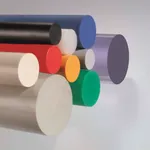
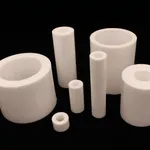
This image was created with artificial intelligence – marked under Art. 50 of the AI Act, Regulation (EU) 2024/1689. It is a placeholder until the company's photos arrive.
What is PTFE?
Definition of the material polytetrafluoroethylene (PTFE). Here you can find out what PTFE or TEFLON is and where it is used.
PTFE, also known under the names Hostaflon, Teflon or Algoflon, describes the material polytetrafluoroethylene and is used when the construction material is subject to high requirements for temperature resistance, chemical resistance or low friction.
As a semi-finished product such as tube, rod, sheet or film, PTFE Teflon can be further processed. The food industry uses PTFE-coated glass fabric as frying / cooking and conveyor belts. Further information on: PTFE TEFLON
The material also finds applications in the automotive supplier industry as a heating and conveyor belt in the production of door interior trim and free-form covering in the vehicle interior.
Are PTFE and Teflon the same?
Yes. PTFE is identical to TEFLON. PTFE stands for polytetrafluoroethylene, which is the name of the plastic. TEFLON™ is a trade name for PTFE, as are Algoflon and Hostaflon.
Common designations for PTFE
- PTFE
- Polytetrafluoroethylene
- Polytetrafluoroethene
- Teflon™
- Xynflon
Definition of PTFE - at Wikipedia
Polytetrafluoroethylene (abbreviation PTFE, occasionally also polytetrafluoroethene) is an unbranched, linearly structured, semi-crystalline polymer made of fluorine and carbon. Colloquially, this plastic is often referred to by the trade name Teflon™ of the company DuPont. Other frequently used trade names of other manufacturers of PTFE are Dyneon PTFE (formerly Hostaflon) and Gore-Tex for PTFE membranes.
PTFE belongs to the class of polyhaloolefins, to which PCTFE (polychlorotrifluoroethylene) also belongs. It belongs to the thermoplastics, although it also exhibits properties that require processing more typical of thermosetting plastics.
The properties of polytetrafluoroethylene (PTFE)
Polytetrafluoroethylene possesses excellent sliding properties, with a low coefficient of friction, and has good resistance to chemical substances and solvents. Furthermore, polytetrafluoroethylene is physiologically harmless and has very good insulating properties. PTFE (Teflon©) has a thermal application range of -200°C to +200°C. The melting range of polytetrafluoroethylene is +320 to +345°C.
Polytetrafluoroethylene is known as a plastic and belongs to the group of thermoplastics. In processing, however, it must rather be assigned to the group of thermosetting plastics, since its melting range is above 320 °C. The bond of fluorine and carbon to the plastic is very strong and processing is only possible in a very high melting range. Thermoplastics can be deformed within certain temperature ranges. They can be heated and deformed repeatedly. Thermoplastics can even be heated in a molten state. This process can be repeated as often as desired. Only overheating must not occur, because then the plastic decomposes and it can no longer be used.
Polytetrafluoroethylene is also known as polytetrafluoroethylene, as well as PTFE. But also under the trade name Teflon of the company DuPont. In addition, PTFE is known under the name Gore-Tex. Gore-Tex is common in the clothing industry. Thanks to the plastic PTFE, the clothing is water-repellent and windproof. Thanks to the plastic, umbrellas, among other things, are also water-repellent.
PTFE belongs to the subgroup of high-performance plastics. High-performance plastics withstand high temperatures as well as chemicals. PTFE can be used without concern in a temperature range of -200 °C to +250 °C. For short periods, the plastic can also be used in a temperature range of + 300 °C.
PTFE is produced from hydrogen and fluorine as a straight and white polymer. It is thanks to the element fluorine that such a high temperature application and resistance is possible at all. The plastic has the largest market share with 65-70 %. Polytetrafluoroethylene possesses a low coefficient of friction, it possesses a very good sliding property, it is weather-resistant, and UV rays can likewise do it no harm. It is non-flammable and can be used in the kitchen without concern. PTFE has one disadvantage: it is not pressure-resistant. It loses its shape here. Only by adding graphite are the compressive strength and the hardness of the plastic increased.
PTFE or Teflon is known as the non-stick coating of pots, pans, baking moulds and irons. PTFE can also be used, among other things, as:
- cutting mats
- shaft seals
- bearings
- brake pads
- dental floss
- insulations
- fittings
- body parts
- inner coatings of tubes or hoses
- conveyor belts
- spectacle lenses
- handles, among other things for garden tools, pots, pans
Areas:
- high-voltage engineering
- bridge construction
- construction
- mechanical engineering
- automotive industry
- electrical engineering
- clothing industry
- optics
- medical technology
- aerospace
| Property | Unit | Value |
|---|---|---|
| Density | g/cm³ | 2.13 - 2.23 |
| Nominal elongation at break | % | >50 |
| Tensile E-modulus | MPa | 400 - 750 |
| Tensile strength | MPa | 20 - 40 |
| Melting temperature | °C | 325 - 335 |
| Thermal conductivity | W/m*K | 0.24 |
| Heat capacity | J/g*K | 0.96 |
| Frost resistance | °C | -270 |
| Dielectric constant | - | 2.1 |
| Transparency | - | opaque (non-transparent, light-impermeable) |
Here you will find data sheets and further PDF documents on the subject of PTFE as a download.
Data sheets
- PTFE data sheet
- PTFE weights table
- PTFE composition