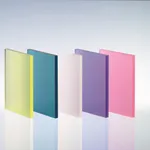
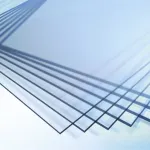
What is PMMA?
PMMA is available under well-known brand names such as PLEXIGLAS®, Perspex or Altuglas and is used in numerous industries.
Polymethyl methacrylate (PMMA) is a transparent, thermoplastic plastic that stands out for its exceptional optical and mechanical properties.
It is available under well-known brand names such as PLEXIGLAS®, Perspex or Altuglas and is used in numerous industries.
Its outstanding light transmission makes PMMA a popular alternative to glass, particularly where low weight and high impact resistance are required. But PMMA does not only impress with its transparency.
The chemical structure of the material ensures remarkable resistance to UV radiation, so that even under many years of sunlight it neither yellows nor becomes brittle. In addition, the material remains dimensionally stable over a broad temperature range and shows high weather resistance, making it suitable for both indoor and outdoor applications.
Alternative names and trade names
PMMA is known under various names and trade names.
Alongside the common term acrylic glass, which refers to the transparency and glass-like appearance of the material, brand names such as PLEXIGLAS®, Perspex, Altuglas and Acrylite are widespread.
These names come from different manufacturers and may exhibit slightly varying material properties, but they are all based on the same chemical basis of polymethyl methacrylate.
Due to its versatile properties, PMMA is often also referred to in various industries as acrylic polymer, methacrylate plastic or simply as clear plastic.
The high brand awareness of some trade names often leads to PMMA being used synonymously with them, although they are the same base material.
Production and processing
The production of PMMA begins with the polymerisation of methyl methacrylate (MMA), a monomer that is converted into a solid plastic using various processes.
One of the most common processes is continuous polymerisation, in which the monomer is heated in a controlled manner together with an initiator in a reactor to form long polymer chains.
Another method is batch polymerisation, in which the material is produced in separate batches, which allows high flexibility in the manufacture of different variants. A third process is solution polymerisation, in which MMA is polymerised in a solvent that is subsequently removed to obtain the pure polymer.
PMMA is processed in various ways, depending on the desired final shape of the product. Sheet material is often produced by casting or extrusion, which allows different thicknesses and surface structures.
For complex moulded parts, PMMA is processed by injection moulding, in which the molten material is injected into a mould under high pressure. This technique allows precise design and enables the production of components with fine details, as required in automotive and medical technology.
Areas of application and advantages
PMMA has established itself as an indispensable material in numerous industries. In construction, it is often used as a substitute for glass in windows, partitions and roofing.
Due to its high transparency and resistance to breakage, it is particularly suitable for large-area applications where conventional glass would be too heavy or too fragile.
In the automotive industry, PMMA is used among other things for headlight covers, as it not only possesses excellent optical properties but also has high scratch resistance.
Another important area of application is lighting technology. Due to its ability to direct light in a targeted manner and distribute it evenly, PMMA is used in modern lighting systems, from street lamps to decorative indoor lights.
PMMA has also gained importance in the medical sector. It is used to manufacture intraocular lenses, which are used in cataract operations, as well as in dentistry for dentures and fillings.
Due to its biocompatibility and chemical resistance, it represents a safe and durable solution for medical implants. In the advertising industry and signage technology, PMMA also plays a central role.
Its weather resistance and the possibility of producing it in a wide variety of colours and shapes make it ideal for long-lasting advertising signs, trade fair stands and illuminated letters.
PMMA compared with glass
PMMA offers a wide range of advantages over glass that make it a preferred choice in many applications:
| Property | PMMA | Glass |
|---|---|---|
| Transparency | Up to 92 % | Approx. 90 % |
| Weight | 50 % lighter than glass | Heavier |
| Impact resistance | Very high | Fragile |
| UV resistance | Does not yellow | Can yellow |
| Thermal insulation | Better than glass | Average |
| Machinability | Easy to cut and shape | Difficult to machine |
PMMA and sustainability
A decisive advantage of PMMA is its complete recyclability.
Through chemical processes, the polymer can be broken down again into its original components and used to manufacture new products. This makes it a more environmentally friendly plastic compared with many other plastics that are difficult or impossible to recycle.
In addition, modern manufacturing processes are geared towards minimising emissions and energy consumption in order to further reduce the environmental impact. With the growing importance of sustainable materials, PMMA will remain a sought-after material, particularly in areas where high optical quality and durability are required.
Conclusion
PMMA is an innovative and versatile material that is used in numerous industries. Its exceptional clarity, weather resistance and mechanical stability make it a first-class alternative to glass.
Whether in architecture, the automotive industry, medicine or advertising technology – PMMA impresses with its versatility and adaptability. It is also fully recyclable, which means it is gaining increasing importance as a sustainable material.
In future, the focus will continue to be on environmentally friendly manufacturing processes and optimised recycling methods in order to make the use of PMMA even more sustainable.
Frequently asked questions (FAQ)
What is the difference between PMMA and acrylic glass? PMMA and acrylic glass are basically the same material. Acrylic glass is merely a common term for PMMA in its transparent form, which is used as an alternative to conventional glass.
Is PMMA resistant to breakage? Yes, PMMA is significantly more resistant to breakage than glass. It withstands impacts better and does not shatter as easily into dangerous splinters, which makes it safer in many applications.
How can PMMA be machined? PMMA can be cut, drilled, milled, bonded and thermally formed. This allows a wide variety of shapes and designs to be realised.
Is PMMA suitable for outdoor use? Yes, PMMA is UV-resistant and does not yellow, which makes it ideal for outdoor use. It also remains stable under extreme weather conditions.
Can PMMA be recycled? Yes, PMMA is fully recyclable. It can be returned to its original components by mechanical or chemical processes and used to manufacture new products.
How does PMMA differ from polycarbonate? PMMA is harder and more scratch-resistant than polycarbonate, while polycarbonate has a higher impact strength. Both materials have their specific advantages and disadvantages, depending on the respective application.