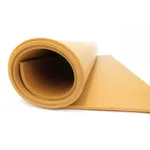
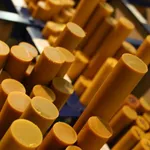
This image was created with artificial intelligence – marked under Art. 50 of the AI Act, Regulation (EU) 2024/1689. It is a placeholder until the company's photos arrive.
Engineering foams
Engineering foams are materials used in a wide variety of industrial and commercial applications.
Technical foams for industrial applications
Technical foams are polymer materials with a defined cell structure. They are used as functional materials for damping, sealing, insulation, spacing and protection.
Typical material groups are PU, PE and EPDM-based foams. Depending on the design, technical foams are suitable for vibration decoupling, noise reduction, thermal insulation or the protection of sensitive components.
What matters when selecting
- Density and compression hardness: determines restoring force, load-bearing capacity and damping effect.
- Cell structure: open-cell for acoustic damping, closed-cell for low water absorption and better sealing.
- Temperature range: select to suit the environment and process heat.
- Contact media: define water, oils, greases, cleaning agents and chemicals as selection criteria.
- Manufacture and shape: sheet stock, cut pieces, strips or moulded parts depending on installation and tolerances.
For the basics of material classification, the article Rubber, foam and plastic: differences helps with categorisation.
Properties of technical foams
Technical foams are characterised by adaptable physical and chemical properties. Selection is always application-related and material-dependent.
Material base
- Polyurethane (PU)
- Polyethylene (PE)
- Ethylene propylene diene rubber (EPDM)
- Other specialised polymer materials
Technical characteristics
- Colour: material- and manufacturer-dependent, functionally relevant for identification.
- Density: variable, determines weight, damping and restoring properties.
- Hardness: from soft to hard, matched to compressive load and installation situation.
- Temperature resistance: typical service range from -40 °C to +100 °C, material-dependent.
- Tensile strength: depends on cell structure and polymer base.
- Sound and thermal insulation: suitable for reducing sound and heat transfer.
Advantages in industrial use
- Low dead weight with functional stability.
- High adaptability through different densities and hardness grades.
- Suitable for vibration, impact and noise damping.
- Effective thermal insulation in technical systems.
- Resistance to water and selected chemicals.
- Good machinability by cutting, punching or forming.
Typical applications
- Automotive industry: seat padding, seals, insulation and damping elements.
- Construction industry: sound and thermal insulation, seals.
- Electronics: insulation and packaging solutions.
- Medical technology: padding, orthoses, functional insoles.
- Packaging: protection of sensitive components during transport and storage.
For an application-related selection and technical coordination, direct consultation via the technical contact is recommended.
Material types of technical foams
The performance of technical foams is largely determined by the respective polymer base. Each material group has specific properties that clearly define its field of application.
PU foams (polyurethane)
PU foams are elastic, dimensionally stable and versatile. They are particularly suitable for applications with high demands on damping, comfort and restoring behaviour.
- Very good vibration and noise damping
- Broad spectrum of densities and hardnesses
- Suitable for padding, damping and packaging solutions
PE foams (polyethylene)
PE foams have a predominantly closed-cell structure and are characterised by low water absorption and chemical resistance.
- Low weight with good mechanical stability
- Resistant to moisture and media
- Suitable for seals, insulation and protective packaging
EPDM foams
EPDM foams are designed for demanding environmental conditions. They show high resistance to weathering, ozone and temperature changes.
- High ageing and weathering resistance
- Stable use outdoors
- Suitable for sealing and insulation applications
A detailed examination of the properties and possible applications is provided by the page PU foam as an example of material-related specifications.
Manufacture and cut to size
Technical foams are supplied in various semi-finished product and finished part forms. The choice of manufacturing type depends on the installation situation, function and required dimensional accuracy.
Delivery forms
- Sheet stock in defined thicknesses and densities
- Strips and rolls for linear applications
- Moulded parts for serial or complex installation situations
Machining and cut-to-size processes
- Contour and face cutting for simple geometries
- Punching for recurring shapes and series
- Forming for precisely fitting components
Cutting is carried out in a material-appropriate manner and takes into account density, cell structure and restoring behaviour. Dimensions and tolerances are defined on an application-related basis to ensure function and assembly.
For project-specific requirements, the technical contact assists with the selection of material, cut and manufacturing form.
Frequently asked questions about technical foams
What are technical foams?
Technical foams are polymer-based materials with an open or closed cell structure. They are used as functional materials for damping, sealing, insulation or the protection of components.
Which materials are used in technical foams?
Common materials are polyurethane (PU), polyethylene (PE) and EPDM. The choice of material depends on requirements for damping, temperature resistance, media contact and ageing behaviour.
What is the difference between open-cell and closed-cell foam?
Open-cell foams are particularly suitable for sound absorption and damping. Closed-cell foams have low water absorption and are preferably used for sealing and insulation applications.
For which temperatures are technical foams suitable?
The typical service range is between -40 °C and +100 °C, depending on the material. For higher or permanently changing temperatures, a material-specific test is recommended.
Are technical foams resistant to water and chemicals?
Many PE and EPDM foams show high resistance to water and selected chemicals. The exact suitability depends on the medium and the duration of use.
In which forms are technical foams available?
Technical foams are supplied as sheets, strips, cut pieces or moulded parts. The choice is made on the basis of the installation situation and the required dimensional accuracy.
Is cutting to size possible?
Material-appropriate cutting to size is standard. Density, restoring behaviour and tolerances are taken into account on an application-related basis.
How do I find the right technical foam for my application?
Selection is based on requirements for damping, temperature, media contact and geometry. Technical coordination via the direct contact assists with reliable material selection.