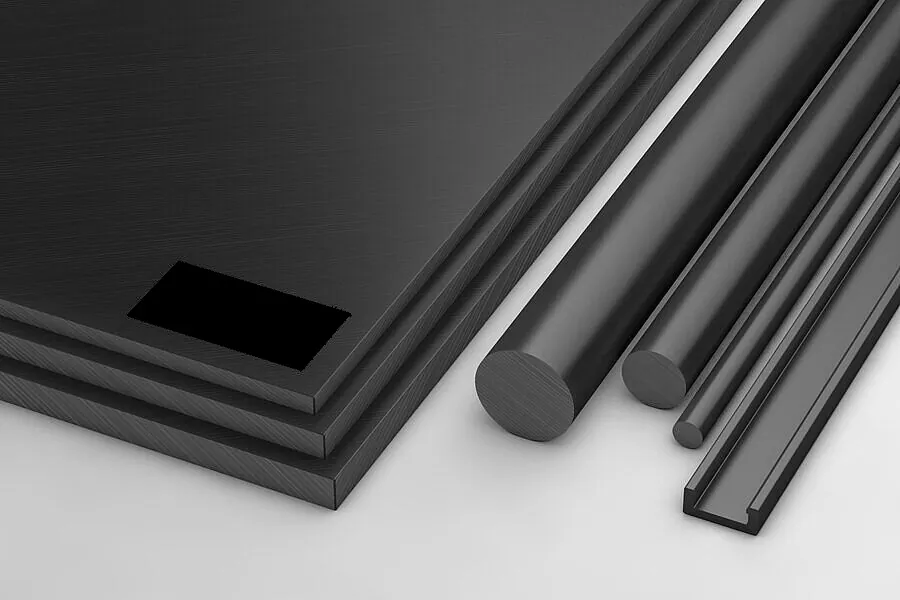
Bulk material handling
Abrasion-resistant plastics for bulk material handling, gravel, sand and granulates. PE-UHMW, wear sheets and custom-made plastic components.
In bulk solids handling, free-flowing or granular materials such as sand, gravel, granulates, grain, powders or other raw materials are transported, stored and dosed. Particularly with mineral bulk solids, high loads arise from friction, impacts and abrasive wear.
For heavily stressed conveying systems, abrasion-resistant and wear-resistant plastics offer a durable alternative or supplement to metal components. They can improve material flow, reduce adhesion and protect system areas at risk of wear.
Martan Plastics supplies suitable plastic semi-finished products as well as individually machined plastic components for conveying systems, chutes, silos, screw conveyors and other bulk solids handling applications.
What is bulk solids?
Bulk solids are loose materials that can be poured, conveyed or stored. Depending on particle size, moisture, hardness and composition, their flow and wear properties differ considerably.
Typical bulk solids include, for example:
- gravel and crushed stone
- sand
- grain
- plastic granulates
- pellets
- powders
- salts
- ores and mineral raw materials
Especially hard bulk solids such as gravel, sand or mineral granulates can place heavy stress on contact surfaces within a conveying system. Materials for these applications must therefore not only be mechanically resilient but often also particularly abrasion-resistant.
For related applications in industrial plant engineering, you can find further information under Plastics for mechanical and plant engineering.
Why are abrasion-resistant plastics worthwhile for bulk solids?
When bulk solids are transported, particles constantly strike chutes, guides, linings and other system components. Depending on conveying speed, bulk solid and design, this causes abrasive wear.
A suitable abrasion-resistant plastic can perform several tasks here:
- protection of heavily stressed surfaces
- reduction of friction
- improvement of material flow
- reduction of adhesion
- corrosion protection
- reduction of component weight
- extension of maintenance intervals
Which plastic grade is suitable always depends on the specific application. Factors to consider include the bulk solid, particle size, conveying speed, temperature, mechanical load and existing friction partners.
Further information on targeted material selection can be found in our article on wear-resistant plastics.
Which plastic is particularly abrasion-resistant?
For applications with abrasive bulk solids, PE 1000 or PE-UHMW is frequently used. Due to its very high molecular weight, this material has high abrasion resistance as well as very good sliding and anti-adhesive properties.
PE 1000 is therefore suitable, among other things, for components that come into permanent contact with sand, gravel, granulates or other abrasive materials.
Typical applications are:
- wear plates
- chute linings
- silo interior linings
- guide rails
- slide bars
- screw conveyors
- chain guides
- sliding and guide elements
Detailed information on the various PE grades is available on our material page for polyethylene (PE).
If you need the material as a semi-finished product, you can also find PE 1000 or PE-UHMW sheets in various designs.
Abrasion-resistant components for processing gravel
The processing and conveying of gravel produces particularly high wear loads. The hard mineral particles act continuously on the contact surfaces of the conveying system.
The following areas in particular can be heavily stressed:
- chutes
- chutes
- hoppers
- deflection areas
- transfer points
- guide elements
- linings
- wear plates
For such areas, components and linings made of PE-UHMW or PE 1000 can be a suitable solution. The plastic combines high wear resistance with good sliding properties and is therefore suitable for numerous applications with abrasive bulk solids.
Which material and which material thickness are required should be determined on the basis of the actual operating conditions. Relevant factors include, for example:
- particle size and particle shape of the gravel
- conveying speed
- impact angle and drop height
- surface pressure
- temperature
- moisture
- desired service life
- structural design of the component
Martan Plastics can manufacture plastic parts to match the existing system geometry. Information on machining options can be found under plastic machining.
For components made from sheet material, you can also directly compare our plastic sheets.
Which plastics are suitable for bulk solids handling?
Depending on the load profile, different engineering plastics may be considered. In addition to abrasion resistance, factors such as stiffness, temperature resistance, dimensional accuracy, friction behaviour and chemical resistance play a role.
PE-UHMW or PE 1000
PE 1000 or PE-UHMW has very high abrasion resistance, high impact strength and very good sliding properties. The material is particularly suitable for wear-stressed components, linings, guides and sliding elements in conveying systems.
Typical applications are:
- chain guides
- slide rails
- wear plates
- linings
- chutes
- hoppers
- conveying elements
If you need PE 1000 as a starting material, you can select suitable PE 1000 sheets directly.
POM
POM is characterised by high strength, stiffness and good dimensional accuracy. The material can be of interest, for example, for precise guide and machine elements where, in addition to wear behaviour, high dimensional stability is required.
POM can be an alternative particularly where PE is not optimally suited due to its comparatively lower stiffness.
Polyamide
Cast polyamide can also be considered for mechanically more heavily loaded components. Typical applications include, for example, rollers, plain bearings, guide elements and components in conveyor technology.
When choosing between PE, POM and polyamide, mechanical load, moisture, friction, dimensional accuracy and wear should be taken into account in particular.
PTFE
PTFE has particularly good sliding properties and high chemical resistance. It can therefore be of interest for special sliding, guide or sealing applications where low friction or media resistance is the priority.
The choice of material should not be based on a single characteristic value alone. For complex applications, an application-specific selection from various high-performance plastics can therefore be advisable.
Typical plastic components in conveying systems
Abrasion-resistant plastics can be used at numerous points in a bulk solids system.
Chutes and chutes
Plastic linings can reduce direct contact between the bulk solid and the underlying structure. At the same time, good sliding properties can support material flow and reduce adhesion.
For highly abrasive applications, wear-resistant grades such as PE 1000 are particularly suitable.
Silos and hoppers
In silos, bunkers and hoppers, plastic linings can be used to protect surfaces at risk of wear and to support material flow.
Particularly with bulk solids that flow poorly or tend to adhere, suitable plastics can create a functional surface.
Screw conveyors
In screw conveyors, plastics can be used, for example, for sliding, guide and bearing elements as well as, depending on the design, for other wear-stressed components.
Individual parts can be manufactured to drawing or technical specifications as part of plastic machining.
Conveyor belts and chain conveyors
Slide bars, chain guides and guide rails made of wear-resistant plastics enable low-friction guidance of moving components.
PE 1000 is frequently used for such applications. Suitable semi-finished products are available, among other things, as PE 1000 sheets.
Transfer and deflection points
At transfer points, particularly high loads often arise from impact and changes of direction. Replaceable wear plates or individual plastic linings can be used here.
Applications from general mechanical and plant engineering also place comparable demands on wear resistance, friction behaviour and component weight.
Abrasion resistance is not the only selection factor
The plastic with the highest abrasion resistance is not automatically the best material for every conveying system.
When selecting a material, the following factors should be taken into account, among others:
| Requirement | Significance for material selection |
|---|---|
| Abrasiveness of the bulk solid | influences the expected wear |
| Particle size and particle shape | influence friction and impact load |
| Conveying speed | higher speeds can increase the wear load |
| Impact load | requires sufficiently tough materials |
| Temperature | limits the use of certain plastics |
| Chemical contact | requires suitable chemical resistance |
| Moisture | can influence material flow and material selection |
| Friction partner | influences sliding behaviour and wear |
| Design | determines load and fastening options |
| Dimensional accuracy | can make the use of stiffer engineering plastics necessary |
The selection of a wear-resistant plastic should therefore always be based on the specific case of use.
An initial overview of suitable material groups is available via our plastic materials.
Plastic semi-finished products or finished components?
Depending on the application, plastics for bulk solids handling can be obtained either as a semi-finished product or as a fully machined component.
Plastic semi-finished products are suitable, for example, when the material is to be further processed in-house.
If, on the other hand, you need ready-to-install components, parts can be manufactured by plastic machining in accordance with your drawing or technical requirements.
Typical components are:
- wear plates to drawing
- linings
- guide rails
- slide bars
- rollers
- bushes
- moulded parts
- milled parts
- turned parts
- individual spare parts
This allows material selection to be combined directly with the required component geometry.
Individual plastic components for bulk solids conveying systems
In addition to semi-finished products, Martan Plastics supplies individually machined plastic parts for industrial conveying systems.
Manufacturing can be carried out on the basis of your drawing, existing component dimensions or technical requirements.
Depending on geometry and material, machining processes can be used, for example. This allows both simple wear plates and more complex guides, rollers, bushes or moulded parts to be produced.
Further information on manufacturing processes and individual solutions is available on the plastic machining page.
If you first need the suitable starting material, you can find a selection under plastic sheets.
How can bulk solids handling be made more sustainable?
A sustainable solution in bulk solids handling cannot be defined across the board by a single material.
Possible approaches are:
- longer component service lives
- specifically replaceable wear elements
- suitable sliding pairings
- low material usage
- reduced maintenance intervals
- optimised material flow
- materials matched to the actual load
Long-lasting wear parts can help to reduce material consumption, spare parts requirements and maintenance-related downtime.
Instead of selecting a plastic solely on the basis of a single material characteristic value, the complete application should therefore be considered.
Plastic solutions for heavily stressed bulk solids systems
If you need a component for gravel, sand, granulates or other abrasive bulk solids, the material and component geometry can be specifically matched to the respective operating conditions.
Information on the following is particularly helpful:
- conveyed material
- particle size
- conveying speed
- temperature
- chemical load
- dimensions
- existing design
- material previously used
- current wear problem
- desired quantity
On this basis, it can be assessed whether, for example, PE 1000 or PE-UHMW, another engineering plastic or an individually machined component is suitable for your application.
For standard semi-finished products, PE 1000 sheets are available, among other things.
For individual geometries, use our plastic machining.
Request a plastic solution now
Frequently asked questions about bulk solids handling
What is bulk solids?
Bulk solids are a loose, free-flowing or pourable material. Typical examples are sand, gravel, granulates, grain, pellets and powders. The properties of a bulk solid differ in terms of, among other things, particle size, moisture, flow behaviour and abrasiveness.
Which plastic is particularly abrasion-resistant?
PE-UHMW or PE 1000 is one of the particularly wear-resistant engineering plastics and at the same time has good sliding and impact strength properties. The material is therefore frequently used for linings, slide bars, chain guides and other wear-stressed components.
Further material information can be found under polyethylene (PE).
Which plastic is suitable for processing gravel?
For highly abrasive applications with gravel, PE-UHMW or PE 1000 can be of interest. Suitable components include, for example, wear plates, chute linings, guides and sliding elements.
The right design depends, among other things, on particle size, conveying speed, impact load and design.
Suitable semi-finished products can be found among our PE 1000 sheets.
What advantages do plastics have over metal in conveying systems?
Depending on the plastic used, advantages such as low weight, corrosion resistance, good sliding properties, electrical insulation or high wear resistance can arise.
Whether plastic is the better solution compared with metal must be assessed on the basis of the respective load and design.
Further possible applications can be found under Plastics for mechanical and plant engineering.
Can plastic components be manufactured to drawing?
Yes. Martan Plastics manufactures plastic parts to technical specifications and can combine suitable semi-finished products with subsequent machining.
This allows, for example, guides, wear plates, bushes, rollers and individual components to be produced to match the conveying system.
You can find out more under plastic machining.
What information is needed to select a wear-resistant plastic?
Information on the bulk solid, particle size, conveying speed, temperature, mechanical load, component geometry and the material previously used is particularly helpful.
This allows the material selection to be matched much more precisely to the actual application.





