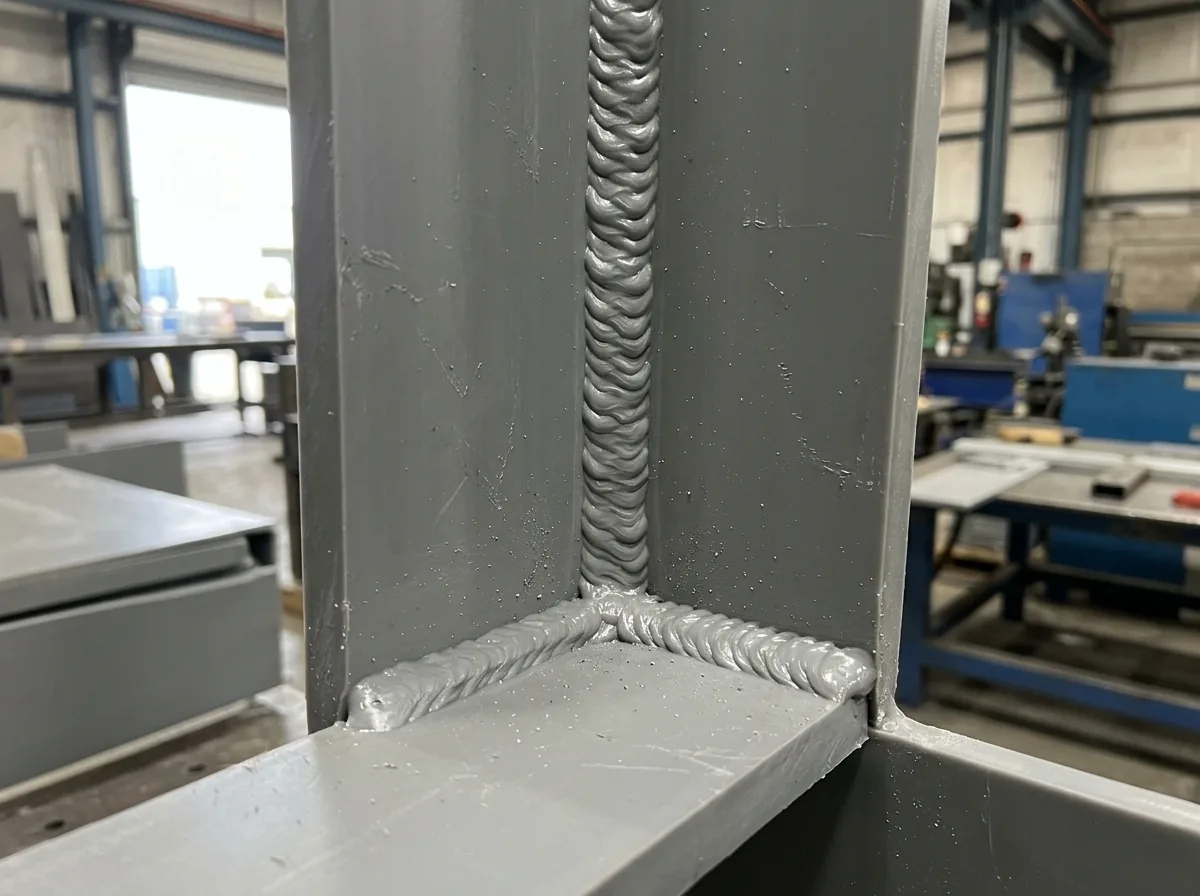
 This image was created with artificial intelligence – marked under Art. 50 of the AI Act, Regulation (EU) 2024/1689. It is a placeholder until the company's photos arrive.
Laser cuttingCO2 laser processing
Laser cutting and CO2 laser processing of acrylic glass
Laser processing is a very economical and extremely precise method for processing various materials. Laser technology is indispensable in today's production and development processes. Versatility, flexibility and cost-effectiveness combined with the highest quality standards are convincing characteristics. Processing with a laser achieves high repeat accuracy, tight manufacturing tolerances and profitability even for very small batch sizes. Lasers offer a wealth of possibilities for processing the most diverse materials. Metal, various plastics, wood, leather and paper can be modified with the special beams of light. Lasers also offer new processing methods that allow products to be manufactured with properties that were previously unachievable. During laser processing, the treated material heats up strongly and evaporates or liquefies. Thermo- or photochemical reactions are triggered for curing and for a colour change. All processes rely on an intense, generally focused laser beam that is absorbed by the material to be processed. Processing with light is fast, permanent and precise. Various types of laser are used for this. The use of a CO2 laser, which works with a gas mixture, is common. To generate the beam of light, the gaseous mixture is excited. Energy can be supplied via a voltage discharge, which produces light waves.
The CO2 laser is a gas laser whose ends in the laser tube are fitted with mirrors. One of these mirrors lets the light partly through, the other is opaque. The generated light waves are reflected back and forth within the laser tube between the mirrors until they finally emerge as a laser beam at the semi-transparent end. Besides the gas laser, there is also the fibre laser. The medium here is a special form of the solid-state laser, in which the doped core of a glass fibre is used to generate the beam of light. So-called pump fibres amplify the laser guided through the fibre. Laser processing is of interest for various fields. Laser cutting, laser engraving and laser marking have developed into important industrial processes. The decisive factor is the precision achievable with the focused laser beam, which is of importance across industries. The relatively inexpensive light technology has become indispensable for medical technology, the automotive industry and electronics manufacturing. Numerous other sectors also benefit from the advanced possibilities of laser processing. The advantages of the process are not few. Moreover, the non-contact processing means there is no material damage. The laser removes only what is desired. A precise configuration is of course crucial in order to achieve the high-quality result. With the right partner at your side, quality is a given. For Heilbronn and the surrounding area, the company BW Kunstoffe is a suitable point of contact. High standards for the product guarantee a tailor-made solution that meets your needs 100 per cent and more than fulfils your expectations. Based in Heilbronn, the company specialises in the manufacture of technical plastic finished parts and semi-finished products. Thanks to laser technology, precisely fitting products can be realised quickly. In a personal consultation you will find out what is possible. For engraving, marking and cutting materials, the use of beams of light is an extremely effective method that ensures long-lasting results. There are hardly any limits to your creative and innovative ideas, because laser processing also allows extensive concepts to be implemented. In order to further optimise manufacturing processes and ensure a high quality of components, laser processing is exactly the right choice.
Precise and non-contact decoration with laser engraving
With a CO2 laser, flawless, true-to-template laser engraving is possible. The beams of light carry out the decoration in a non-contact process. The material is merely melted and vaporised with the aid of the laser light. In contrast to the mechanical method with a tool, there is no wear during laser engraving. The quality of the engraving remains consistently at a high level. Laser processing is very gentle on materials. To apply the engraving, the material to be processed does not need to be fixed or clamped. As a result, there is no damage to the workpiece and there is less waste. Laser engraving ensures high-quality and permanent results. Decorations created with the laser are finer. A further advantage lies in the durability. While printed designs are not exactly known for adhering permanently to the product, laser technology guarantees longevity. The motif does not matter, because whatever you have in mind can be engraved. Names, dedications, logos or greyscale images can be applied to the product quickly, absolutely true to detail and permanently by laser engraving. Depending on the material, various engraving depths are possible. Processing with the laser can be carried out, for example, on wood, on plastics, on leather and textiles, on paper and cardboard as well as on glass. There are only a few surfaces that cannot be decorated with light technology. With the laser engraving process, you can easily add your logo to popular promotional gifts. The engraving will never disappear and will always represent your brand in visually flawless condition. The advantages of laser engraving are unbeatable. Non-contact processing and the fact that fixing is not required prevent material damage to the workpiece. The impressive precision and repeat accuracy ensure consistently high-quality and consistent results. The technology also guarantees a high degree of flexibility in the choice of contour. The environmentally friendly aspect should also be emphasised. Laser engraving uses no chemicals or other additives. The efficient use produces no unnecessary waste, so that the carbon footprint of product manufacturing can be kept lower. The resulting engravings are abrasion-resistant and food-safe and, compared with printed designs, are by far the better choice. Various woods are suitable for laser engraving. With hardwood such as oak and beech, more power is required for engraving. The decoration with the laser is darker than with softwoods. Poplar is one of these soft wood types, which accordingly requires less laser power. As a result, the engravings can be applied more quickly. The result is lighter and not so high in contrast. Acrylic glass can be processed optimally with the laser. Whether it is structured, clear or coloured, mirrored or satin-finished material is irrelevant. Particularly high-contrast engravings can be expected on cast acrylic glass, on which an excellent cut edge can also be achieved. Laser engraving can also be applied to other plastics. With some materials, the best results are not always possible. Polypropylene can indeed be processed with a CO2 laser, but it cannot be ruled out that instead of removal, melting and an uneven surface occur. The reason is the relatively low melting point of polypropylene. Laser engraving is used in various fields. The technology is above all an essential method for marking specific parts in the automotive industry and in the electronics sector. Manufacturers of gift and decorative items also make extensive use of laser engraving. If you are looking for a company to decorate your products with the beam of light, BW Kunstoffe in Heilbronn is a competent candidate. A detailed consultation and recommendation of ideal materials is included.
Achieving the best possible results with laser cutting
Cutting materials by means of a laser is one of the most economical and precise methods for processing various materials. With the process, large series and individual parts can be cut to size precisely. The use of beam technology offers a very high manufacturing standard, which brings various advantages to your company and the corresponding products. The high precision and optimal cutting speeds ensure rapid and first-class results. During laser cutting, the cut surfaces are produced with pinpoint accuracy at the desired locations. The product is something to be proud of. With a configurator you create the shape according to your wishes. Rectangles with individual cut-outs are just as possible as round designs. Circles and rings can be realised without difficulty with the method. Other geometric shapes can also be implemented precisely by laser cutting. The clean cut edges of the treated parts are even and smooth. Post-processing is generally not necessary. Laser cutting delivers the highest dimensional accuracy, and that with very tight manufacturing tolerances. The method enables precise processing of meltable materials with quality cuts up to 50 millimetres in thickness. The technical effort of cutting depends on the respective materials and the thickness of the piece to be processed. Plastics, leather, metals, paper, wood and other materials can be cut efficiently with the laser without the use of mechanical processes. The advantages over conventional techniques are numerous. The use of the laser is economical, since there is a high utilisation of the material. Various materials can be processed and cut to size extremely precisely. The cut edges are narrow and clean and require no post-processing. Moreover, laser cutting can be used for a production quantity from a single piece. The high flexibility in the shape of the cut piece brings further advantages. Complicated designs are difficult to implement cleanly with the usual techniques. With the laser method, various geometric shapes can be cut to size. For individual shape cut pieces made of plastic, the company BW Kunstoffe in Heilbronn is the right point of contact. With the company's state-of-the-art technology, you can have standard and special plastics cut to size precisely and professionally. Precisely fitting results with clean cut edges can be realised quickly with this company as competent support. Cutting plastic to size requires experience and constant monitoring of the process. During laser processing of the material, gases form that can easily ignite and should preferably be extracted. A closed system and the guarantee of extraction of gases is essential when laser cutting plastics. The material PETG is not suitable for the process, since processing with the beams of light releases toxic gases that pose a danger to people and the environment. Laser cutting of PVC is likewise not recommended, because corrosive hydrochloric acid is produced here.
Giving your products an individual touch with laser marking
Laser marking gives your products an unmistakable personal touch. With the technology, both deep engraving and raised-free fine marking can be produced. Marking objects with the aid of an intense laser beam is the perfect solution for labelling and individualising. In contrast to laser printing, in which pigments are applied to the material with a weak laser beam, laser marking changes the material to be processed itself. Depending on the material, the marking is very durable. Water and sweat cannot harm it. The lettering can be applied quickly and designed according to your needs. All common fonts, but also entirely individual designs, are feasible. Due to the versatility and flexibility of the process, marking objects with the laser is a very widespread technique in industry. The labelling of metals and plastics is particularly in demand. The reason for this is the advantages of the technology. The marking produced with the laser enables the precise execution of lettering and shapes, integration into production lines and the permanent legibility of the marking. The process is suitable for the most diverse materials and is highly economical, since only low operating and maintenance costs arise. From plastic to steel, almost anything is possible. Tamper-proofing and high flexibility complement the positive aspects of laser marking. The short set-up times of the method are also advantageous. Depending on the material, marking is carried out by removal or by heat treatment. During removal, a colour contrast is created by removing the top layer of a workpiece, for example in the case of painted or anodised components. During heat treatment, on the other hand, the surface layer of the material is heated selectively by the laser and discoloured accordingly. Since several steps can be achieved in a single operation with light technology, processing with the laser offers an attractive price-performance ratio. The company BW Kunstoffe from Heilbronn helps you to carry out first-class marking of your products. Orders placed can be implemented quickly. The results of the efficient method have so far left all customers extremely satisfied. With plastics, the marking is applied by foaming and colour changes. During foaming, gas bubbles are created by the melting of the surface, which increases the volume and achieves the desired contrast. The marking is raised on the product. Colour changes are brought about by a change in the molecules of the plastic, which are caused by the laser. While the surface of the material remains almost undamaged, a change in colour occurs. Laser marking of plastic is possible quickly and in an automated way. In this way, products such as signs, housing parts and plugs can be individually labelled. The plastics that can be marked include polyamide, polycarbonate and ABS, among others. The company BW Kunstoffe in Heilbronn will be happy to advise you on the possibility of marking other materials with the laser beam.