Laboratory and medical technology
Plastic parts for laboratory and medical technology to drawing. Precision milled and turned parts made from POM-C, PEEK, PTFE and other engineering plastics.
Plastic parts for laboratory and medical technology
In laboratory and medical technology, plastic components often have to meet high requirements in terms of dimensional accuracy, chemical resistance, cleanability and mechanical load capacity. Depending on the application, different engineering plastics are used. What matters is not the material alone, but the combination of operating conditions, design and manufacturing process.
We manufacture custom plastic parts for laboratory and medical technology to drawing, CAD data or technical specifications. Individual parts, prototypes, spare parts as well as small and series production are possible.
What requirements must plastic parts in laboratory and medical technology meet?
The requirements differ considerably depending on the area of application. A component in an analytical instrument is subjected to different stresses than a guide in laboratory automation or a cover within a medical device.
Typical requirements are:
- high dimensional accuracy
- low moisture absorption
- chemical resistance
- good cleanability
- low friction
- wear resistance
- electrical insulation
- low component weight
- temperature resistance
- defined surface quality
For applications with increased regulatory requirements, the specific material grade, manufacturer documentation and, where applicable, existing approvals must also be taken into account.
A blanket statement that a plastic is suitable for every medical application is therefore not possible.
Why are engineering plastics used in laboratory and medical technology?
Engineering plastics enable properties that are sometimes difficult to combine with metallic materials.
Many plastic components are significantly lighter than comparable metal components. At the same time, suitable materials can be corrosion-resistant, electrically insulating or particularly low-friction.
In addition, there is the wide range of materials. Properties such as hardness, friction behaviour, temperature resistance or chemical resistance can be specifically adapted to the respective application.
Machining also allows complex geometries to be produced without a special mould. This is particularly interesting for prototypes, special components and smaller quantities.
Typical plastic parts for laboratory instruments and medical devices
Custom plastic components are used in numerous instruments, fixtures and automated systems.
Typical examples are:
- guides
- holders
- spacers
- housing parts
- covers
- mounting elements
- carrier plates
- slide plates
- bushes
- rollers
- distance rings
- adapters
- mounting plates
- fixtures
- functional parts for laboratory automation
Even more complex plastic milled parts with holes, pockets, grooves or threads can be manufactured according to a technical drawing.
For rotationally symmetrical components, on the other hand, plastic turned parts are often used.
Which plastics are suitable for laboratory and medical technology?
The choice of material always depends on the specific application. Temperature, mechanical load, moisture, cleaning agents and manufacturing tolerances must be considered together.
POM-C
POM-C is one of the frequently used engineering plastics for precise functional parts.
The material is characterised in particular by good dimensional accuracy, high strength and favourable sliding properties. It can also be machined very well.
Typical applications are:
- guides
- bushes
- holders
- precision components
- moving functional parts
- mounting elements
POM-C is particularly suitable for components where tight tolerances and good mechanical stability are required.
Whether a specific POM-C grade is suitable for a regulated medical use must be checked on the basis of the respective material documentation.
PEEK
PEEK is a high-performance plastic for applications with increased thermal, mechanical or chemical requirements.
The material has a high temperature resistance and very good mechanical properties.
PEEK can, for example, be used for highly stressed functional parts, holders or components that operate under conditions for which classic engineering plastics are not sufficient.
Due to its higher material price, PEEK is usually used specifically where its properties are technically necessary.
PTFE
PTFE is used in particular because of its very low friction and its high chemical resistance.
Typical applications are:
- sliding elements
- components exposed to chemicals
- sealing elements
- insulating parts
- bearing and guide elements
However, PTFE has a lower mechanical stiffness than, for example, POM-C or PEEK. With tight tolerances and mechanically loaded components, this must already be taken into account during design.
Polypropylene
Polypropylene is often used when chemical resistance, low weight and low moisture absorption are important.
Conceivable applications are container elements, covers, carriers or components in laboratory setups.
The actual suitability depends in particular on temperature, mechanical load and the chemicals used.
Polyethylene
Polyethylene is available in various grades. Depending on the variant, wear resistance, stiffness and sliding properties differ considerably.
PE 300 is suitable for numerous simple technical components, while PE 500 and PE 1000 can be used for higher requirements in terms of wear and sliding properties.
Typical components are:
- guides
- slide plates
- supports
- protective parts
- simple fixture parts
Polycarbonate
Polycarbonate is used above all when transparency and high impact strength are to be combined.
Possible applications are:
- viewing covers
- protective screens
- transparent housing parts
- device covers
For applications with cleaning or disinfecting agents, the resistance to the specific medium used must be checked.
PMMA / acrylic glass
Acrylic glass offers high transparency and can be used very well for optical purposes.
Typical applications are:
- viewing windows
- device covers
- transparent holders
- protective hoods
- housing elements
Compared with polycarbonate, PMMA has a lower impact strength, but often offers better optical quality and good surface properties.
Which plastic is suitable for which application?
| Requirement | Frequently suitable materials |
|---|---|
| High dimensional accuracy | POM-C, PEEK |
| Good sliding properties | POM-C, PTFE, PE 1000 |
| High chemical resistance | PTFE, PEEK, PP |
| Transparent components | Polycarbonate, PMMA |
| High impact strength | Polycarbonate |
| High temperature load | PEEK, PTFE |
| Wear stress | PE 1000, POM-C |
| Electrical insulation | depending on material and application |
The table serves only as initial guidance. For a reliable material selection, all operating conditions must be taken into account.
Chemical resistance in laboratory applications
Cleaning agents, solvents, acids or alkalis are often used in laboratory systems. The chemical resistance of plastic parts therefore plays a central role.
The statement "chemical-resistant" alone is not sufficient.
The decisive factors include:
- the chemical used
- concentration
- temperature
- contact time
- mechanical load
- repeated or permanent contact
A plastic can, for example, be sufficiently resistant to a chemical at room temperature, but be attacked considerably faster at a higher temperature.
For critical applications, the material selection should therefore be based on specific resistance data.
Cleaning and sterilisation
Not every engineering plastic is automatically suitable for every cleaning or sterilisation process.
Depending on the application, components can come into contact with alcohol-based cleaners, alkaline media or other disinfectants, for example.
Elevated temperatures can also play a role.
When selecting a plastic, the following questions must therefore be clarified, among others:
- How is the component cleaned?
- Which cleaning agents are used?
- What temperatures occur?
- How often is cleaning carried out?
- Is the component sterilised?
- Which sterilisation process is used?
Only then can it be assessed whether a material is suitable for the specific load.
Precise plastic parts through CNC machining
For custom components, CNC plastic machining offers a significant advantage: components can be produced directly from semi-finished products.
Moulds as in injection moulding are not required.
The process is therefore particularly suitable for:
- individual parts
- prototypes
- special components
- small series
- spare parts
- design changes
- variant production
Complex contours, hole patterns, pockets, grooves and threads can be manufactured according to the component geometry.
Through our production of plastic milled parts, for example, mounting plates, holders, guides or complex functional parts can be manufactured.
Dimensional accuracy in plastic components
Plastics behave differently during machining than metallic materials.
Temperature, moisture, internal stresses and the respective plastic can influence the achievable dimensional accuracy.
This is particularly important for:
- fits
- bearing points
- guides
- thin-walled components
- large-area milled parts
- components with tight tolerances
Tolerances should therefore not be adopted wholesale from metal designs.
A design suited to plastics can reduce manufacturing effort and at the same time improve functional reliability.
Having plastic parts manufactured to drawing
For the manufacture of plastic parts to drawing, technical specifications that are as complete as possible are required.
Ideally, the following information is provided:
- technical drawing
- CAD file
- desired material
- dimensions
- tolerances
- quantity
- desired surfaces
- service temperature
- mechanical load
- media or chemical contact
If the material has not yet been determined, information on the operating conditions is particularly important.
On this basis, it can be assessed which material group is technically sensible.
Prototypes and small series for laboratory and medical technology
Particularly in the development of new devices, individual prototypes are often produced first.
Machining offers the advantage here that design changes can be implemented comparatively quickly. A new mould is not necessary.
After successful testing, the same manufacturing process can often also be used for small series or recurring components.
This is particularly interesting for:
- development projects
- laboratory instruments in small quantities
- special-purpose machines
- individual analytical systems
- spare parts for existing systems
Design of plastic components
The right choice of material alone is not enough. The geometry should also be adapted to the behaviour of engineering plastics.
Critical areas can be, for example, very thin wall thicknesses, large material cross-sections or unnecessarily tight tolerances.
The following should already be taken into account during design:
- mechanical loads
- temperature
- thermal expansion
- moisture absorption
- required fits
- screw connections
- threads
- wall thicknesses
- possible deformation
A design suited to plastics often improves both the component function and the cost-effectiveness of manufacturing.
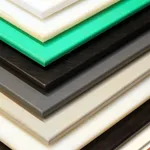
Plastic sheets as starting material
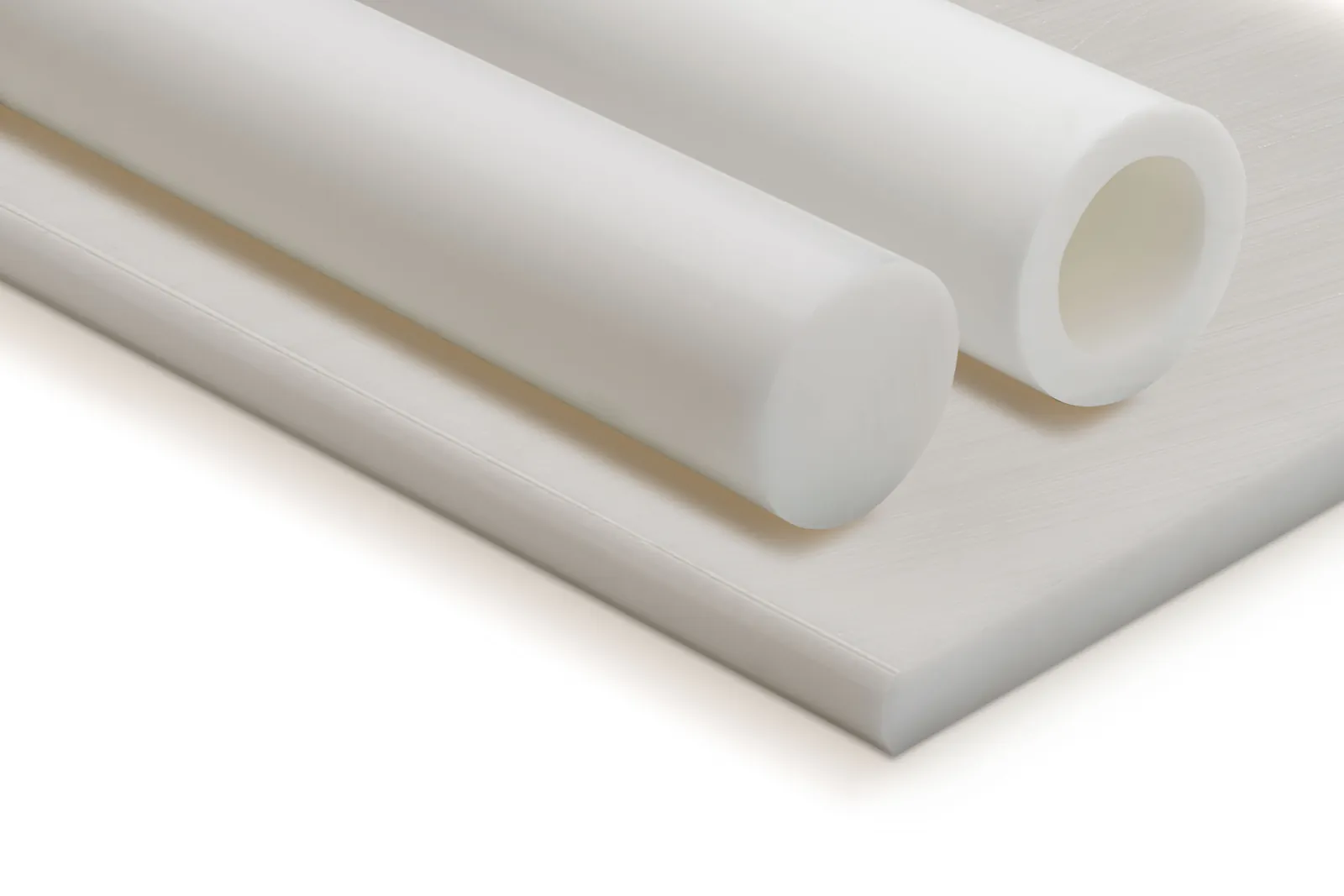
Many milled components are manufactured from engineering plastic sheets.
Depending on the application, different materials and material thicknesses are available.
Even simple cut sheet pieces can be used as mounting plates, carriers or base plates in laboratory systems. Further machining turns them into complex functional parts with individual contours, holes and milled recesses.
What is particularly important in medical applications?
Depending on the component, the requirements of medical technology go far beyond pure mechanical function.
Relevant factors can include, for example:
- direct or indirect patient contact
- contact with biological media
- cleaning and sterilisation processes
- documentation requirements
- traceability
- material certificates
- special regulatory requirements
Whether a particular plastic meets these requirements must be checked for the specific material grade and the intended use.
A technical material designation such as PEEK, POM-C or PTFE alone does not constitute a medical approval.
Frequently asked questions about plastic parts for laboratory and medical technology
Which plastics are used in medical technology?
Frequently used engineering plastics include POM-C, PEEK, PTFE, polypropylene and polycarbonate. Which material is suitable depends on the specific application, the temperatures, chemicals and regulatory requirements.
Which plastic is suitable for precise milled parts?
POM-C is often used for dimensionally accurate and mechanically loadable precision parts. For higher thermal or chemical requirements, PEEK can be an alternative. The final selection depends on the operating conditions.
Can plastic parts be manufactured to drawing?
Yes. Plastic parts can be manufactured on the basis of technical drawings or CAD data. Milled parts, turned parts, sheet components, guides, holders and individual functional parts are possible, among others.
Are engineering plastics sterilisable?
That depends on the plastic, the specific material grade and the sterilisation process. Temperature, radiation or chemical media can affect plastics in different ways. Suitability must therefore be checked for the specific application.
Can prototypes and small series also be manufactured?
CNC machining is particularly suitable for individual parts, prototypes and small series, as no special mould is required. Design changes can therefore be implemented comparatively flexibly.