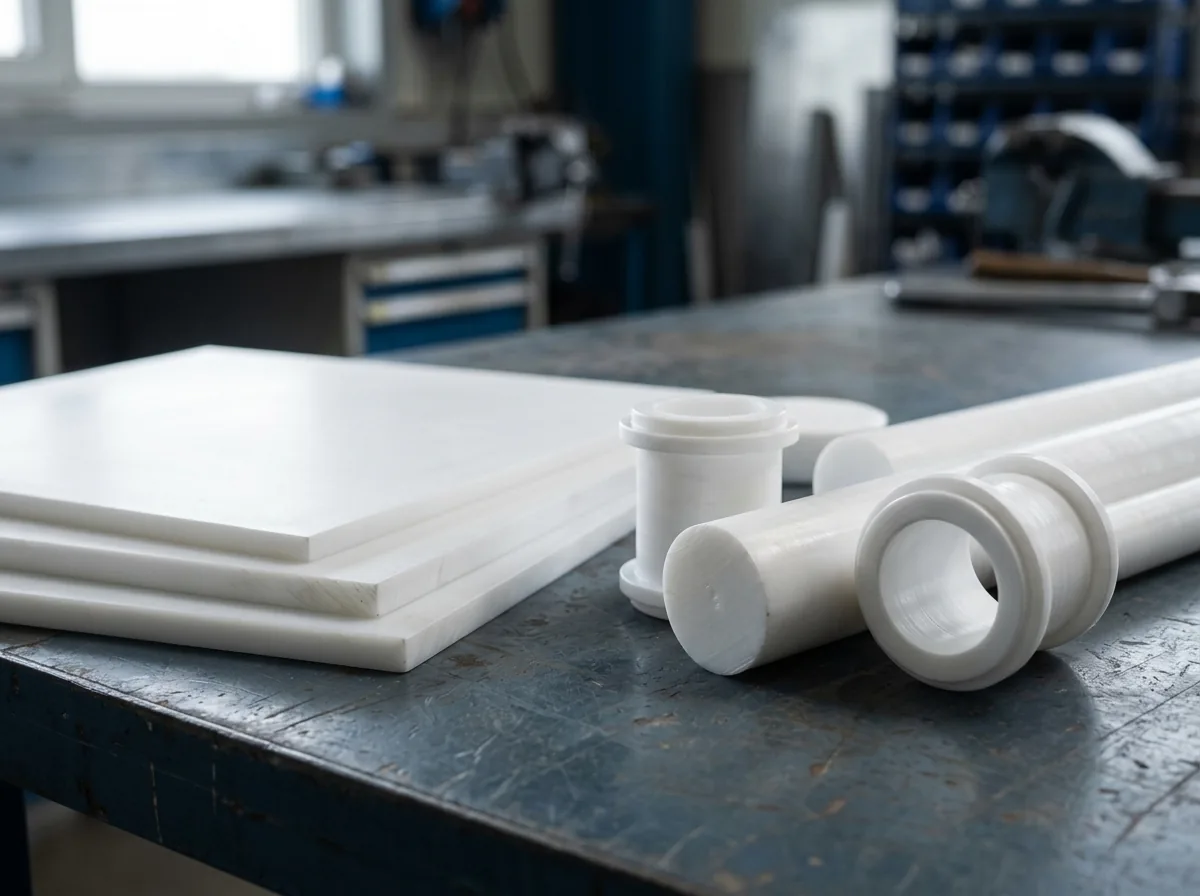
 This image was created with artificial intelligence – marked under Art. 50 of the AI Act, Regulation (EU) 2024/1689. It is a placeholder until the company's photos arrive.
Heat-resistant seals
Heat-resistant seals for high temperatures: materials, applications, selection criteria and service life.
Heat-resistant seals, also known as high-temperature seals, are used wherever conventional elastomers lose their physical properties. In industrial applications, they reliably safeguard processes at permanently high temperatures, thermal cyclic loads and often also under additional pressure or chemical exposure.
What are heat-resistant seals?
Heat-resistant seals are specially developed sealing elements for applications with increased thermal requirements. They are used wherever standard seals would lose their elasticity, dimensional stability or sealing effect due to temperature, pressure or chemical exposure.
Depending on the material used, heat-resistant seals are designed for temperature ranges from around 200 °C to well over 1,000 °C. It is not only the peak load that is decisive here, but above all the duration of temperature exposure and the interaction with pressure, medium and mechanical load. In practice, it is precisely this combination that determines the suitability of a high-temperature seal.
Temperature ranges and material limits
The selection of a high-temperature seal always begins with the real temperature load in operation. Short-term peaks, continuous temperatures and thermal cycles affect materials differently.
| Material | Typical temperature range |
|---|---|
| Graphite | up to approx. 450 °C (oxidising), significantly higher in protective atmosphere |
| AFM / fibre material | up to approx. 400 °C |
| PTFE (modified) | up to approx. 260 °C |
| Metallic seals | depending on design > 800 °C |
Materials for high-temperature seals
Various materials are available for high-temperature applications, differing in temperature resistance, pressure absorption, chemical resistance and mechanical behaviour.
Graphite seals are characterised by very high temperature and pressure resistance. They are particularly suitable for applications with strong temperature fluctuations, as they exhibit stable relaxation behaviour.
Fibre material seals are frequently used in mechanical and plant engineering. They offer good adaptability to sealing surfaces and are suitable for many industrial standard applications with elevated temperatures.
PTFE-based high-temperature seals are used when high chemical resistance is required in addition to temperature. Modified PTFE materials extend the application range compared with classic PTFE.
Metallic seals are used in extreme high-temperature and high-pressure applications, for example in power generation or the process industry. They require precise sealing surfaces and defined installation conditions.
Chemical resistance and pressure behaviour
In addition to temperature, the medium to be sealed significantly influences the service life of a high-temperature seal. Gases, vapours, oils or aggressive chemicals affect the materials used in different ways and can accelerate ageing processes.
Pressure behaviour is equally decisive. High-temperature seals must seal reliably even under material expansion, relaxation and changing pressure conditions. Sufficient and uniform surface pressure forms the basis for a permanently stable sealing connection.
Selection criteria for the right high-temperature seal
The following factors should be taken into account when selecting heat-resistant seals:
- Maximum and continuous operating temperature
- Type of medium
- Pressure level and surface pressure
- Mechanical load and vibration
- Installation situation and available sealing surfaces
A clean coordination of these parameters reduces failure risks and significantly extends the service life of the seal.
Typical areas of application in industry
- Mechanical and plant engineering: Heat-resistant seals ensure reliable sealing of flanges, housings and process connections at permanently high operating temperatures.
- Chemical and process industry: In reactors, pipelines and apparatus, high-temperature seals safeguard processes against heat, pressure and aggressive media.
- Power generation and power plant technology: In boilers, turbines and exhaust systems, they ensure safe sealing under extreme thermal and mechanical loads.
- Exhaust and furnace systems: High-temperature seals withstand high exhaust temperatures and reliably compensate for thermal expansion.
- Plastics and metal processing: In extrusion, casting and heat treatment, they ensure a tight connection despite high process heat.
Cut pieces and custom solutions
In addition to standard formats, heat-resistant seals are frequently manufactured as cut-to-size pieces or individual custom solutions. Precise cut pieces are required particularly for complex geometries, large surfaces or special installation situations.
Clean cut edges, defined tolerances and material-appropriate processing are decisive here. Only in this way can it be ensured that the seal permanently fulfils its function even under high-temperature conditions.
Common mistakes in high-temperature applications
Typical problems arise from:
- incorrect assessment of the real temperature
- neglect of thermal cycles
- unsuitable material combinations
- insufficient surface pressure
Particularly critical is the assumption of a constant operating temperature. In many plants, heating and cooling phases lead to additional material fatigue, which should be taken into account during design.
Thermal ageing and service life
High-temperature seals are subject to progressive thermal ageing, which increases with rising temperature and operating time. Continuous heat exposure changes the material structure, strength and recovery behaviour, which has a direct effect on the sealing effect. Recurring heating and cooling phases are particularly critical, as they lead to additional material fatigue and accelerated relaxation.
For a realistic assessment of service life, it is therefore not enough to consider only the maximum temperature. What is decisive is the actual duration of temperature exposure, the frequency of temperature changes, contact with oxidising or aggressive media and the possibility of retightening the sealing connection if required. Careful consideration of these influencing variables forms the basis for reliable maintenance intervals and permanently safe plant availability.
Influence of installation on the sealing function
Even the best sealing material only fulfils its function when installed correctly. Clean sealing surfaces, uniform bolt tightening and defined surface pressure are particularly important with high-temperature seals. Installation errors have a faster and more serious effect at high temperatures than in the low-temperature range.
Economic consideration
Heat-resistant seals are generally more cost-intensive than standard seals. In the overall consideration, however, the costs are put into perspective by:
- longer service lives
- reduced downtime
- lower risk of leaks
- higher process reliability
A purely price-driven selection frequently leads to increased maintenance effort and unplanned failures in high-temperature applications.
Distinction from classic elastomer seals
Elastomer seals such as NBR, EPDM or FKM quickly reach their limits at high temperatures. High-temperature seals take over where elastomers become brittle, shrink or lose their restoring forces. The clear distinction between the two seal classes is an essential step in the design of reliable sealing concepts.
Summary and classification
Heat-resistant seals perform a central functional and safety task in industrial high-temperature applications. They safeguard processes where classic sealing materials reach their limits and thermal, chemical and mechanical loads occur simultaneously.
A robust design requires more than consideration of a maximum temperature specification. What is decisive is the interaction of continuous load, temperature changes, medium, pressure conditions and installation situation. Only when these factors are realistically assessed and coordinated with one another can permanently reliable sealing be achieved.
The use of suitable high-temperature seals thus contributes significantly to process stability, to the reduction of unplanned downtime and to the long-term economic efficiency of plants. A technically sound material selection pays off over the entire service life of the application.
FAQ on heat-resistant seals
From what temperature are high-temperature seals required?
In practice, high-temperature seals are used from around 200 °C. Continuous load, medium and pressure are decisive.
Which seal is suitable for very high temperatures?
Graphite seals and metallic seals are suitable for very high temperatures, depending on the pressure level and application.
Are heat-resistant seals also chemical-resistant?
Chemical resistance depends on the material. PTFE and graphite seals offer high media resistance.
Our rubber sheets
For industry and trade, we offer a wide variety of rubber sheets.
SBR rubber sheet
Our high-quality SBR rubber sheet (styrene-butadiene rubber) is the solution for numerous industrial and commercial applications. This rubber sheet is manufactured from first-class styrene-butadiene rubber and is characterised by its outstanding physical properties.
EPDM rubber sheet
Discover the versatility and reliability of our EPDM rubber sheet, which is manufactured from ethylene propylene diene monomer (EPDM). This high-quality elastomer solution has been specially developed to meet the most demanding industrial and commercial applications.
NBR rubber sheet
The NBR rubber sheet is a high-quality industrial product that has been specially developed for applications requiring excellent resistance to oils, greases and various chemicals.
Viton rubber sheet
The Viton rubber sheet is a high-quality technical product that is used for a wide range of industrial applications. Manufactured from fluoro rubber (FKM), it offers outstanding properties that make it the ideal choice for extreme conditions.
FKM rubber sheet
The FKM rubber sheet is a high-quality technical product that is ideal for use in demanding industrial applications. Made from fluoro rubber (FKM), it is characterised by a wide range of outstanding properties that make it the optimum choice for extreme operating conditions.
Silicone rubber sheet
The silicone rubber sheet is a first-class technical product that has been specially developed for applications placing high demands on temperature resistance and flexibility.
PUR rubber sheet
The PUR rubber sheet, manufactured from high-quality polyurethane, is a technically advanced product that has been developed for applications placing the highest demands on abrasion resistance and mechanical load capacity.
Neoprene rubber sheet
The Neoprene rubber sheet, manufactured from high-quality chloroprene rubber (CR), is a versatile technical product that is ideal for a wide range of industrial and commercial applications.