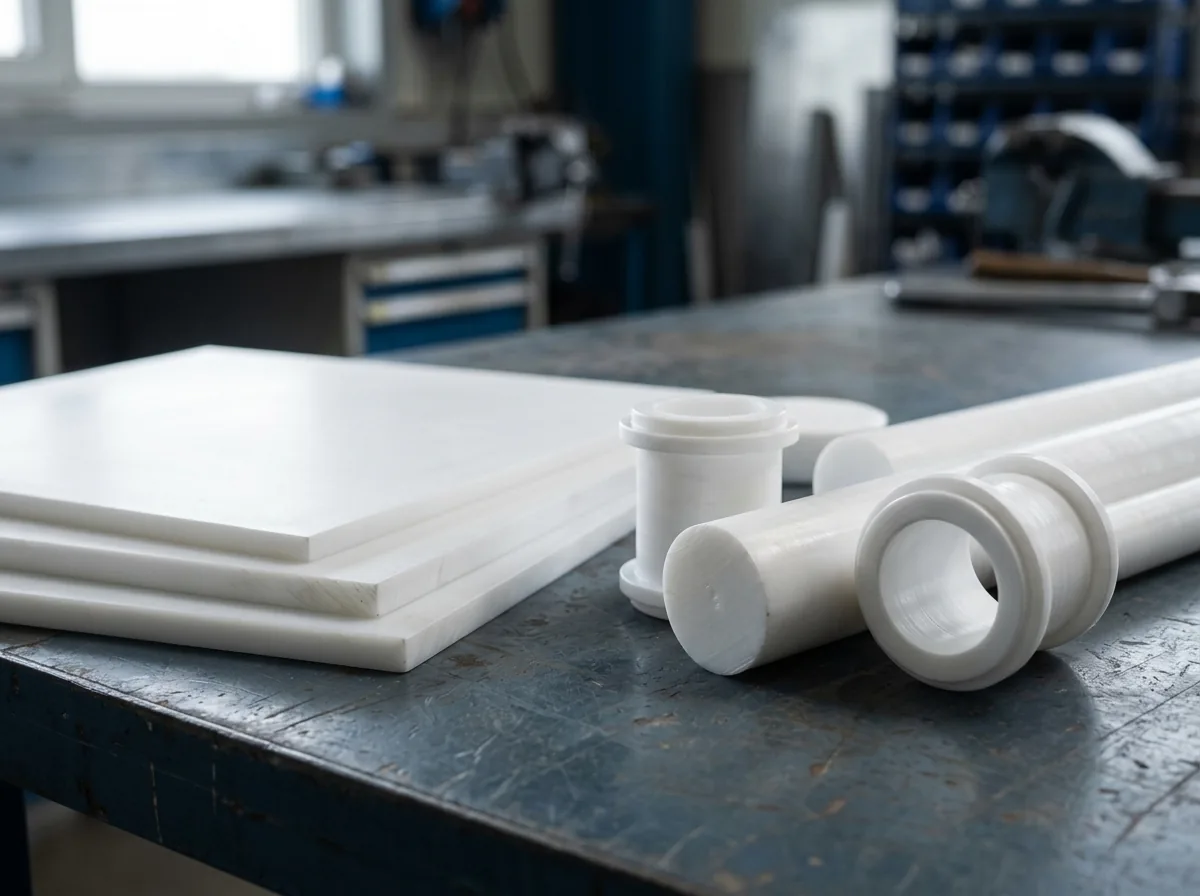
High-performance plastics for semiconductor manufacturing
Which plastics are suitable for the semiconductor industry? Everything about PEEK, PTFE & Co., their advantages, areas of application and selection criteria.
Why plastics are gaining importance in the semiconductor industry
Semiconductor manufacturing is a highly complex process in which every detail decides success. Alongside classic materials such as metals and glass,
are becoming increasingly important. The reason for this lies in their outstanding suitability for highly sensitive production environments. They offer an exceptional combination of chemical resistance,
and purity, which is crucial for the manufacture of microchips and semiconductor components. They are also lighter than metal, easier to process than glass and can be individually adapted for complex shapes and applications.
The growing demand for miniaturised, high-purity and durable components makes high-performance plastics a strategic
of the future. At the same time, they open up new possibilities in design and process engineering. In an industry that thrives on technological innovation, the ability to adapt materials flexibly to new requirements is a decisive competitive advantage.
Requirements for materials in semiconductor manufacturing
In chip production, materials must withstand numerous loads:
- Resistance to highly aggressive chemicals
- Thermal stability up to 250 °C and more
- Low outgassing and particle formation
- Electrostatic properties controllable
- Processing for ultra-precise components
These criteria make high-performance plastics the preferred choice in many areas of semiconductor manufacturing.
Advantages of high-performance plastics over traditional materials
Metallic components
can release particles, corrode or become thermally unstable.
Glass
is brittle and difficult to machine. High-performance polymers, by contrast, offer:
- High chemical resistance to acids, alkalis and solvents
- Excellent cleanability and low particle emission
- Cleanroom suitability through low outgassing
- Formability for complex geometries
- Use in metal-free environments possible
Important high-performance plastics in use
PEEK (polyetheretherketone)
is particularly in demand in the semiconductor industry. It is mechanically highly resilient, extremely resistant to chemicals and withstands temperatures of up to 260 °C. It is also cleanroom-suitable and exhibits very low particle emission.
PVDF (polyvinylidene fluoride)
is a semi-crystalline fluoroplastic with good chemical resistance, high purity and excellent weldability. Ideal for pipes, valves and filter housings.
PFA / PTFE (perfluoroalkoxy / polytetrafluoroethylene)
Both materials are suitable for aggressive chemicals, especially in wet processes. They offer excellent chemical resistance, but are more difficult to machine.
PSU / PPSU (polysulfone / polyphenylsulfone)
These amorphous thermoplastics combine temperature stability with good chemical resistance. PPSU is also more impact-resistant and is suitable for reusable components.
PEI (polyetherimide)
High strength, dimensional stability and excellent electrical insulation make PEI a sensible choice in electrical or mechanically stressed components.
Typical areas of application in semiconductor production
High-performance plastics are used in almost all sections of semiconductor production. These include valves and seals in etching and cleaning systems, carriers and holders for wafers, and housings for sensors and pumps. They are also used in piping systems for process chemicals and in the manufacture of cleanroom-compliant containers and tools.
Due to their outstanding properties, these materials offer the possibility of replacing metallic components with corrosion-free and low-particle alternatives without compromising on stability or cleanability. Plastics are likewise found in holding frames, transport devices or as insulators in electronic components. Their versatility, combined with high media resistance and cleanroom suitability, makes them indispensable elements of modern production facilities.
Material properties in comparison
| Material | Temp. resistance | Chem. resistance | Cleanroom-suitable | Machinability |
|---|---|---|---|---|
| PEEK | up to 260 °C | very high | very good | good |
| PVDF | up to 150 °C | high | very good | very good |
| PFA/PTFE | up to 260 °C | excellent | very good | limited |
| PSU | up to 160 °C | good | good | good |
| PEI | up to 170 °C | moderate | good | very good |
Cleanroom suitability and chemical resistance
Cleanroom suitability is a central criterion in semiconductor manufacturing. Even the smallest impurities can cause production downtime or lead to rejects. High-performance plastics are characterised by extremely low particle emission and minimal outgassing, which makes them ideal for use in high-purity environments.
Many materials meet the requirements up to ISO Class 5 or higher. They also offer excellent chemical resistance to hydrofluoric acid, peroxides, solvents or chlorine compounds, as are commonly used in etching and cleaning chemistry. This combination of chemical stability and cleanroom quality is hardly achievable with classic materials. Their material structure remains stable even under long-term exposure to aggressive substances, which significantly increases the service life of system components. At the same time, cleaning effort is reduced – a decisive cost factor in production.
Challenges in processing
Despite their technical advantages, high-performance plastics also bring processing challenges with them. Many of the materials, such as PTFE or PFA, cannot simply be injection moulded or welded. Machining also requires special tools, machine parameters and know-how in order to avoid thermal loads and preserve material purity.
There are also long cooling times, limited design freedom with certain materials and high material costs. For successful application, therefore, not only the right choice of material is decisive, but also close coordination with experienced processors and semi-finished product suppliers. In addition, users must take material-related properties into account already during the design phase, for example with wall thicknesses, joining techniques or tolerances. Only in this way can functionality, purity and durability in the end product be reliably ensured.
Selection criteria for designers and buyers
- Chemical resistance: Which media are used?
- Temperature requirements: How high are the thermal loads?
- Cleanroom class: What requirements exist for particle freedom?
- Mechanical load: Must the component be able to withstand static or dynamic loads?
- Processability: Is machining worthwhile or does injection moulding make sense?
Future-proof through high-performance polymers
With advancing miniaturisation and increasing process complexity, the requirements for materials in semiconductor production will continue to rise. High-performance plastics offer the possibility of mastering these challenges. They can be flexibly adapted to new production conditions, are durable, process-reliable and reduce the risk of contamination. They also enable a high degree of design freedom, which is indispensable for modern system layouts and modular components.
For manufacturers and suppliers who want to rely on future-proof and at the same time economical materials, there is no way around high-performance plastics. Their use not only contributes to technical advancement, but also to cost reduction and sustainable production. In view of growing requirements with regard to purity, resource conservation and efficiency, high-performance plastics are a key technology for the future of the semiconductor industry.