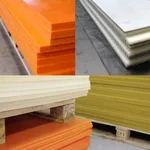
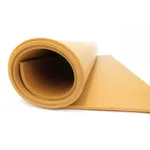
This image was created with artificial intelligence – marked under Art. 50 of the AI Act, Regulation (EU) 2024/1689. It is a placeholder until the company's photos arrive.
Selecting anti-slip solutions for industrial transport surfaces
Flat gaskets made of rubber in NBR, EPDM, FKM & silicone. Find out all about applications, selection criteria and custom-made parts.
Industrial transport surfaces are subject to high loads every day. Smooth surfaces, moisture, oil or abrasion quickly lead to unsafe conditions. Even small changes in the coefficient of friction have a direct effect on the safety and stability of processes. Transported goods start to slip, employees move around unsafely and machines run outside optimal conditions.
A purposefully selected anti-slip solution ensures controlled movement sequences, stable processes and a reliable basis for daily operation. Alongside safety, cost-effectiveness also plays a role, as unplanned downtime, wear or damage are reduced. The selection is always made on the basis of the specific operating conditions and requires a clear assessment of material, surface and environment.
Requirements for industrial transport surfaces
Transport surfaces must withstand mechanical load, changing temperatures and often also chemical influences. At the same time, the surface remains functional, easy to clean and permanently slip-resistant.
Typical requirements:
- high abrasion resistance
- resistance to oils, greases or chemicals
- consistent coefficient of friction
- easy integration into existing systems
Causes of slip problems in practice
Slip problems rarely arise from a single issue. Usually several factors act together.
Common causes:
- smooth materials without structure
- moisture or condensation
- oil and lubricant residues
- wear of the surface
- wrong choice of material
Standards and guidelines
For industrial applications, standards play a central role in assessing slip resistance. Classification is often carried out via DIN 51130 with the R classes R9 to R13. Higher classes stand for greater slip resistance under defined test conditions.
In addition, DGUV rules provide practical specifications for work areas in which increased safety requirements apply. A clear classification of the application within these classes makes it easier to select suitable materials and reduces liability risks.
Materials and systems at a glance
The choice of the right solution depends heavily on the area of application. Different materials react differently to load, media contact and temperature. A blanket solution rarely leads to stable results. Instead, it is necessary to examine the properties of the respective systems in detail and to tailor them to the specific application.
In industry, several systems have become established that are used in a targeted manner depending on the case of application.
Rubber mats and elastomers
Rubber offers high friction thanks to its natural elasticity and adapts flexibly to loads. Particularly on transport surfaces with changing loads, a stable grip is created because the material deforms slightly and thereby increases the contact area. Different elastomers allow targeted adaptation to the operating conditions. NBR is suitable for oil-containing environments, EPDM for applications with exposure to weather and temperature changes, while SBR is frequently used in standard applications.
You will also find a suitable selection in the rubber sheets section as well as complementary solutions such as rubber mats and custom cut pieces.
Coatings
Anti-slip coatings are applied directly to existing surfaces and enable subsequent optimisation without replacing the entire surface. They form a closed, seamless layer that can be adapted to different requirements. Thanks to the low build-up height, the existing construction remains almost unchanged, while at the same time slip resistance is specifically improved. These solutions are particularly suitable for large areas or existing systems where structural changes are to be avoided.
Structured surfaces
Mechanically structured materials increase the coefficient of friction through targeted profiles or surface patterns. These structures engage with the contact surface and ensure better adhesion, particularly with moving goods or pedestrian traffic. Depending on the design, different profiles can be used that adapt to conveying speed, weight and ambient conditions. Such solutions are frequently used on conveyor belts, transport lines or walkways.
Comparison of materials
| Material | Thickness | Weakness | Typical use |
|---|---|---|---|
| NBR | high oil resistance, stable coefficient of friction | lower UV resistance | production, machine environment |
| EPDM | UV and weather resistance | limited oil resistance | outdoor areas, storage areas |
| SBR | economical, versatile | lower media resistance | standard applications |
Selection by area of application
The optimal solution results from the specific application.
| Area of application | Recommendation |
|---|---|
| Conveyor technology | structured rubber mats or coatings |
| Storage areas | robust anti-slip coverings with high abrasion resistance |
| Production with oil | NBR-based solutions |
| Outdoor areas | EPDM with UV and weather resistance |
Coefficient of friction in practice
The coefficient of friction changes significantly depending on the ambient condition. Dry surfaces often deliver stable values, while moisture, dust or oil influence adhesion. For selection, the real operating situation counts, as laboratory values only represent a reference.
Practical guide values:
- dry: µ approx. 0.6–0.9
- damp: µ approx. 0.4–0.7
- oil-laden: µ approx. 0.2–0.5
Material and surface determine how strongly these values fluctuate under load. Elastomers with structure show more stable results under real conditions than smooth surfaces.
Important technical parameters
Measurable properties are relevant for selection.
- coefficient of friction (µ): determines slip resistance
- Shore hardness: influences flexibility and grip
- temperature range
- media resistance
- abrasion behaviour
A stable coefficient of friction under real conditions counts for more than laboratory values.
Cost-effectiveness and service life
Alongside technical suitability, cost-effectiveness plays a central role. A long-lasting solution reduces maintenance effort, downtime and replacement intervals. High-quality materials often pay for themselves over their service life, as they function consistently and require fewer interventions.
The assessment is carried out over the entire service life and takes into account material costs, installation effort and possible production losses.
Installation and integration into existing systems
Integration decides the long-term function. Improper installation quickly leads to detachment, stress in the material or uneven loading. Professional implementation begins with the preparation of the substrate, which must be clean, load-bearing and free of residues.
Depending on the system, fastening is carried out by bonding or mechanical fixing. It must be taken into account that materials expand under load or temperature fluctuations. A well-considered integration ensures that the anti-slip solution permanently fulfils its function and fits evenly into the existing system.
Typical mistakes in selection
Many problems arise already during the planning phase.
- focus only on price instead of operating conditions
- wrong choice of material with oil or chemicals
- failure to take wear into account
- unsuitable surface structure
Practical examples from industry and logistics
Conveyor belt with incline: On inclined transport lines, goods slip even at low angles of inclination. Structured rubber mats with medium Shore hardness and profile significantly increase adhesion and stabilise the material flow.
Production with oil film: In machine environments with lubricants, the coefficient of friction drops sharply. NBR materials retain a stable grip even under oil load and reduce failures.
Forklift traffic in the warehouse: High point loads and dynamic movements require abrasion-resistant coverings. Thicker rubber mats in the range of 5–10 mm provide a robust basis and increase safety during vehicle movements.
Outdoor areas with weather: Rain, temperature changes and UV exposure act simultaneously. EPDM remains flexible and slip-resistant, even under changing conditions.
Decision logic
The selection can be structured on the basis of typical operating conditions.
- oil load present: use of NBR with a structured surface
- outdoor area with exposure to weather: use of EPDM with profile
- conveyor technology with movement: structured rubber mats with adapted Shore hardness
- forklift traffic: higher material thickness and abrasion-resistant surface
- retrofitting existing surfaces: coatings or applied coverings
The wrong choice leads to slipping goods, increased wear and unstable processes. The right solution ensures constant grip and plannable workflows.
How to proceed
First analyse the real operating conditions such as media contact, load and environmental influences. Then select the material specifically according to these criteria and test the solution under real conditions.
Precise coordination saves costs, reduces downtime and ensures stable processes.
Frequently asked questions
Which anti-slip solution is suitable for oil load?
NBR-based materials offer high resistance to oils and retain their coefficient of friction even when contaminated.
When are coatings worthwhile?
Coatings are particularly suitable for large areas or when existing surfaces are to be retrofitted.
How is slip resistance measured?
The assessment is carried out via the coefficient of friction as well as practical tests under real operating conditions.
What role does Shore hardness play?
Shore hardness influences how flexibly the material adapts under load. A suitable hardness improves grip and function in the respective area of application.
How long do anti-slip solutions last?
The service life depends on load, material and environment. High-quality solutions achieve stable properties over years.
Can existing surfaces be retrofitted?
Coatings and applied coverings enable efficient retrofitting without complete replacement.
Which solution is suitable for conveyor belts?
Structured rubber mats provide reliable guidance and increase adhesion with moving transported goods.
Which thickness is sensible?
The material thickness depends on load and area of application. 3 to 10 mm is typical depending on mechanical stress.
Our rubber sheets
For industry and trade we offer a wide variety of rubber sheets.
SBR rubber sheet
Our high-quality SBR rubber sheet (styrene-butadiene rubber) is the solution for numerous industrial and commercial applications. This rubber sheet is manufactured from first-class styrene-butadiene rubber and stands out thanks to its outstanding physical properties.
EPDM rubber sheet
Discover the versatility and reliability of our EPDM rubber sheet, which is manufactured from ethylene propylene diene monomer (EPDM). This high-quality elastomer solution has been specially developed to meet the most demanding industrial and commercial applications.
NBR rubber sheet
The NBR rubber sheet is a high-quality industrial product that has been specially developed for applications where excellent resistance to oils, greases and various chemicals is required.
Viton rubber sheet
The Viton rubber sheet is a high-quality technical product that is used for a wide range of industrial applications. Manufactured from fluoro rubber (FKM), it offers outstanding properties that make it the ideal choice for extreme conditions.
FKM rubber sheet
The FKM rubber sheet is a high-quality technical product that is ideal for use in demanding industrial applications. Made from fluoro rubber (FKM), it stands out thanks to a wide range of outstanding properties that make it the optimal choice for extreme operating conditions.
Silicone rubber sheet
The silicone rubber sheet is a first-class technical product that has been specially developed for applications that place high demands on temperature resistance and flexibility.
PUR rubber sheet
The PUR rubber sheet, manufactured from high-quality polyurethane, is a technically advanced product that has been developed for applications that place the highest demands on abrasion resistance and mechanical load capacity.
Neoprene rubber sheet
The neoprene rubber sheet, manufactured from high-quality chloroprene rubber (CR), is a versatile technical product that is ideal for a wide range of industrial and commercial applications.